Triphenylphosphine → HCID 67973456, compound
Reaction equation

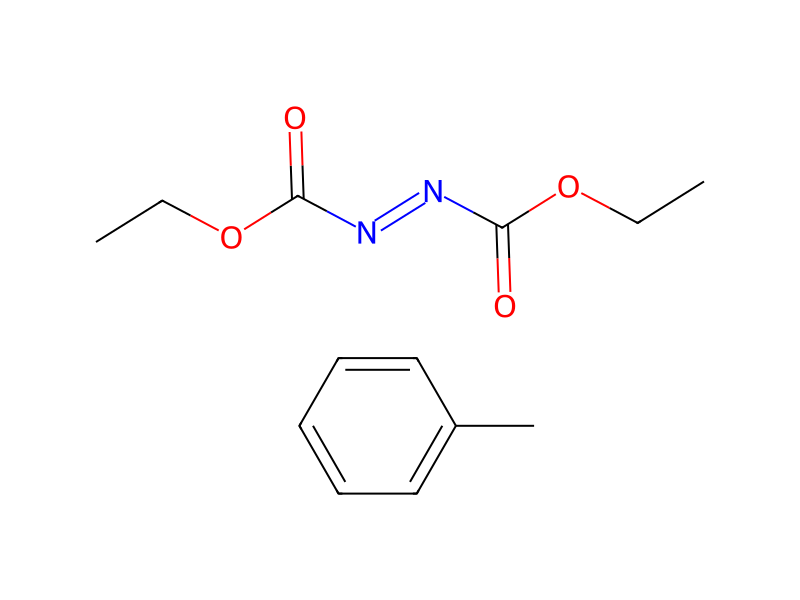
[Br:1][C:2]1[C:3]([CH3:9])=[CH:4][C:5]([OH:8])=[N:6][CH:7]=1.O[CH2:11][C:12]1([C:15]([O:17][CH3:18])=[O:16])[CH2:14][CH2:13]1.C1(P(C2C=CC=CC=2)C2C=CC=CC=2)C=CC=CC=1.N(C(OCC)=O)=NC(OCC)=O.C1(C)C=CC=CC=1>O1CCCC1.C(OCC)(=O)C.O>[Br:1][C:2]1[C:3]([CH3:9])=[CH:4][C:5]([O:8][CH2:11][C:12]2([C:15]([O:17][CH3:18])=[O:16])[CH2:14][CH2:13]2)=[N:6][CH:7]=1Participants
Reactant 4



Product 1

Reagents, catalysts & solvents 3



Conditions
- Temperature
- 70 °C
Procedure
In tetrahydrofuran (26 mL) was dissolved 5-bromo-4-methylpyridin-2-ol (1.3 g), methyl 1-(hydroxymethyl)cyclopropanecarboxylate (1.08 g) and triphenylphosphine (2.72 g), and 40% diethyl azodicarboxylate-toluene solution (4.72 mL) was added dropwise to the solution at 0° C. The mixture was stirred at 70° C. for 4 hours. The reaction mixture was cooled to room temperature, water and ethyl acetate were added to the mixture, and the organic layer was washed with a saturated brine and dried over anhydrous sodium sulfate. After concentrating the mixture under reduced pressure, the obtained residue was purified by silica gel column chromatography (n-hexane:ethyl acetate=99:1 to 99:5) to obtain methyl 1-{[(5-bromo-4-methylpyridin-2-yl)oxy]-methyl}cyclopropanecarboxylate (2.08 g).
Workup
- additionwas added dropwise to the solution at 0° C
- temperatureThe reaction mixture was cooled to room temperature
- washthe organic layer was washed with a saturated brine
- dry with materialdried over anhydrous sodium sulfate
- concentrationAfter concentrating the mixture under reduced pressure
- customthe obtained residue was purified by silica gel column chromatography (n-hexane:ethyl acetate=99:1 to 99:5)
Sources & evidence
- ORD record
- ord-a2f02373277d4a0194303457b088c164
- Source dataset
- uspto-grants-2016_04
- Patent number
- US09302996B2
Reaction notes
Loading…