Oxygen → N-{3-hydroxybicyclo[1.1.1]pentan-1-yl}acetamide
Reaction equation

[C:1]12([NH:6][C:7](=[O:9])[CH3:8])[CH2:5][CH:3]([CH2:4]1)[CH2:2]2.[OH:10]S(O)(=O)=O.O(C(C(F)(F)F)=O)C(C(F)(F)F)=O.N([O-])=O.[Na+].C(O)(C(F)(F)F)=O.O=O.O(OC)OC.C(OO)(=O)C.C(C1C(=O)C(Cl)=C(Cl)C(=O)C=1C#N)#N.S(O)(C(F)(F)F)(=O)=O>C(Cl)Cl.CC(O)=O>[OH:10][C:3]12[CH2:5][C:1]([NH:6][C:7](=[O:9])[CH3:8])([CH2:4]1)[CH2:2]2Participants
Reactant 10
 HCID 977Oxygen
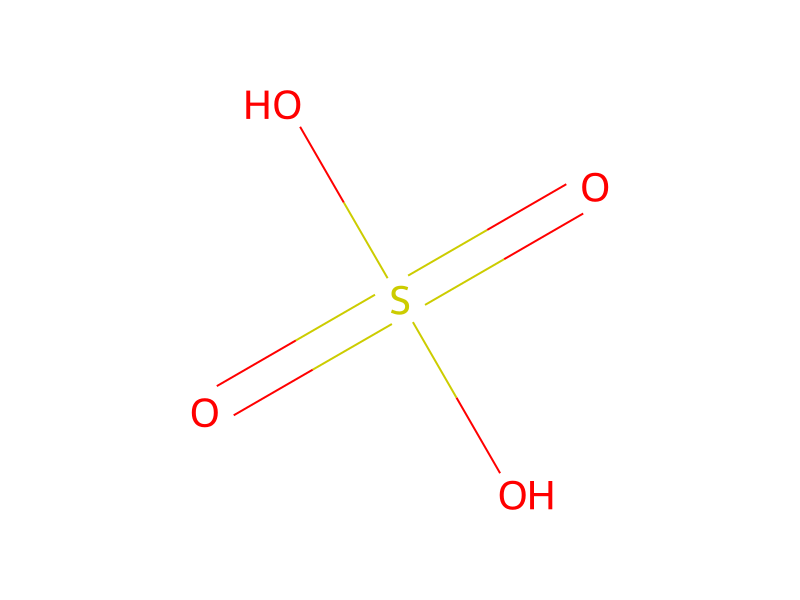 HCID 1118Sulfuric Acid
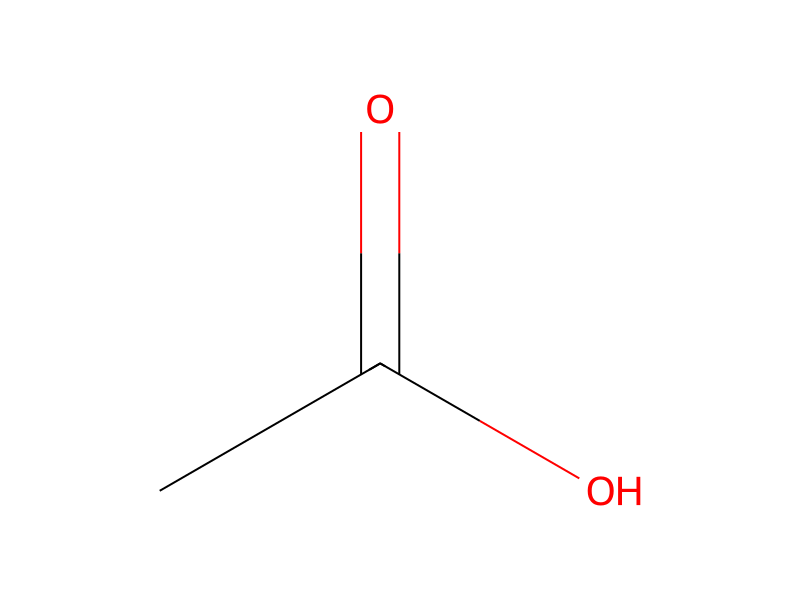
 HCID 6422Trifluoroacetic acid2×
 HCID 6585Peracetic Acid
 HCID 67752,3-Dichloro-5,6-dicyano-1,4-benzoquinone
 HCID 9845Trifluoroacetic anhydride
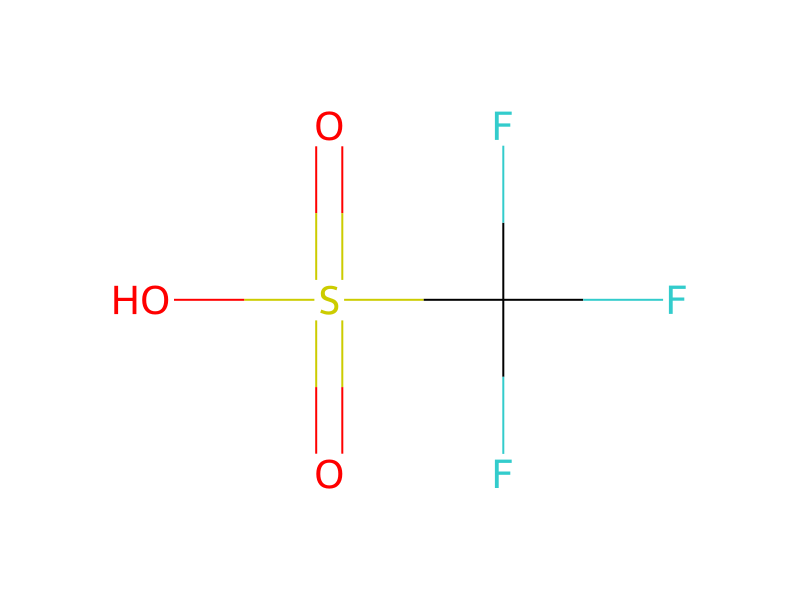 HCID 62406Trifluoromethanesulfonic acid
 HCID 17819761Trioxide, dimethyl
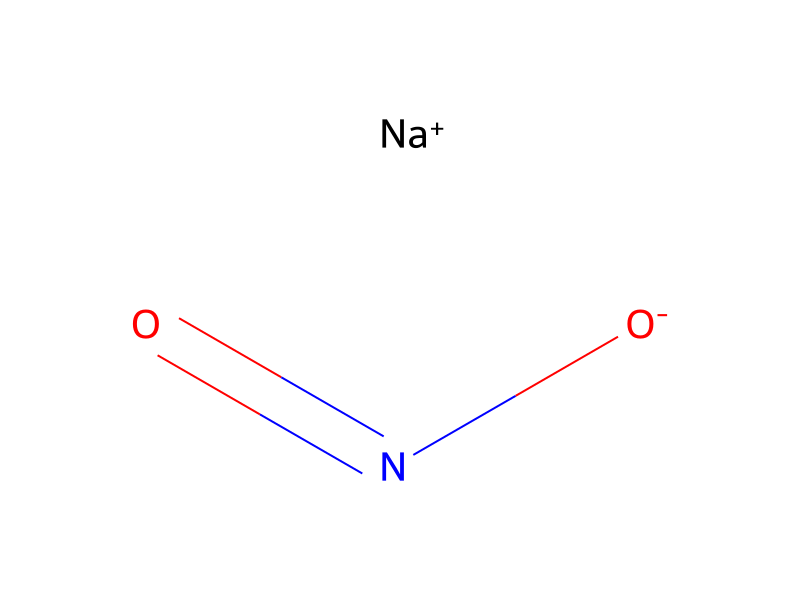 HCID 23668193Sodium Nitrite
 HCID 86287956N-{bicyclo[1.1.1]pentan-1-yl}acetamide
Product 1

Reagents, catalysts & solvents 2
Procedure
The C—H activation/oxidation (Scheme 3) of commercially available bicyclo[1.1.1]pentan-1-amine by an appropriate oxidizing reagent or condition (for example, H2SO4 (conc.)/HNO3 (conc. or 50%); H2SO4 (conc.)/NH4NO3; perfluoro-cis-2-n-butyl-3-n-propyloxaziridine; CBr4/H2O/Mo(CO)6; [(Me3tacn)RuCl3], CAN, AgClO4, t-BuOH/H2O; RuCl3-xH2O, KBrO3, H2O, pyridine, CH3CN; dimethyldioxirane (DMD) or methyl(trifluoromethyl)dioxirane (TFDO), with or without HBF4; CrO3, H5IO6; KMnO4, KOH; and the like) can give 3-aminobicyclo[1.1.1]pentan-1-ol. The amino alcohol intermediate can then be coupled with an appropriate carboxylic acid or acid chloride, such as acetyl chloride to give 3-acetamidobicyclo[1.1.1]pentan-1-yl acetate (3). Selective hydrolysis of the ester group with hydroxide ion gives N-(3-hydroxybicyclo[1.1.1]pentan-1-yl)acetamide (1). Alternatively, starting with N-(bicyclo[1.1.1]pentan-1-yl)acetamide (4), C—H activation/oxidation with an appropriate oxidizing reagent or conditions (for example, see listed above, and H2SO4 (conc.), (CF3CO)2O; NaNO2, TFA, O2; CrO3, CH3CO2H, (H3CO)2O; RuCl3 (cat.), TFA, DCM, peracetic acid; DDQ, TfOH; and the like) can give N-(3-hydroxybicyclo[1.1.1]pentan-1-yl)acetamide (1).
Sources & evidence
- ORD record
- ord-0d5bfcdcd62643648b2482b6220a8332
- Source dataset
- uspto-grants-2016_09
- Patent number
- US09447025B2
Reaction notes
Loading…