Triphenylphosphine → HCID 178472394, compound
Reaction equation

[Br:1][C:2]1[CH:3]=[C:4]2[C:8](=[CH:9][CH:10]=1)[NH:7][N:6]=[CH:5]2.O[C@H:12]1[CH2:17][CH2:16][C@H:15]([C:18]([O:20][CH2:21][CH3:22])=[O:19])[CH2:14][CH2:13]1.C1(P(C2C=CC=CC=2)C2C=CC=CC=2)C=CC=CC=1.CCOC(/N=N/C(OCC)=O)=O>C1COCC1>[Br:1][C:2]1[CH:3]=[C:4]2[C:8](=[CH:9][CH:10]=1)[N:7]([C@@H:12]1[CH2:17][CH2:16][C@H:15]([C:18]([O:20][CH2:21][CH3:22])=[O:19])[CH2:14][CH2:13]1)[N:6]=[CH:5]2Participants
Reactant 4

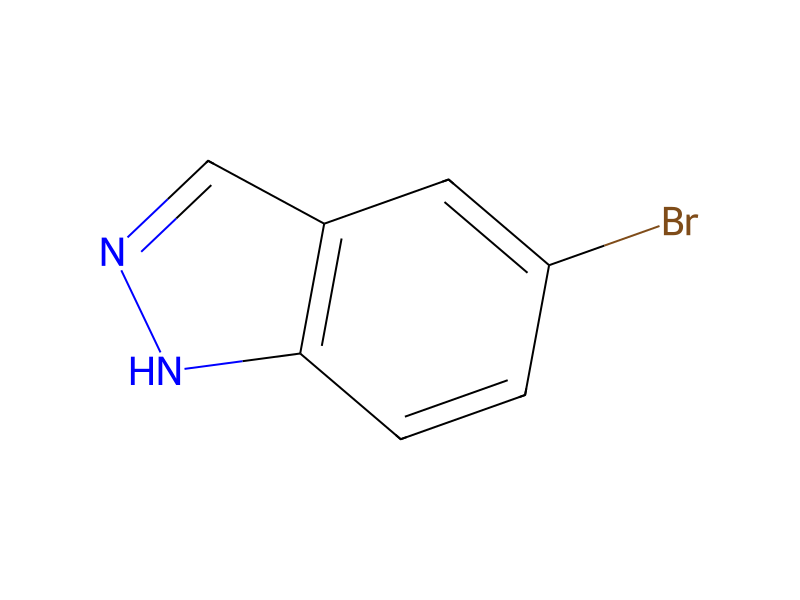


Product 1

Reagents, catalysts & solvents 1

Conditions
- Temperature
- 50 °C
Procedure
A solution of 5-bromoindazole (5.00 g), ethyl trans-4-hydroxycyclohexanecarboxylate (8.73 g), triphenylphosphine (13.3 g) in THF (150 mL) was stirred at 0° C. for 15 minutes. To the reaction solution was added dropwise diethylazodicarboxylate (9.03 g) under nitrogen atmosphere at 0° C., and the mixture was stirred at 50° C. for 13 hours. Then, the solvent was removed out, and ethyl acetate (100 mL) and petroleum ether (30 mL) were added thereto. The mixture was stirred at room temperature for 2 hours. The reaction solution was filtered, the solvent was evaporated under reduced pressure, and the residue was purified by silica gel column chromatography (ethyl acetate:petroleum ether=1:80-1:15 as the eluting solvent) to give Compound Q14 (3.50 g).
Workup
- customThen, the solvent was removed out
- additionethyl acetate (100 mL) and petroleum ether (30 mL) were added
- stirringThe mixture was stirred at room temperature for 2 hours
- filtrationThe reaction solution was filtered
- customthe solvent was evaporated under reduced pressure
- customthe residue was purified by silica gel column chromatography (ethyl acetate
- custompetroleum ether=1:80-1:15 as the eluting solvent) to give Compound Q14 (3.50 g)
Sources & evidence
- ORD record
- ord-da0e3f3795c4481e9e82213e5cadc299
- Source dataset
- uspto-grants-2016_04
- Patent number
- US09309221B2
Reaction notes
Loading…