Hydrochloric Acid → HCID 126684725, compound
Reaction equation

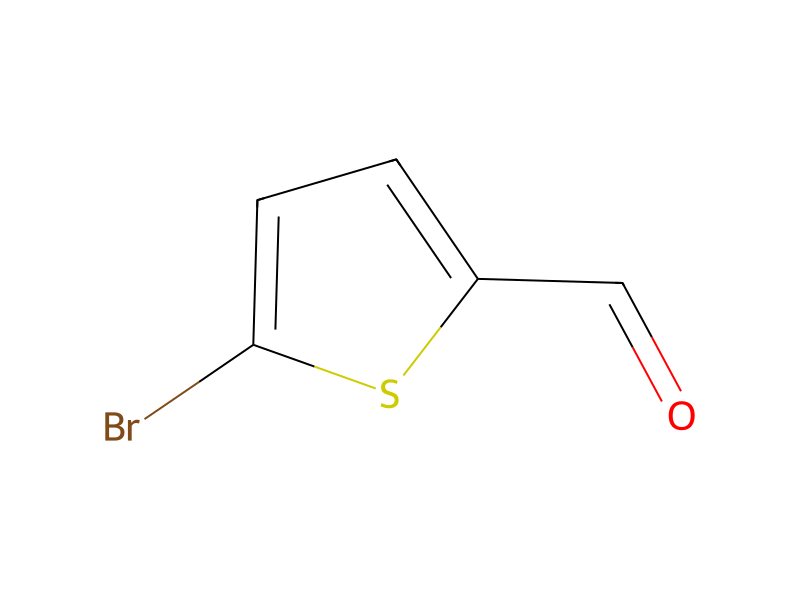
Br[C:2]1[S:6][C:5]([CH:7]=[O:8])=[CH:4][CH:3]=1.[F:9][C:10]([F:19])([F:18])[C:11]1[CH:16]=[CH:15][C:14]([OH:17])=[CH:13][CH:12]=1.C(=O)([O-])[O-].[K+].[K+].Cl>CN(C)C=O>[F:9][C:10]([F:18])([F:19])[C:11]1[CH:16]=[CH:15][C:14]([O:17][C:2]2[S:6][C:5]([CH:7]=[O:8])=[CH:4][CH:3]=2)=[CH:13][CH:12]=1Participants





Conditions
- Temperature
- 100 °C
Procedure
To a solution of 5-bromothiophene-2-carbaldehyde (0.12 mL, 1.0 mmol) and 4-trifluoromethylphenol (195 mg, 1.20 mmol) in 3 mL dimethylformamide was added potassium carbonate (276 mg, 2.00 mmol). The resulting suspension was stirred at 100° C. for 68 h before being cooled to room temperature and poured into 20 mL 0.2 N hydrochloric acid. Organics were extracted with ether (3×25 mL), washed with 2 N NaOH (2×30 mL), 0.2 N hydrochloric acid and brine (30 mL each), dried over magnesium sulfate, filtered and concentrated. The crude residue was subjected to chromatography on silica gel with gradient elution (5-10% ethyl acetate in hexanes+2% triethylamine) to give 5-(4-(trifluoromethyl)phenoxy)thiophene-2-carbaldehyde (79 mg, 29%) as an off-white solid. Used without further characterization.
Workup
- temperaturebefore being cooled to room temperature
- extractionOrganics were extracted with ether (3×25 mL)
- washwashed with 2 N NaOH (2×30 mL), 0.2 N hydrochloric acid and brine (30 mL each)
- dry with materialdried over magnesium sulfate
- filtrationfiltered
- concentrationconcentrated
- washThe crude residue was subjected to chromatography on silica gel with gradient elution (5-10% ethyl acetate in hexanes+2% triethylamine)
Sources & evidence
- ORD record
- ord-d302f3d9136f4641aa7f110ec2f1ca98
- Source dataset
- uspto-grants-2016_04
- Patent number
- US09315495B2
Reaction notes
Loading…