N-Hydroxyphthalimide → HCID 59774397, compound
Reaction equation

N(C(OC(C)C)=O)=NC(OC(C)C)=O.[C:15]([O:19][CH2:20][CH2:21][CH2:22][OH:23])([CH3:18])([CH3:17])[CH3:16].C1(P(C2C=CC=CC=2)C2C=CC=CC=2)C=CC=CC=1.O[N:44]1[C:48](=[O:49])[C:47]2=[CH:50][CH:51]=[CH:52][CH:53]=[C:46]2[C:45]1=[O:54]>C1COCC1>[C:15]([O:19][CH2:20][CH2:21][CH2:22][O:23][N:44]1[C:48](=[O:49])[C:47]2[C:46](=[CH:53][CH:52]=[CH:51][CH:50]=2)[C:45]1=[O:54])([CH3:18])([CH3:17])[CH3:16]Participants
6
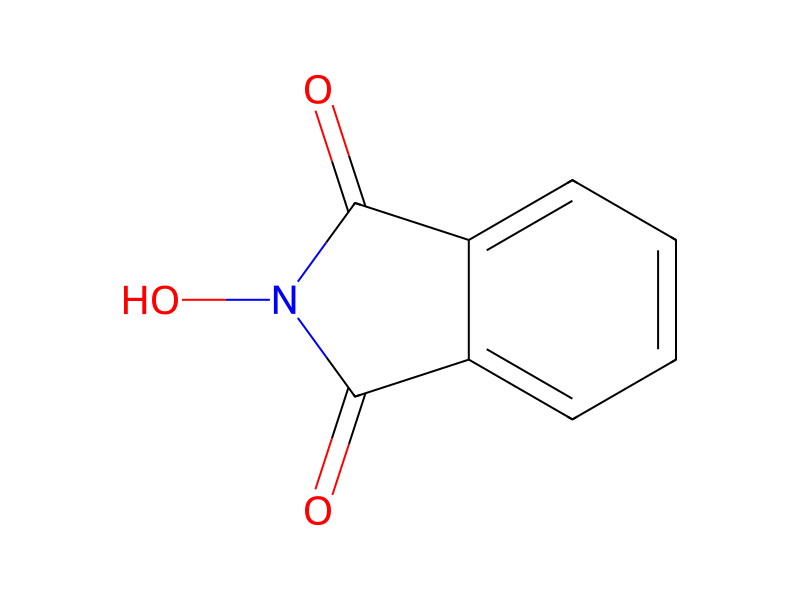





Procedure
Diisopropyl azodicarboxylate (13.4 mL, 68 mmol) was added dropwise at 0° C. to a stirred suspension of 3-tert-butoxy-propan-1-ol (9.0 g, 68 mmol), triphenylphosphine (17.8 g, 68 mmol), and N-hydroxyphthalimide (11.1 g, 68 mmol) in THF (150 mL), and the reaction stirred for 16 h at room temperature. The solution was concentrated in vacuo and purified by silica gel chromatography (20% Et2O/hexanes) to give 15.5 g (82%) of 2-(3-tert-Butoxy-propoxy)-isoindole-1,3-dione as a faintly yellow solid. 1H NMR (400 MHz, CDCl3): δ 7.72-7.84 (m, 4H), 4.30 (t, 2H, J=4.8 Hz), 3.58 (t, 2H, J=4.8 Hz), 1.94-2.00 (m, 2H), 1.20 (s, 9H). MS (ES) [m+H] calc'd for C15H19NO4, 278; found 278.
Workup
- concentrationThe solution was concentrated in vacuo
- custompurified by silica gel chromatography (20% Et2O/hexanes)
Sources & evidence
- ORD record
- ord-3f49a6c969404606815444e8e108fb58
- Source dataset
- uspto-grants-2010_04
- Patent number
- US07696218B2
Reaction notes
Loading…