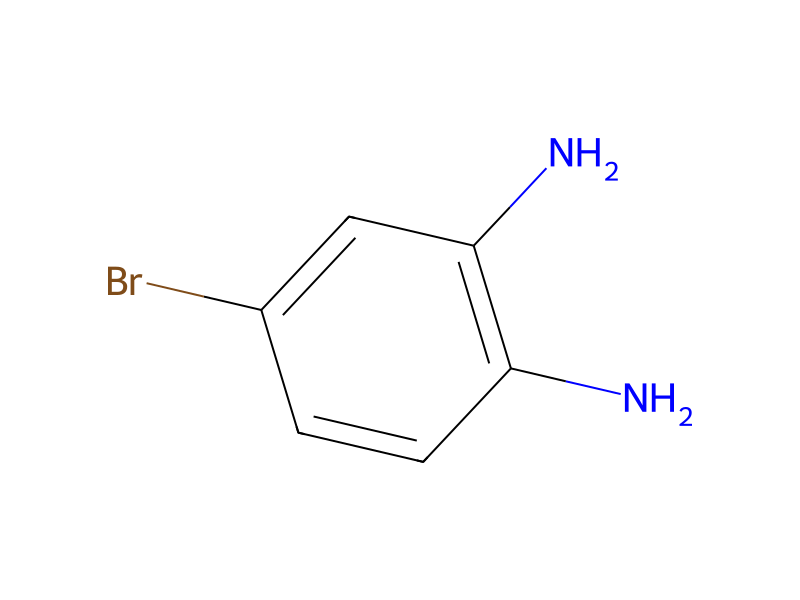
Ethanol → 4-Bromobenzene-1,2-diamine
Reaction equation

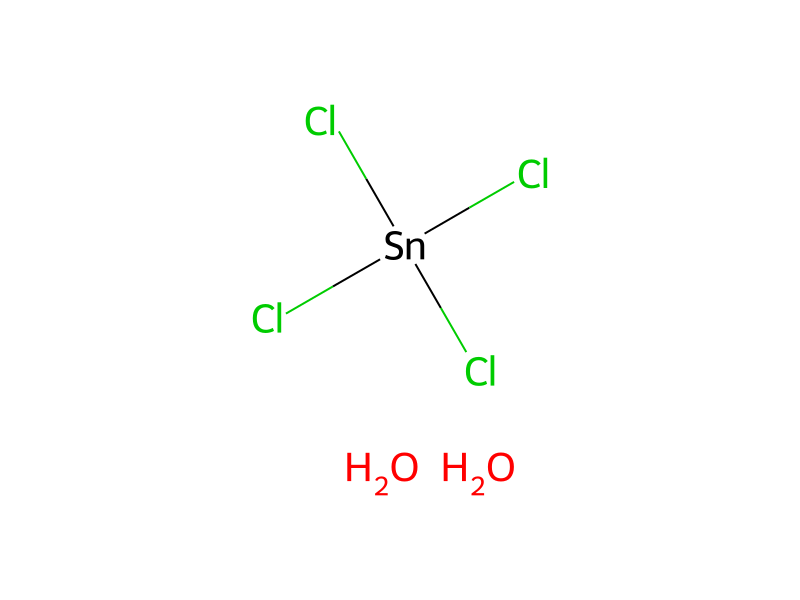
[Br:1][C:2]1[CH:8]=[CH:7][C:5]([NH2:6])=[C:4]([N+:9]([O-])=O)[CH:3]=1.C(O)C.O.O.[Sn](Cl)(Cl)(Cl)Cl.C(=O)(O)[O-].[Na+]>C(OCC)(=O)C.O>[Br:1][C:2]1[CH:8]=[CH:7][C:5]([NH2:6])=[C:4]([NH2:9])[CH:3]=1Participants





Procedure
In a round bottom flask were combined 4-Bromo-2-nitroaniline (4.03 g, 18.6 mMol), ethanol (190 proof, 93 mL), and tin chloride dihydrate (8.38 g, 37.1 mMol) and a water-cooled condenser attached. The reaction was heated to reflux in an oil bath and stirred for three days. The mixture was then cooled to room temperature and diluted with ethyl acetate (250 mL). Saturated sodium bicarbonate solution was added until the pH was basic. The slurry was then filtered thru Celite and the filtrate transferred to a separatory funnel. The aqueous layer was discarded and the organics washed with saturated sodium bicarbonate (2×50 mL), brine (50 mL), and then dried with magnesium sulfate, filtered, and concentrated to dryness to yield 3.07 g (88% yield) of 4-Bromo-1,2-phenylenediamine as an orange-brown solid. 1H NMR (DMSO-d6): δ=6.63 (d,1H,J=2.3Hz), 6.5-6.3 (m,2H), 4.71 (br s,2H), 4.56 (br s,2H).
Workup
- customIn a round bottom flask were combined
- temperatureThe reaction was heated
- temperatureto reflux in an oil bath
- filtrationThe slurry was then filtered thru Celite
- customthe filtrate transferred to a separatory funnel
- washthe organics washed with saturated sodium bicarbonate (2×50 mL), brine (50 mL)
- dry with materialdried with magnesium sulfate
- filtrationfiltered
- concentrationconcentrated to dryness
Sources & evidence
- ORD record
- ord-b4393dc2033a4bc2ba27b332c5553072
- Source dataset
- uspto-grants-2010_04
- Patent number
- US07696210B2
Reaction notes
Loading…