Acetic Acid → 1-benzyl-1,2,3,4-tetrahydroquinoline
Reaction equation

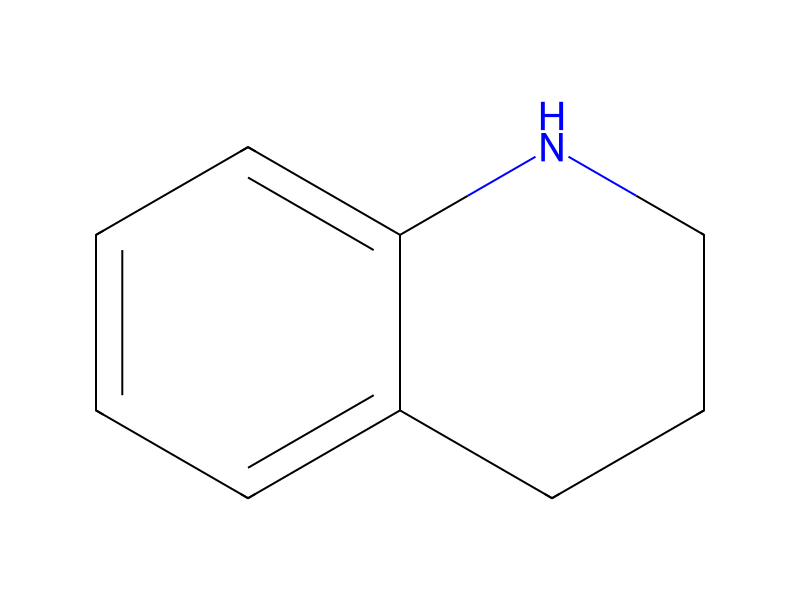
[NH:1]1[C:10]2[C:5](=[CH:6][CH:7]=[CH:8][CH:9]=2)[CH2:4][CH2:3][CH2:2]1.[CH:11](=O)[C:12]1[CH:17]=[CH:16][CH:15]=[CH:14][CH:13]=1.C(O)(=O)C.C([BH3-])#N.[Na+].Cl>CO>[CH2:11]([N:1]1[C:10]2[C:5](=[CH:6][CH:7]=[CH:8][CH:9]=2)[CH2:4][CH2:3][CH2:2]1)[C:12]1[CH:17]=[CH:16][CH:15]=[CH:14][CH:13]=1Participants






Procedure
1,2,3,4-tetrahydroquinoline (2.66 g, 0.02 mol), benzaldehyde (3.12 g, 0.03 mol) and glacial acetic acid (0.67 ml, 0.012 mol) were dissolved in methanol (10 ml). Sodium cyanoborohydride (0.675 g, 0.0107 mol) was added portionwise, controlling the resulting vigorous gas evolution by the rate of addition. After 3 hours, the reaction mixture was poured into 50 ml 1N HCl and extracted 3×40 ml ether. The organic layers were combined, dried (MgSO4) and stripped to yield crude title product contaminated with benzyl alcohol. The crude product was dissolved in 50 ml ether, cooled to 0° C. and diffused with HCl gas until precipitation of hydrochloride salt was complete. The ether was decanted from the resulting semi-solid salt. The salt was washed with 20 ml fresh ether, the ether decanted, and the washed salt taken up in 50 ml of fresh ether and 50 ml of H2O. The pH was adjusted to 12 with 1N NaOH, and the ether layer separated, dried (K2CO3) and stripped to 2.47 g of product still containing some residual benzyl alcohol. Repeated conversion to hydrochloride salt and back to free base gave purified title product, 2.02 g.
Workup
- additionby the rate of addition
- extractionextracted 3×40 ml ether
- dry with materialdried (MgSO4)
Sources & evidence
- ORD record
- ord-423069a487304262b69d4e004a0c9412
- Source dataset
- uspto-grants-1988_04
- Patent number
- US04738972
Reaction notes
Loading…