1-Bromo-3-chloropropane → 1-(3-Chloropropyl)-4-phenylpiperidine
Reaction equation

[C:1]1([CH:7]2[CH2:12][CH2:11][NH:10][CH2:9][CH2:8]2)[CH:6]=[CH:5][CH:4]=[CH:3][CH:2]=1.Br[CH2:14][CH2:15][CH2:16][Cl:17].C(=O)([O-])[O-].[K+].[K+]>C(#N)C>[Cl:17][CH2:16][CH2:15][CH2:14][N:10]1[CH2:9][CH2:8][CH:7]([C:1]2[CH:6]=[CH:5][CH:4]=[CH:3][CH:2]=2)[CH2:12][CH2:11]1Participants
5
Reactant 3


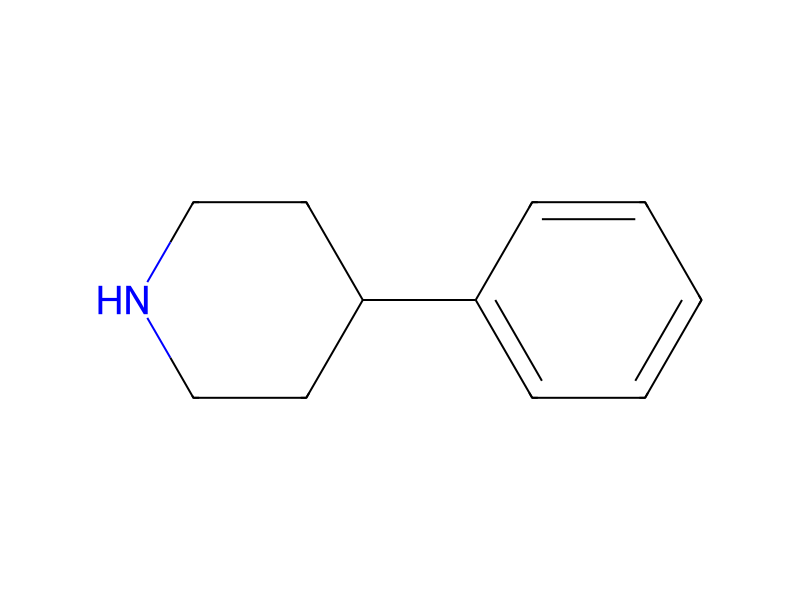
Product 1

Reagents, catalysts & solvents 1

Procedure
1-(3-Chloropropyl)-4-phenylpiperidine can be obtained as follows: a solution of 4-phenylpiperidine (8 g) and of 1-bromo-3-chloropropane (20 cc) in acetonitrile (80 cc) is stirred at 25° C. for 24 hours with potassium carbonate (28 g). The mixture is filtered and is then concentrated to dryness under reduced pressure (2.7 kPa). The residue is chromatographed on a column of silica gel (0.06-0.2-mm particle size, 3-cm diameter, 25-cm height) and eluted with a mixture of cyclohexane and ethyl acetate (50--50 by volume), 60-cc fractions being collected. Fractions 6 to 10 are combined and concentrated to dryness under reduced pressure (2.7 kPa). 1-(3-Chloropropyl)-4-phenylpiperidine (8 g) is obtained in the form of oil.
Workup
- filtrationThe mixture is filtered
- concentrationis then concentrated to dryness under reduced pressure (2.7 kPa)
- customThe residue is chromatographed on a column of silica gel (0.06-0.2-mm particle size, 3-cm diameter, 25-cm height)
- washeluted with a mixture of cyclohexane and ethyl acetate (50--50 by volume), 60-cc fractions
- custombeing collected
- concentrationconcentrated to dryness under reduced pressure (2.7 kPa)
Sources & evidence
- ORD record
- ord-96a595aedfb947aaa9c169f686fd59c4
- Source dataset
- uspto-grants-1992_07
- Patent number
- US05130313
Reaction notes
Loading…