Hydrogen Peroxide → Acrylic acid hydroxyethyl acrylate
Reaction equation

[OH-].[K+].[PH2](O)=O.[PH2]([O-])=O.[Na+].[C:10]([OH:14])(=[O:13])[CH:11]=[CH2:12].[C:15]([O:19][CH2:20][CH2:21][OH:22])(=[O:18])[CH:16]=[CH2:17].OO.[Na]>O.C(O)(C)C>[C:10]([OH:14])(=[O:13])[CH:11]=[CH2:12].[C:15]([O:19][CH2:20][CH2:21][OH:22])(=[O:18])[CH:16]=[CH2:17]Participants
Reactant 7

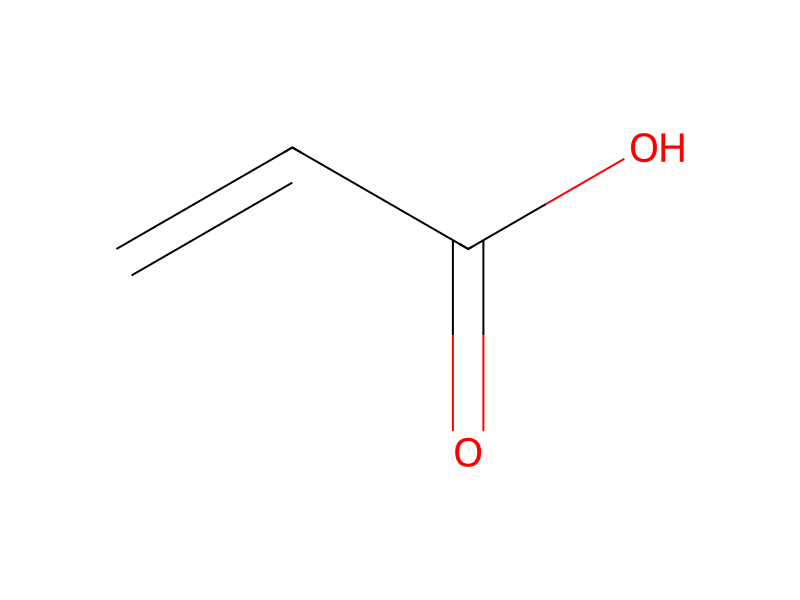





Product 1

Reagents, catalysts & solvents 2


Conditions
- Temperature
- 70 °C
Procedure
An aqueous solution polymer of 70/30 glacial acrylic acid/2-hydroxyethyl acrylate (HEA/AA) is prepared by charging 190 g water and 5.6 g solid potassium hydroxide to a reaction vessel and mixing until all of the potassium hydroxide is dissolved. To the reaction vessel is then added 13.2 g 50% hypophosphorous acid over a period of at least 15 minutes with mixing, followed by the addition of 10.4 g isopropyl alcohol, 10.5 g sodium hypophosphite, 19.8 g 50% hypophosphorous acid and 0.04 g ferrous sulfate. The temperature of the reaction vessel is then increased to 70° C. Then a monomer feed of 341.8 g glacial acrylic acid and 161 g 2-hydroxyethyl acrylate is fed into the reaction vessel over a period of five hours and the reaction temperature is maintained at from 80° C. to 90° C. An oxidizer feed of 31.7 g water and 1.33 g 50% hydrogen peroxide and a reducer feed of 31.1 g water and 2.65 g BRUGGOLITE FF6 sodium salt of an organic sulfinic acid derivative (Brüggemann Chemicals Inc., Germany) are also fed to the reaction vessel.
Workup
- dissolutionis dissolved
- additionwith mixing
- temperaturethe reaction temperature is maintained at from 80° C. to 90° C
Sources & evidence
- ORD record
- ord-7161ea56591e4177a78af9435588a0d0
- Source dataset
- uspto-grants-2011_12
- Patent number
- US08080488B2
Reaction notes
Loading…