N-Hydroxyphthalimide → tert-Butyl (2-((1,3-dioxoisoindolin-2-yl)oxy)ethyl)carbamate
Reaction equation

[C:1]([O:5][C:6](=[O:11])[NH:7][CH2:8][CH2:9][OH:10])([CH3:4])([CH3:3])[CH3:2].C1(P(C2C=CC=CC=2)C2C=CC=CC=2)C=CC=CC=1.O[N:32]1[C:36](=[O:37])[C:35]2=[CH:38][CH:39]=[CH:40][CH:41]=[C:34]2[C:33]1=[O:42].N(C(OCC)=O)=NC(OCC)=O>O1CCCC1>[C:1]([O:5][C:6](=[O:11])[NH:7][CH2:8][CH2:9][O:10][N:32]1[C:36](=[O:37])[C:35]2[C:34](=[CH:41][CH:40]=[CH:39][CH:38]=2)[C:33]1=[O:42])([CH3:4])([CH3:2])[CH3:3]Participants
6
Reactant 4
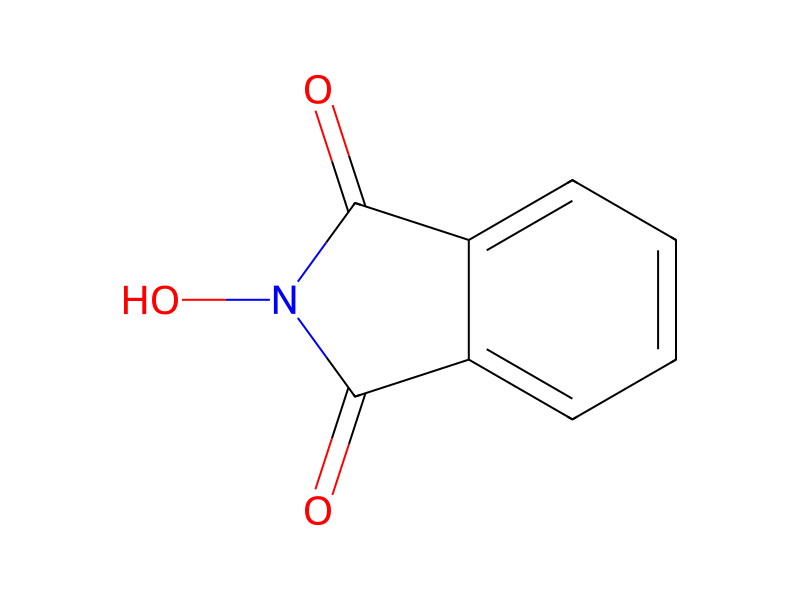



Product 1

Reagents, catalysts & solvents 1

Procedure
tert-Butyl(2-hydroxyethyl)carbamate (1.61 g, 10.0 mmol) was stirred under an argon atmosphere at room temperature with dehydrated tetrahydrofuran (50 mL). Then, triphenylphosphine (2.75 g) and N-hydroxyphthalimide (Pht-OH, 1.71 g) were added. After the reaction mixture was under ice cooling, diethyl azodicarboxylate (DEAD, 1.82 g) was added dropwise gradually, followed by stirring at room temperature for 24 hours. After completion of the reaction, the residue resulting from distilling off the solvent under reduced pressure was subjected to silica gel column chromatography (hexane/ethyl acetate=4/1→1/1) to afford 2.61 g of the title compound (yield 85.2%).
Workup
- customAfter completion of the reaction
- customthe residue resulting
- distillationfrom distilling off the solvent under reduced pressure
Sources & evidence
- ORD record
- ord-43e05f68a2fa428fbf746726571a35dd
- Source dataset
- uspto-grants-2015_11
- Patent number
- US09181250B2
Reaction notes
Loading…