Hydrochloric Acid → HCID 22025467, compound
Reaction equation

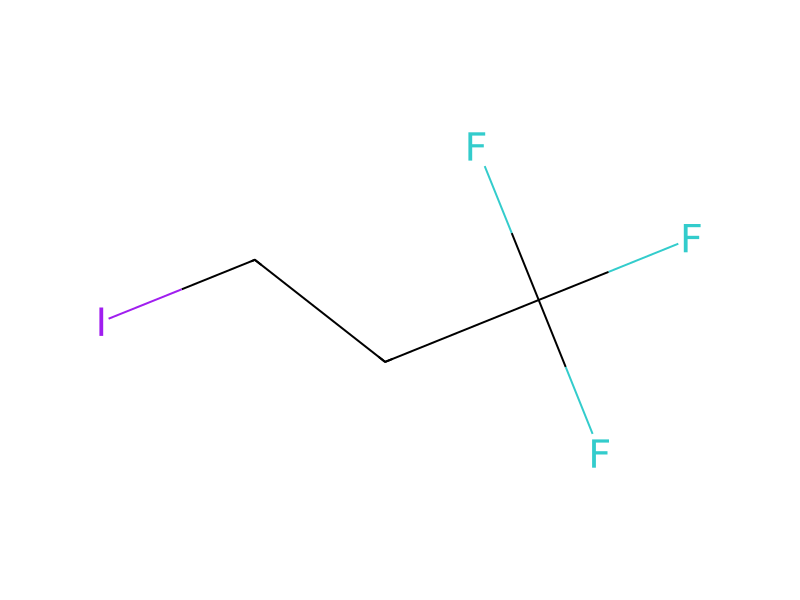
[F:1][C:2]([F:7])([F:6])[CH2:3][CH2:4]I.[Cl:8][C:9]1[CH:10]=[C:11]2[C:16](=[O:17])[NH:15][C:13](=[O:14])[C:12]2=[CH:18][CH:19]=1.C(=O)([O-])[O-:21].[K+].[K+].Cl>CN(C)C=O.O>[Cl:8][C:9]1[CH:10]=[C:11]([C:16]([NH:15][CH2:4][CH2:3][C:2]([F:7])([F:6])[F:1])=[O:17])[C:12](=[CH:18][CH:19]=1)[C:13]([OH:21])=[O:14]Participants






Conditions
- Temperature
- 20 °C
Procedure
3.6 g of 1,1,1-trifluoro-3-iodopropane are added dropwise to a mixture of 7.5 g of 4-chlorophthalimide and 4.6 g of potassium carbonate in 40 cm3 of dimethylformamide at a temperature in the region of 110° C. with stirring. After stirring for 11 hours at a temperature in the region of 120° C., the reaction mixture is cooled to a temperature in the region of 20° C. and then poured into 200 cm3 of water. The mixture is acidified with dilute aqueous hydrochloric acid solution to a pH of about 3, and is then extracted 3 times with 100 cm3 of ethyl acetate. The organic phase is dried over magnesium sulfate and then concentrated to dryness. 5.0 g of 4-chloro-N-(3,3,3-trifluoropropyl)phthalamic acid are thus obtained, Rf=0.12 (thin layer chromatography on silica gel, eluent: ethyl acetate).
Workup
- stirringAfter stirring for 11 hours at a temperature in the region of 120° C.
- extractionis then extracted 3 times with 100 cm3 of ethyl acetate
- dry with materialThe organic phase is dried over magnesium sulfate
- concentrationconcentrated to dryness
Sources & evidence
- ORD record
- ord-f9288219f906402eba9e99eb90b7c661
- Source dataset
- uspto-grants-2009_09
- Patent number
- US07589117B2
Reaction notes
Loading…