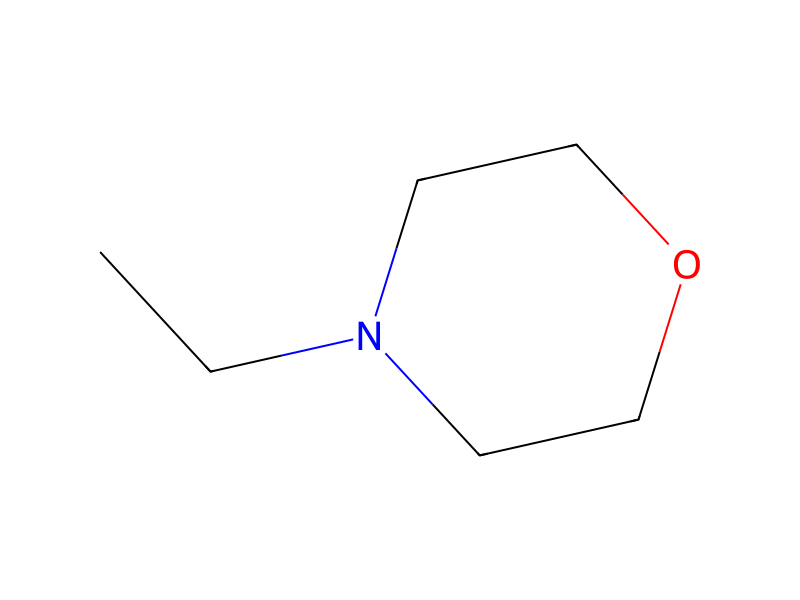
Ethylmorpholine → 4-Chloro-1-methyl-7-(4-morpholinylcarbonyl)-1H-pyrrolo[3,2-c]pyridine
Reaction equation

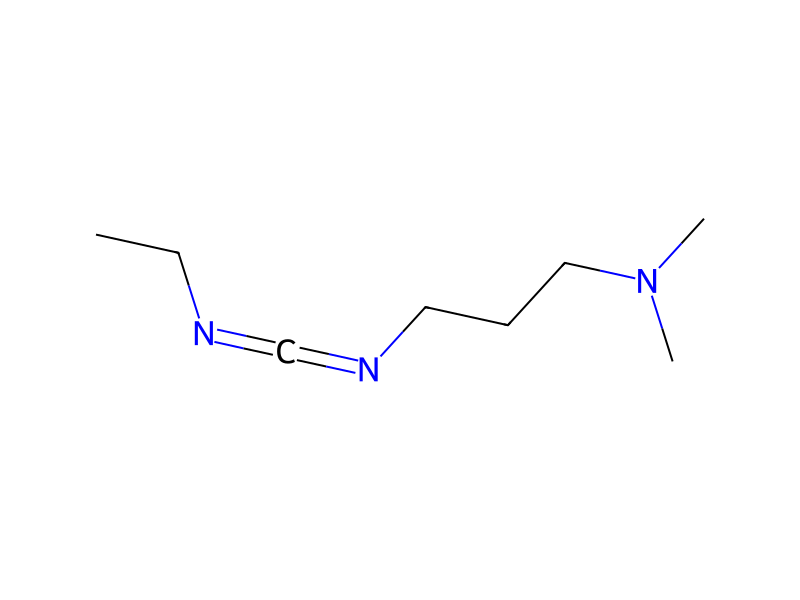
[Cl:1][C:2]1[C:7]2[CH:8]=[CH:9][N:10]([CH3:11])[C:6]=2[C:5]([C:12]([OH:14])=O)=[CH:4][N:3]=1.CN(C)CCCN=C=NCC.ON1C2C=CC=CC=2N=N1.C([N:38]1[CH2:43][CH2:42][O:41][CH2:40][CH2:39]1)C.N1CCOCC1>CN(C)C=O.O>[Cl:1][C:2]1[C:7]2[CH:8]=[CH:9][N:10]([CH3:11])[C:6]=2[C:5]([C:12]([N:38]2[CH2:43][CH2:42][O:41][CH2:40][CH2:39]2)=[O:14])=[CH:4][N:3]=1Participants
8
Reactant 5



Product 1

Reagents, catalysts & solvents 2


Procedure
To a solution of 4-chloro-1-methyl-1H-pyrrolo[3,2-c]pyridine-7-carboxylic acid (660 mg) in dimethylformamide (10 ml) was added 1-[3-(dimethylamino)propyl]-3-ethylcarbodiimide (1.21 g), 1-hydroxybenzotriazole (0.86 g), N-ethylmorpholine (0.8 ml) and morpholine (0.55 ml). The solution was stirred at room temperature overnight. The reaction was diluted with water and extracted three times with ethyl acetate. The ethyl acetate layers were combined, washed with saturated sodium chloride solution and dried (MgSO4) then evaporated to afford the title compound as an off-white solid (783 mg). This was carried through without further purification.
Workup
- extractionextracted three times with ethyl acetate
- washwashed with saturated sodium chloride solution
- dry with materialdried (MgSO4)
- customthen evaporated
Sources & evidence
- ORD record
- ord-c034bcd4aaaf4fe4934334a5284cd160
- Source dataset
- uspto-grants-2009_09
- Patent number
- US07589206B2
Reaction notes
Loading…