Trityl chloride → (2S)-1-Triphenylmethyl-2-pyrrolidinecarboxylic acid methyl ester
Reaction equation

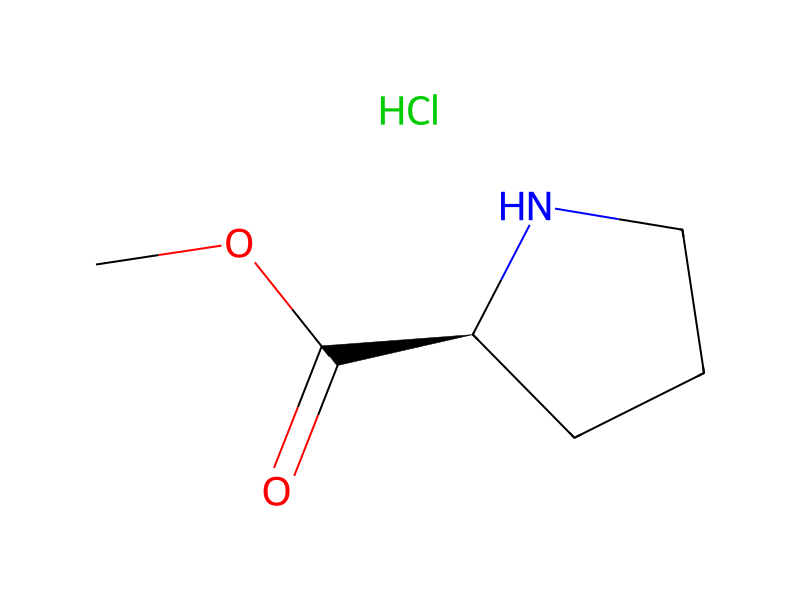
Cl.[CH3:2][O:3][C:4](=[O:10])[C@@H:5]1[CH2:9][CH2:8][CH2:7][NH:6]1.[C:11](Cl)([C:24]1[CH:29]=[CH:28][CH:27]=[CH:26][CH:25]=1)([C:18]1[CH:23]=[CH:22][CH:21]=[CH:20][CH:19]=1)[C:12]1[CH:17]=[CH:16][CH:15]=[CH:14][CH:13]=1.C(N(CC)CC)C>ClCCCl>[C:11]([N:6]1[CH2:7][CH2:8][CH2:9][CH:5]1[C:4]([O:3][CH3:2])=[O:10])([C:12]1[CH:17]=[CH:16][CH:15]=[CH:14][CH:13]=1)([C:24]1[CH:25]=[CH:26][CH:27]=[CH:28][CH:29]=1)[C:18]1[CH:19]=[CH:20][CH:21]=[CH:22][CH:23]=1Participants
5




Conditions
- Temperature
- 60 °C
Procedure
A solution of 3.00 g (18.1 mmol) of L-proline methyl ester hydrochloride, 5.05 g (18.1 mmol) of trityl chloride and 10 mL of triethylamine in 40 mL of 1,2-dichloroethane is stirred at 22° C. After a few minutes, a thick precipitate began to form. An additional 20 mL of 1,2-dichloroethane is added and the mixture is heated to 60° C. and stirred for 3 hrs. The reaction mixture is partitioned between water (100 mL) and CH2Cl2 (100 mL). The organic layer is washed with satd. NaHCO3 (50 mL), dried (MgSO4) and evaporated. The residue is recrystallized from hexane/EtOAc to give 5.76 g of 1-trityl-pyrrolidine-2-carboxylic acid, methyl ester as a white crystalline solid which is used directly in the next step.
Workup
- waitAfter a few minutes
- customto form
- customThe reaction mixture is partitioned between water (100 mL) and CH2Cl2 (100 mL)
- washThe organic layer is washed with satd
- dry with materialNaHCO3 (50 mL), dried (MgSO4)
- customevaporated
- customThe residue is recrystallized from hexane/EtOAc
Sources & evidence
- ORD record
- ord-b6e51c4d46244cd28a91e52fe70d874f
- Source dataset
- uspto-grants-1996_09
- Patent number
- US05556990
Reaction notes
Loading…