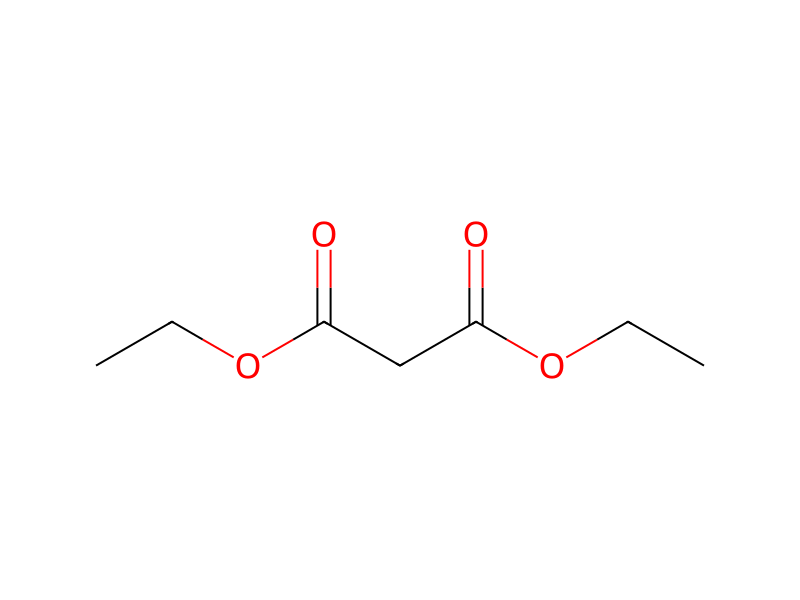
Diethyl Malonate → HCID 59752447, compound
Reaction equation

C(C(CCCC=C)(C(O)=O)C(O)=O)CCC=C.C(OCC)(=O)CC(OCC)=O.[H-].[Na+].BrCCCCC=C.[CH2:38]([C:44]([CH2:51][CH2:52][CH2:53][CH2:54][CH:55]=[CH2:56])(C(O)=O)[C:45]([OH:47])=[O:46])[CH2:39][CH2:40][CH2:41][CH:42]=[CH2:43]>C1COCC1>[CH2:51]([CH:44]([CH2:38][CH2:39][CH2:40][CH2:41][CH:42]=[CH2:43])[C:45]([OH:47])=[O:46])[CH2:52][CH2:53][CH2:54][CH:55]=[CH2:56]Participants




Procedure
Using a procedure identical to that described in Example 58 for the synthesis of di(4-pentenyl)malonic acid, diethyl malonate (25 g, 156 mmol) was dissolved in 150 mL dry THF in a 3 necked round bottom flask, and was reacted with NaH (18.74 g of 60% dispersion in mineral oil, 469 mmol, 3.0 eq.) and 6-bromo-1-hexene (63.6 g, 390 mmol, 2.5 eq.) and saponified/neutralized. The resultant yellow-brown oil, 2,2-di-(5-hexenyl)malonic acid, was placed in an oversized round-bottomed flask equipped with a reflux condenser, and heated with vigorous magnetic stirring to 200–210° C. using an oil bath. Gas evolution was observed upon reflux. After a 1 hour period, decarboxylation (evidenced by vigorous frothing) was complete. The mixture was cooled to room temperature and fractionally distilled at 115–118° C./0.1 torr, then further purified by flash chromatography using 15% ethyl acetate:hexanes as mobile phase to give 2-(5-hexenyl)-7-octenoic acid (9.5 g, 13.6%). 1H NMR (CDCl3): δ 11.2–12.2 (br, 1H), 5.6–6.0 (m, 2H), 4.8–5.0 (m, 4H), 2.2–2.4 (m, H), 1.9–2.1 (m, 4H), 1.8–1.9 (m, 2H), 1.2–1.8 (m, 10H) ppm.
Workup
- customequipped with a reflux condenser
- temperatureheated with vigorous
- temperatureupon reflux
- distillationfractionally distilled at 115–118° C./0.1 torr
- customfurther purified by flash chromatography
Sources & evidence
- ORD record
- ord-eefc93f9ac4a4a4bb34af2efdeacf889
- Source dataset
- uspto-grants-2008_07
- Patent number
- US07402642B2
Reaction notes
Loading…