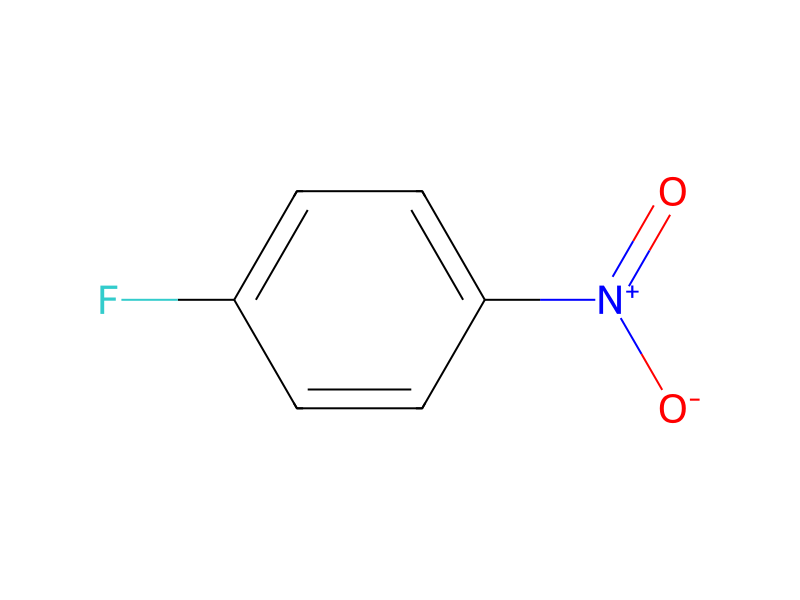
p-Fluoronitrobenzene → 3-(4-nitrophenyl)[1,3]oxazolo[4,5-b]pyridin-2(3H)-one
Reaction equation

[O:1]1[C:9]2[C:4](=[N:5][CH:6]=[CH:7][CH:8]=2)[NH:3][C:2]1=[O:10].[H-].[Na+].F[C:14]1[CH:19]=[CH:18][C:17]([N+:20]([O-:22])=[O:21])=[CH:16][CH:15]=1>CN(C=O)C.C(OCC)(=O)C>[N+:20]([C:17]1[CH:18]=[CH:19][C:14]([N:3]2[C:4]3=[N:5][CH:6]=[CH:7][CH:8]=[C:9]3[O:1][C:2]2=[O:10])=[CH:15][CH:16]=1)([O-:22])=[O:21]Participants





Procedure
A solution of oxazolo[4,5-b]pyridin-2(3H)-one (200 mg) in DMF (3.5 mL) was treated with a 60% dispersion of sodium hydride in mineral oil (62 mg) and the resulting mixture stirred at ambient temperature for 5 min. The mixture was treated with 1-fluoro-4-nitrobenzene (248 mg) then stirred at 100° C. for 17 h. After this time, the reaction mixture was cooled to ambient temperature, diluted with ethyl acetate (100 ml), washed with water (2×50 ml), 5% aqueous lithium chloride (50 mL) then brine (50 mL), dried over sodium sulfate, and filtered and the filtrate was concentrated under reduced pressure. The residue obtained was purified by chromatography (silica, heptane to 1:1 ethyl acetate/heptane) to afford 3-(4-nitrophenyl) [1,3]oxazolo[4,5-b]pyridin-2(3H)-one (73 mg) as a yellow solid.
Workup
- stirringthen stirred at 100° C. for 17 h
- temperatureAfter this time, the reaction mixture was cooled to ambient temperature
- washwashed with water (2×50 ml), 5% aqueous lithium chloride (50 mL)
- dry with materialbrine (50 mL), dried over sodium sulfate
- filtrationfiltered
- concentrationthe filtrate was concentrated under reduced pressure
- customThe residue obtained
- customwas purified by chromatography (silica, heptane to 1:1 ethyl acetate/heptane)
Sources & evidence
- ORD record
- ord-8bb1a35fa60040fcb5e07732b8314db1
- Source dataset
- uspto-grants-2014_09
- Patent number
- US08846713B2
Reaction notes
Loading…