p-Fluoronitrobenzene → 1-(4-nitrophenyl)-1H-pyrazolo[3,4-b]pyridine
Reaction equation

[NH:1]1[C:5]2=[N:6][CH:7]=[CH:8][CH:9]=[C:4]2[CH:3]=[N:2]1.[H-].[Na+].F[C:13]1[CH:18]=[CH:17][C:16]([N+:19]([O-:21])=[O:20])=[CH:15][CH:14]=1.C(=O)([O-])[O-].[Cs+].[Cs+]>CN(C=O)C.CCOC(C)=O.O>[N+:19]([C:16]1[CH:17]=[CH:18][C:13]([N:1]2[C:5]3=[N:6][CH:7]=[CH:8][CH:9]=[C:4]3[CH:3]=[N:2]2)=[CH:14][CH:15]=1)([O-:21])=[O:20]Participants
Reactant 4
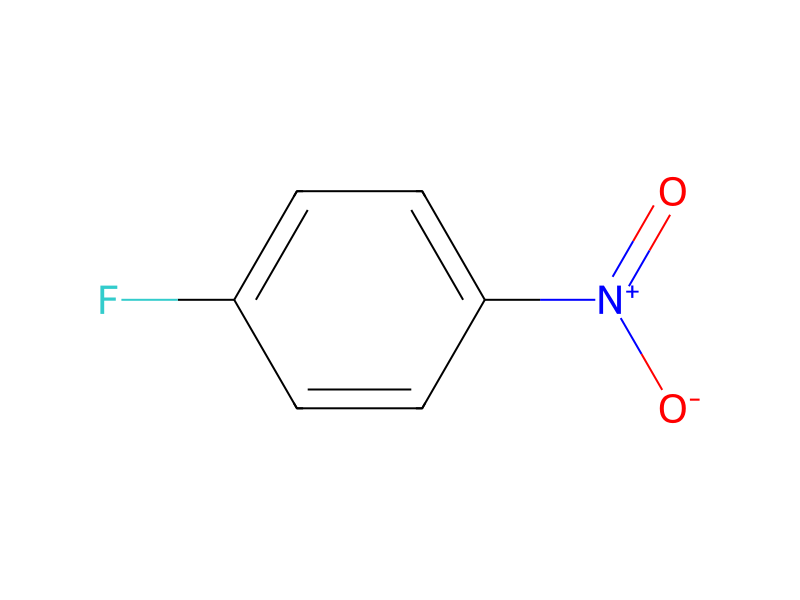



Product 1

Reagents, catalysts & solvents 3



Procedure
To a stirred solution of 1H-pyrazolo[3,4-b]pyridine (300 mg) in DMF (3.0 mL) was added sodium hydride (101 mg) (60% in mineral oil) with ice-cooling. The mixture was stirred at room temperature for 30 min, and then 1-fluoro-4-nitrobenzene (355 mg) was added. After stirring at room temperature for 2 h, the mixture was warmed up to 50° C. The mixture was stirred at 50° C. for 12 h. Cesium carbonate (821 mg) was added and the mixture was stirred at 100° C. for 12 h, and treated with water and AcOEt. The insoluble material was filtered off. The organic layer was separated and the aqueous layer was extracted with AcOEt. The organic layer was combined, dried over MgSO4 and concentrated in vacuo. The residue was used for the next reaction.
Workup
- temperaturecooling
- stirringAfter stirring at room temperature for 2 h
- temperaturethe mixture was warmed up to 50° C
- stirringThe mixture was stirred at 50° C. for 12 h
- stirringthe mixture was stirred at 100° C. for 12 h
- filtrationThe insoluble material was filtered off
- customThe organic layer was separated
- extractionthe aqueous layer was extracted with AcOEt
- dry with materialdried over MgSO4
- concentrationconcentrated in vacuo
- customThe residue was used for the next reaction
Sources & evidence
- ORD record
- ord-8e5efc2658b7448e9306bbb719905f3f
- Source dataset
- uspto-grants-2014_09
- Patent number
- US08846713B2
Reaction notes
Loading…