1-Bromo-3-chloropropane → Piperazine, 1-(3-chloropropyl)-4-(diphenylmethyl)-
Reaction equation

[CH:1]([N:14]1[CH2:19][CH2:18][NH:17][CH2:16][CH2:15]1)([C:8]1[CH:13]=[CH:12][CH:11]=[CH:10][CH:9]=1)[C:2]1[CH:7]=[CH:6][CH:5]=[CH:4][CH:3]=1.Br[CH2:21][CH2:22][CH2:23][Cl:24].C(=O)([O-])[O-].[K+].[K+]>CC(C)=O>[CH:1]([N:14]1[CH2:19][CH2:18][N:17]([CH2:21][CH2:22][CH2:23][Cl:24])[CH2:16][CH2:15]1)([C:8]1[CH:13]=[CH:12][CH:11]=[CH:10][CH:9]=1)[C:2]1[CH:7]=[CH:6][CH:5]=[CH:4][CH:3]=1Participants
5
Reactant 3


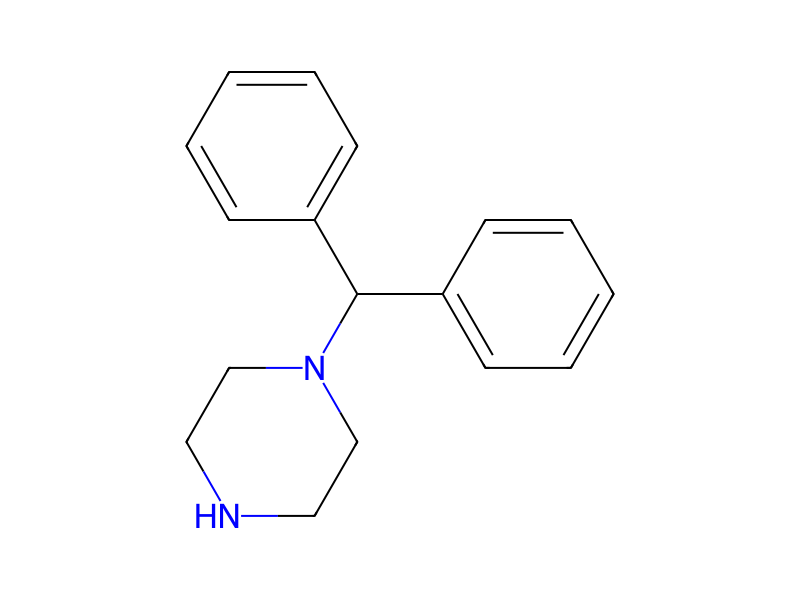
Product 1

Reagents, catalysts & solvents 1

Procedure
A mixture of 1-benzhydrylpiperazin (4.13 g), 1-bromo-3-chloropropane (5.18 g) and anhydrous potassium carbonate (2.26 g) in anhydrous acetone (82 ml) was refluxed for 10 hours under stirring. The insoluble materials were filtered off and the filtrate was evaporated to dryness. The residue was subjected to column chromatography on alumina (50 g) using benzene as an eluent. The fractions containing the object compound were collected and evaporated to give oil of 1-benzhydryl-4-(3-chloropropyl)piperazine (3.04 g).
Workup
- temperaturewas refluxed for 10 hours
- filtrationThe insoluble materials were filtered off
- customthe filtrate was evaporated to dryness
- additionThe fractions containing the object compound
- customwere collected
- customevaporated
Sources & evidence
- ORD record
- ord-3601993dba0648e4b0edfa2989795a34
- Source dataset
- uspto-grants-1983_05
- Patent number
- US04382934
Reaction notes
Loading…