Potassium Carbonate → 3-[3-Chloro-4-(cyclopropylmethoxy)phenyl]-1-cyclopentylpropan-1-one
Reaction equation

[Cl:1][C:2]1[CH:3]=[C:4]([CH2:9][CH2:10][C:11]([CH:13]2[CH2:17][CH2:16][CH2:15][CH2:14]2)=[O:12])[CH:5]=[CH:6][C:7]=1[OH:8].CN(C=O)C.CC#N.C([O-])([O-])=O.[K+].[K+].Br[CH2:33][CH:34]1[CH2:36][CH2:35]1>CN(C=O)C>[Cl:1][C:2]1[CH:3]=[C:4]([CH2:9][CH2:10][C:11]([CH:13]2[CH2:17][CH2:16][CH2:15][CH2:14]2)=[O:12])[CH:5]=[CH:6][C:7]=1[O:8][CH2:33][CH:34]1[CH2:36][CH2:35]1Participants
6
Reactant 4

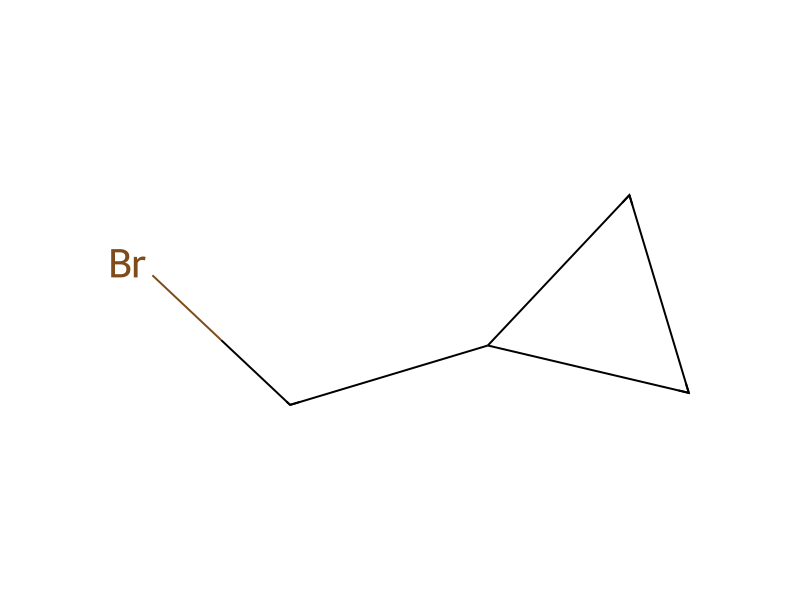


Product 1

Reagents, catalysts & solvents 1

Conditions
- Temperature
- 100 °C
Procedure
A solution of 3-(3-chloro-4-hydroxyphenyl)-1-cyclopentylpropan-1-one ((25 g, 0.099 mol, from Step 2) in 1:1 DMF/CH3CN (200 mL) was treated with K2CO3 (15 g, 0.109 mol, 1.1 equiv), and the mixture stirred for 15 min. A solution of (bromomethyl)cyclopropane (17.4 g, 0.129 mol, 1.3 equiv) in DMF (50 mL) was added dropwise, and the reaction mixture heated to 100° C. for 1 h. The volatiles were removed in vacuo. The residue was dissolved in a minimal amount of ethyl acetate, and this solution washed with water, dried over Na2SO4, filtered, and evaporated. Chromatographic purification of the residue on silica gel using hexanes/ethyl acetate afforded 29.12 g (96%) of the title compound.
Workup
- customThe volatiles were removed in vacuo
- dissolutionThe residue was dissolved in a minimal amount of ethyl acetate
- washthis solution washed with water
- dry with materialdried over Na2SO4
- filtrationfiltered
- customevaporated
- customChromatographic purification of the residue on silica gel
Sources & evidence
- ORD record
- ord-934d53c27c2843278dbc83063b74a39e
- Source dataset
- uspto-grants-2006_12
- Patent number
- US07148226B2
Reaction notes
Loading…