Trichloroacetyl chloride → 2-(Trichloroacetyl)pyrrole
Reaction equation

[Cl:1][C:2]([Cl:7])([Cl:6])[C:3](Cl)=[O:4].[NH:8]1[CH:12]=[CH:11][CH:10]=[CH:9]1.C(=O)([O-])[O-].[K+].[K+]>C(OCC)C.O>[Cl:1][C:2]([Cl:7])([Cl:6])[C:3]([C:9]1[NH:8][CH:12]=[CH:11][CH:10]=1)=[O:4]Participants
6
Reactant 3

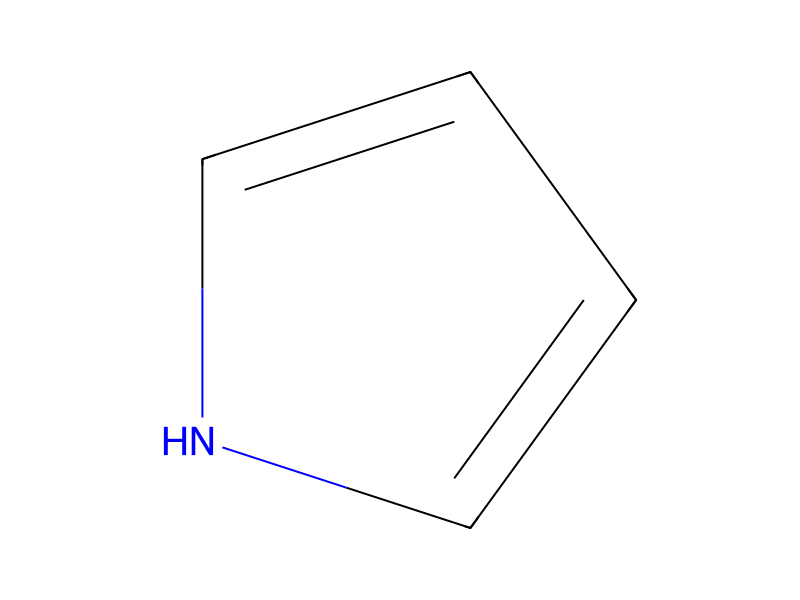

Product 1
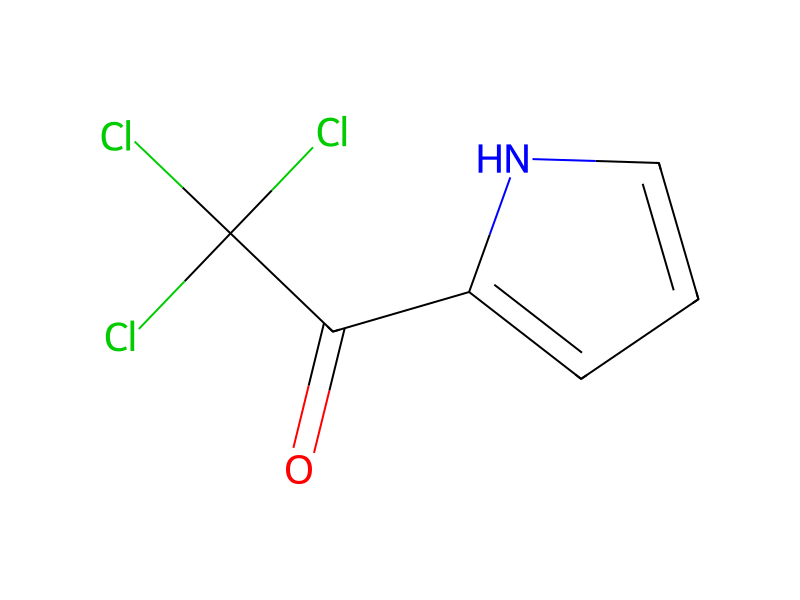
Reagents, catalysts & solvents 2


Procedure
45 g (247 mmol) of trichloroacetyl chloride and 100 ml of ethyl ether were introduced into a three-necked flask. A solution of 15.4 g (230 mmol) of pyrrole in 100 ml of ethyl ether was added dropwise and stirring was carried out at room temperature for one hour. A solution of 20 g of potassium carbonate in 60 ml of water was then slowly added. The organic phase was separated by settling, dried over magnesium sulfate and evaporated and the residue was triturated in hexane and filtered. 42.7 g (87%) of the expected compound, with a melting point of 78°-79° C., were recovered.
Workup
- customThe organic phase was separated
- dry with materialdried over magnesium sulfate
- customevaporated
- customthe residue was triturated in hexane
- filtrationfiltered
- custom42.7 g (87%) of the expected compound, with a melting point of 78°-79° C., were recovered
Sources & evidence
- ORD record
- ord-045c986cda9345a493a0607745bd0da6
- Source dataset
- uspto-grants-1998_02
- Patent number
- US05716624
Reaction notes
Loading…