Sodium hydride → 4-Chloro-1-(triisopropylsilyl)-1H-pyrrolo[2,3-b]pyridine
Reaction equation
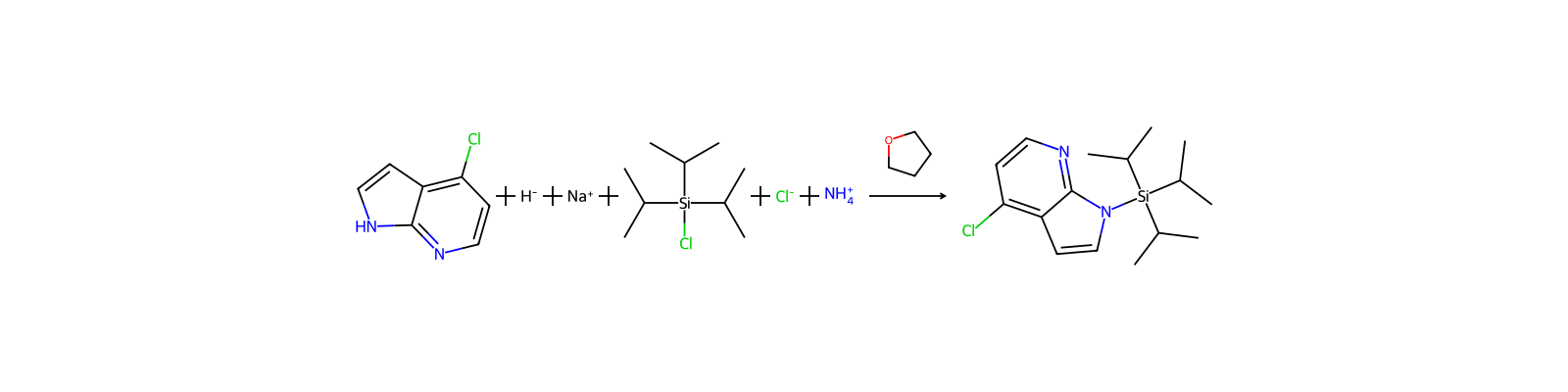
[Cl:1][C:2]1[CH:7]=[CH:6][N:5]=[C:4]2[NH:8][CH:9]=[CH:10][C:3]=12.[H-].[Na+].[CH:13]([Si:16](Cl)([CH:20]([CH3:22])[CH3:21])[CH:17]([CH3:19])[CH3:18])([CH3:15])[CH3:14].[Cl-].[NH4+]>C1COCC1>[Cl:1][C:2]1[CH:7]=[CH:6][N:5]=[C:4]2[N:8]([Si:16]([CH:20]([CH3:22])[CH3:21])([CH:17]([CH3:19])[CH3:18])[CH:13]([CH3:15])[CH3:14])[CH:9]=[CH:10][C:3]=12Participants
6





Procedure
4-Chloro-1H-pyrrolo[2,3-b]pyridine (5.0 g, 32.8 mmol) in THF (50 mL) was cooled to 0° C., and NaH (1.64 g, 41.0 mmol, 60% oil dispersion) was added. After 15 minutes, triisopropylsilylchloride (“TIPS-Cl”; 6.94 mL, 32.8 mmol) was added, and the reaction was stirred at room temperature for 1 hour. A saturated ammonium chloride solution (20 mL) was added, and the mixture was extracted with hexanes (40 mL), washed with brine and dried over sodium sulfate. After removal of the solvent, the residue was purified by chromatography (hexanes) to give 4-chloro-1-(triisopropylsilyl)-1H-pyrrolo[2,3-b]pyridine (10.0 g, 99% yield) as an oil.
Workup
- extractionthe mixture was extracted with hexanes (40 mL)
- washwashed with brine
- dry with materialdried over sodium sulfate
- customAfter removal of the solvent
- customthe residue was purified by chromatography (hexanes)
Sources & evidence
- ORD record
- ord-f4c1382d775c4e42a4e430867a27dace
- Source dataset
- uspto-grants-2015_03
- Patent number
- US08981085B2
Reaction notes
Loading…