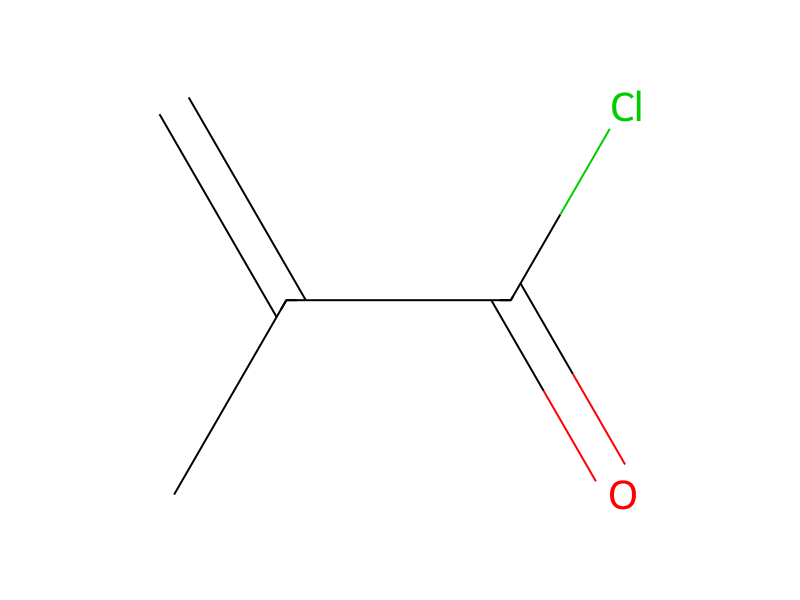
Methacryloyl chloride → HCID 117703144, compound
Reaction equation

[NH2:1][C:2]1[C:3]([F:22])=[C:4]([C:8]2[C:9]3[C:16]([C:17]([O:19][CH2:20][CH3:21])=[O:18])=[CH:15][NH:14][C:10]=3[N:11]=[CH:12][N:13]=2)[CH:5]=[CH:6][CH:7]=1.CCN(C(C)C)C(C)C.[C:32](Cl)(=[O:36])[C:33]([CH3:35])=[CH2:34]>C1COCC1>[F:22][C:3]1[C:2]([NH:1][C:32](=[O:36])[C:33]([CH3:35])=[CH2:34])=[CH:7][CH:6]=[CH:5][C:4]=1[C:8]1[C:9]2[C:16]([C:17]([O:19][CH2:20][CH3:21])=[O:18])=[CH:15][NH:14][C:10]=2[N:11]=[CH:12][N:13]=1Participants
5
Reactant 3


Product 1

Reagents, catalysts & solvents 1

Procedure
To a solution of ethyl 4-(3-amino-2-fluorophenyl)-7H-pyrrolo[2,3-d]pyrimidine-5-carboxylate (6.5 mg, 0.022 mmol) and DIPEA (12 μL, 0.066 mmol) in THF (220 μL) at room temperature was added methacryloyl chloride (3.5 mg, 0.033 mmol) and the solution was stirred for 1 hour. The reaction was concentrated and the residues, dissolved in 2 mL of DMSO, were purified by reverse phase HPLC using an acetonitrile gradient in water with 0.1% TFA modifier. Lyophilization of the desired fractions afforded a colorless solid. LRMS (ESI) calc'd for C19H18N4O3F [M+H]+: 369, found 369.
Workup
- concentrationThe reaction was concentrated
- dissolutionthe residues, dissolved in 2 mL of DMSO
- customwere purified by reverse phase HPLC
- customLyophilization of the desired fractions afforded a colorless solid
Sources & evidence
- ORD record
- ord-f3f76b98f1624392b24f044c35fc7bd4
- Source dataset
- uspto-grants-2015_03
- Patent number
- US08993756B2
Reaction notes
Loading…