Methanol → 5,12-Dihydroquinolino[2,3-b]acridine-7,14-dione;2,9-dimethyl-5,12-dihydroquinolino[2,3-b]acridine-7,14-dione
Reaction equation

C=[CH:2][C:3]1[CH:8]=[CH:7][CH:6]=[CH:5][CH:4]=1.[C:9](O)(=O)C=C.C(OCCO)(=O)C(C)=C.[CH3:23][OH:24].[OH-:25].[K+].C1C(C=O)=CC=C(C=O)C=1.[CH:37]1[CH:42]=[C:41]2[C:43]([C:45]3[C:50]([NH:51][C:40]2=[CH:39][CH:38]=1)=[CH:49][C:48]1[C:52]([C:54]2[C:59]([NH:60][C:47]=1[CH:46]=3)=[CH:58][CH:57]=[CH:56][CH:55]=2)=[O:53])=[O:44]>CS(C)=O.CC1C=CC2NC3C(C(=O)C=2C=1)=CC1NC2C=CC(C)=CC=2C(=O)C=1C=3.O>[CH:56]1[CH:55]=[C:54]2[C:52]([C:48]3[C:47]([NH:60][C:59]2=[CH:58][CH:57]=1)=[CH:46][C:45]1[C:43]([C:41]2[C:40]([NH:51][C:50]=1[CH:49]=3)=[CH:39][CH:38]=[CH:37][CH:42]=2)=[O:44])=[O:53].[CH3:2][C:3]1[CH:8]=[CH:7][C:6]2[NH:60][C:47]3[C:48]([C:23](=[O:24])[C:5]=2[CH:4]=1)=[CH:49][C:50]1[NH:51][C:40]2[CH:39]=[CH:38][C:37]([CH3:9])=[CH:42][C:41]=2[C:43](=[O:25])[C:45]=1[CH:46]=3Participants
Reactant 5


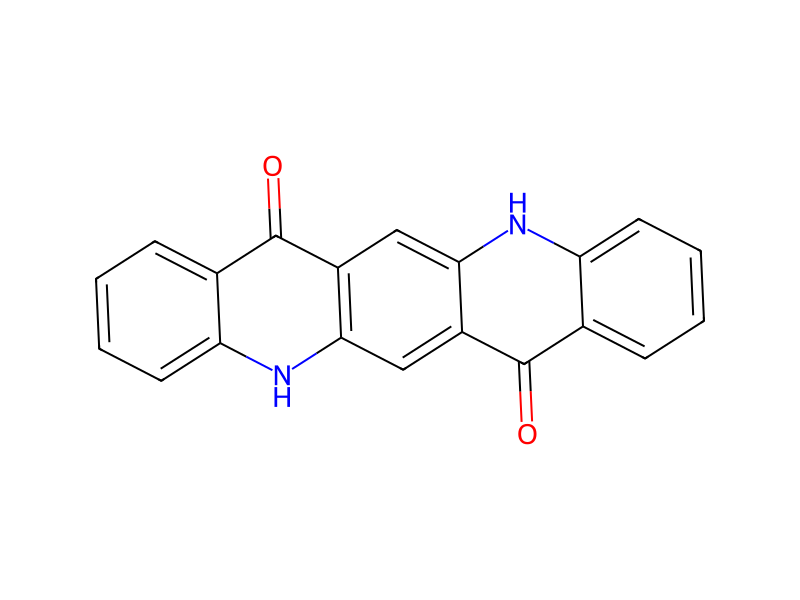


Product 1

Reagents, catalysts & solvents 3


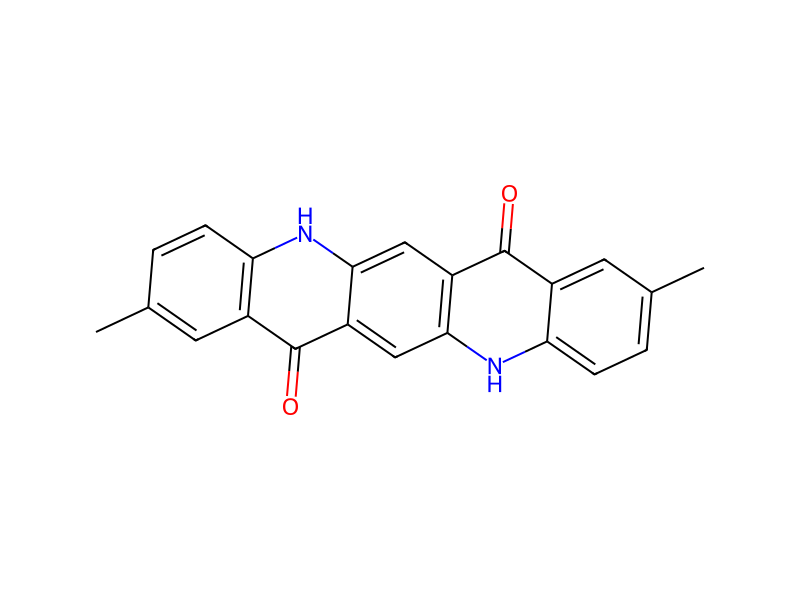
Conditions
- Temperature
- 0 °C
Procedure
Nine parts of a styrene/acrylic acid/hydroxyethyl methacrylate (6/3/1; molar ratio) terpolymer (molecular weight: 5,000) as a dispersing agent having a crosslinkable functional group were dissolved in 80 parts of dimethyl sulfoxide, and 10 parts of a quinacridone pigment (C.I. Pigment Red 122) were suspended in the resultant solution in a flask at 25° C. under an air atmosphere. A 30% methanol solution of potassium hydroxide was then added dropwise little by little to dissolve the quinacridone pigment. After the pigment solution was stirred for 3 hours, terephthaldialdehyde as a crosslinking agent was added to and dissolved in the pigment solution in a proportion of 1 part per 10 parts of the pigment, and the resultant solution was quickly poured into ion-exchanged water (400 parts of ion-exchanged water per 10 parts of the pigment; 0° C.) stirred by an impellor type agitating blade (800 rpm), purged with nitrogen and cooled and temperature-maintained by means of 2 system dispensers (manufactured by Musashi Engineering K.K.; needle internal diameter: 0.57 mm; delivery pressure: 4.0 kgf/cm2) to obtain an aqueous dispersion of quinacridone-pigment-containing particles having an average particle diameter of 29.7 nm. This aqueous dispersion was transferred to a reaction vessel equipped with a mantle heater, cooling tower, stirrer and thermometer, and this system was purged with nitrogen with stirring at 300 rpm and heated to an internal temperature of 80° C. While retaining the internal temperature of 80° C., 10% hydrochloric acid was added dropwise to adjust the pH of the reaction mixture to 4.0. After continuing the reaction for additional 5 hours, the reaction mixture was cooled back to room temperature. Thereafter, aggregates formed were filtered under reduced pressure through a membrane filter (holding particle diameter: 0.45 μm) and washed 3 times with 500 ml of ion-exchanged water to obtain a paste of an aqueous dispersion of the quinacridone pigment-containing particles desalted and desolvated.
Workup
- stirringagitating blade (800 rpm)
- custompurged with nitrogen
- temperaturecooled
- temperaturetemperature-maintained by means of 2 system dispensers (manufactured by Musashi Engineering K.K.; needle internal diameter: 0.57 mm; delivery pressure: 4.0 kgf/cm2)
Sources & evidence
- ORD record
- ord-96d908d346684dfab351c768be98e29a
- Source dataset
- uspto-grants-2005_07
- Patent number
- US06921433B2
Reaction notes
Loading…