Isopropanol → 1-Methyl-4-(2-thiophen-3-yl-pyridin-4-yl)-piperazine
Reaction equation
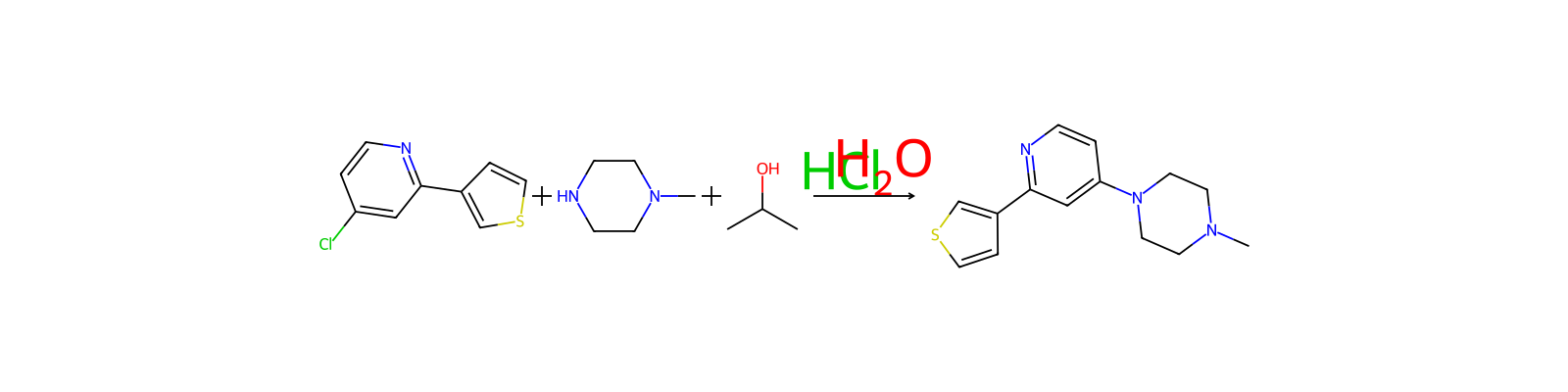
Cl[C:2]1[CH:7]=[CH:6][N:5]=[C:4]([C:8]2[CH:12]=[CH:11][S:10][CH:9]=2)[CH:3]=1.[CH3:13][N:14]1[CH2:19][CH2:18][NH:17][CH2:16][CH2:15]1.CC(O)C>Cl.O>[CH3:13][N:14]1[CH2:19][CH2:18][N:17]([C:2]2[CH:7]=[CH:6][N:5]=[C:4]([C:8]3[CH:12]=[CH:11][S:10][CH:9]=3)[CH:3]=2)[CH2:16][CH2:15]1Participants
6




Conditions
- Temperature
- 180 °C
Procedure
To a microwave tube was added 4-chloro-2-thiophen-3-yl-pyridine (50 mg, 0.26 mmol), 1-methylpiperazine (100 mg, 1 mmol), 2-propanol (0.7 mL) and concentrated HCl (1 drop). The resulting mixture was heated at 180° C. for 40 min using a Personal Chemistry Smith Synthesizer. The resulting mixture was poured into water and extracted with CH2Cl2. The organic layer was dried and concentrated, and the residue was purified by preparative TLC (CH2Cl2/MeOH) to yield the title compound as a solid.
Workup
- extractionextracted with CH2Cl2
- customThe organic layer was dried
- concentrationconcentrated
- customthe residue was purified by preparative TLC (CH2Cl2/MeOH)
Sources & evidence
- ORD record
- ord-4e34362b413945fd84f4b7e02aae39dc
- Source dataset
- uspto-grants-2011_09
- Patent number
- US08022209B2
Reaction notes
Loading…