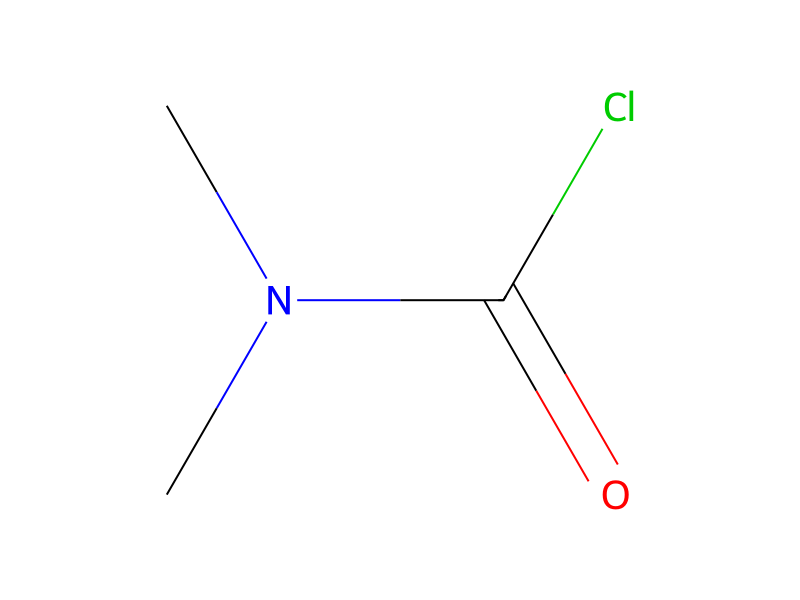
Dimethylcarbamoyl Chloride → 3,5-Dibromopicolinonitrile
Reaction equation

[Br:1][C:2]1[CH:3]=[N+:4]([O-])[CH:5]=[C:6]([Br:8])[CH:7]=1.C[Si]([C:14]#[N:15])(C)C.CN(C)C(Cl)=O.C(=O)([O-])O.[Na+]>C(Cl)Cl>[C:14]([C:3]1[C:2]([Br:1])=[CH:7][C:6]([Br:8])=[CH:5][N:4]=1)#[N:15]Participants
6





Procedure
A mixture of 3,5-dibromopyridine N-oxide (prepared in the above (1)) 2.26 g, trimethylsilylcyanide 1.06 g and dimethylcarbamic acid chloride 1.15 g in methylene chloride 25 ml is refluxed under heating for 1 day. To the mixture are added trimethylsilylcyanide 443 mg and dimethylcarbamic acid chloride 480 mg, and the mixture is refluxed under heating for 20 hours. An aqueous sodium hydrogen carbonate solution is added to the reaction mixture cooled, and the mixture is extracted with methylene chloride. The combined extract is washed, dried and the solvent is removed in vacuo. The residue is purified by silica gel chromatography (solvent; n-hexane:ethyl acetate=1:1) to give 2-cyano-3,5-dibromopyridine 1.38 g. mp 109-112° C.
Workup
- temperatureis refluxed
- temperatureunder heating for 1 day
- temperaturethe mixture is refluxed
- temperatureunder heating for 20 hours
- temperaturecooled
- extractionthe mixture is extracted with methylene chloride
- extractionThe combined extract
- washis washed
- customdried
- customthe solvent is removed in vacuo
- customThe residue is purified by silica gel chromatography (solvent; n-hexane:ethyl acetate=1:1)
Sources & evidence
- ORD record
- ord-d65113fd895c4bb9b73064aaf4f95776
- Source dataset
- uspto-grants-2007_09
- Patent number
- US07273868B2
Reaction notes
Loading…