Dimethylcarbamoyl Chloride → 6-Acetylpyridine-2-carbonitrile
Reaction equation

[C:1]([C:4]1[CH:9]=[CH:8][CH:7]=[CH:6][N+:5]=1[O-])(=[O:3])[CH3:2].[CH3:11][N:12](C)C(Cl)=O.C([Si](C)(C)C)#N.C([O-])([O-])=O.[K+].[K+]>C(Cl)Cl>[C:1]([C:4]1[CH:9]=[CH:8][CH:7]=[C:6]([C:11]#[N:12])[N:5]=1)(=[O:3])[CH3:2]Participants
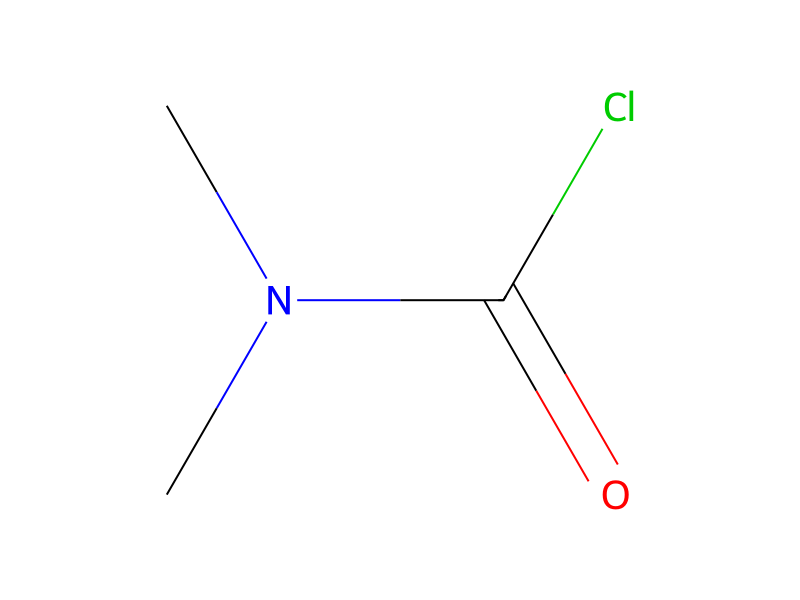




Procedure
To a solution of 2-acetylpyridine-N-oxide (0.098 mol) prepared in example 15 in 200 ml of dry methylene chloride was added N,N-dimethylcarbamoyl chloride (0.1 mol), and the reaction mixture was allowed to react at room temperature under nitrogen for 24 h. An additional aliquot of N,N-dimethylcarbamoyl chloride (0.1 mol) was added, followed by an aliquot of cyanotrimethylsilane (0.22 mol), and the resulting mixture was allowed to react at 20° C. for 2 days. Another 4 mL (0.03 mol) of cyanotrimethylsilane was then added, and the mixture was stirred for an additional 24 h. An aqueous solution (200 ml) of 10% K2CO3 was added to the reaction mixture to produce a mild exotherm, and the resulting mixture was stirred for 45 min. The aqueous layer was extracted with 100 ml methylene chloride twice and the organic layer was dried (K2CO3). After stripping the solvent, 16.9 g of crude material was isolated. This crude residue was chromatographed over Florisil to isolate the desired product plus several by-products whose structures were assigned consistent with spectroscopic data obtained. Thus, gradient elution by the series of solvents gave 2-acetyl-6-cyanopyridine (2.0 g) using 50/50 CH2Cl2 /hexane v/v. Also isolated were by-products: 2-[2-(6-cyanopyridyl)]-2-trimethylsiloxypropionitrile (0.81 g) eluting with CH2Cl2 ; 2-[2-(6-cyanopyridyl)]-2-(N,N-dimethylcarbamoyloxy)propionitrile (1.67 g) eluting with 25:75 EtOAc/CH2Cl2 ; 2-acetylpyridine cyanohydrin (0.42 g) eluting with 50:50 EtOAc/CH2Cl2 ; and 2-(1-cyano-1-N,N-dimethylcarbamoyloxy)ethylpyridine-N-oxide (1.8 g) eluting with EtOAc. The desired 2-acetyl-6-cyanopyridine exhibited spectroscopic properties consistent with the assigned structure: 1H NMR (CDCl3): 2.75 (s, 3H, CH3), 7.9 (d, 1H), 8.05 (t, 1H), and 8.25 ppm (d, 1H); 13C NMR (CDCl3): 26.18 (CH3), 117.23 (CN); 125.07, 131.89, 133.72, 138.84, 154.94, and 198.75 ppm (C=0); mass spectrum, (DCI) M+H=147 m/e; IR (CDCl3)max 1709 cm-1 (C=0) [2244 cm-1, weak, C=N].
Workup
- customto react at room temperature under nitrogen for 24 h
- customto react at 20° C. for 2 days
- customto produce a mild exotherm
- stirringthe resulting mixture was stirred for 45 min
- extractionThe aqueous layer was extracted with 100 ml methylene chloride twice
- dry with materialthe organic layer was dried (K2CO3)
- custom16.9 g of crude material was isolated
- customThis crude residue was chromatographed over Florisil
Sources & evidence
- ORD record
- ord-874552bc135041a4b63ad0927f91059b
- Source dataset
- uspto-grants-1998_06
- Patent number
- US05760191
Reaction notes
Loading…