Triethylamine → HCID 59020397, compound
Reaction equation

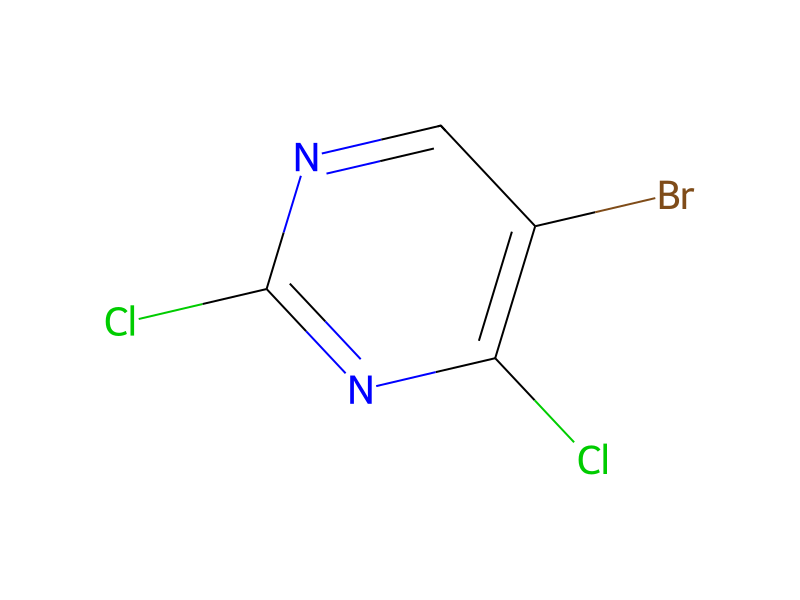
[Br:1][C:2]1[C:3](Cl)=[N:4][C:5]([Cl:8])=[N:6][CH:7]=1.[C:10]([NH:17][CH2:18][CH2:19][CH2:20][NH2:21])([O:12][C:13]([CH3:16])([CH3:15])[CH3:14])=[O:11].C(N(CC)CC)C>C(#N)C.C(OCC)(=O)C>[C:13]([O:12][C:10](=[O:11])[NH:17][CH2:18][CH2:19][CH2:20][NH:21][C:3]1[C:2]([Br:1])=[CH:7][N:6]=[C:5]([Cl:8])[N:4]=1)([CH3:16])([CH3:14])[CH3:15]Participants
6
Reactant 3


Product 1

Reagents, catalysts & solvents 2


Procedure
A solution of 6.1 g (26.6 mmol) of 5-bromo-2,4-dichloro-pyrimidine in 100 ml of acetonitrile is mixed successively with 5.0 g (28.7 mmol) of N-boc-1,3-diaminopropane and 4.5 ml (32.4 mmol) of triethylamine and stirred for 3.5 hours at room temperature. The batch is diluted with 200 ml of ethyl acetate. It is washed with saturated NaCl solution, citric acid (10%), saturated NaHCO3 solution as well as saturated NaCl solution. The combined organic phases are dried (Na2SO4), filtered and concentrated by evaporation. 9.7 g (26.6 mmol, corresponding to 100% of theory) of the product is obtained.
Workup
- washIt is washed with saturated NaCl solution, citric acid (10%), saturated NaHCO3 solution as well as saturated NaCl solution
- dry with materialThe combined organic phases are dried (Na2SO4)
- filtrationfiltered
- concentrationconcentrated by evaporation
- custom9.7 g (26.6 mmol, corresponding to 100% of theory) of the product is obtained
Sources & evidence
- ORD record
- ord-512e97e0cfa140f8a15a9954a3286810
- Source dataset
- uspto-grants-2007_12
- Patent number
- US07312225B2
Reaction notes
Loading…