Nitric Acid → Benzene, 1,3-dichloro-5-nitro-
Reaction equation

[Cl:1][C:2]1[CH:8]=[C:7]([N+:9]([O-:11])=[O:10])[CH:6]=[C:5]([Cl:12])[C:3]=1N.C(O)(C)C.[N+]([O-])(O)=O.N([O-])=O.[Na+]>O>[Cl:1][C:2]1[CH:8]=[C:7]([N+:9]([O-:11])=[O:10])[CH:6]=[C:5]([Cl:12])[CH:3]=1Participants
6
Reactant 4


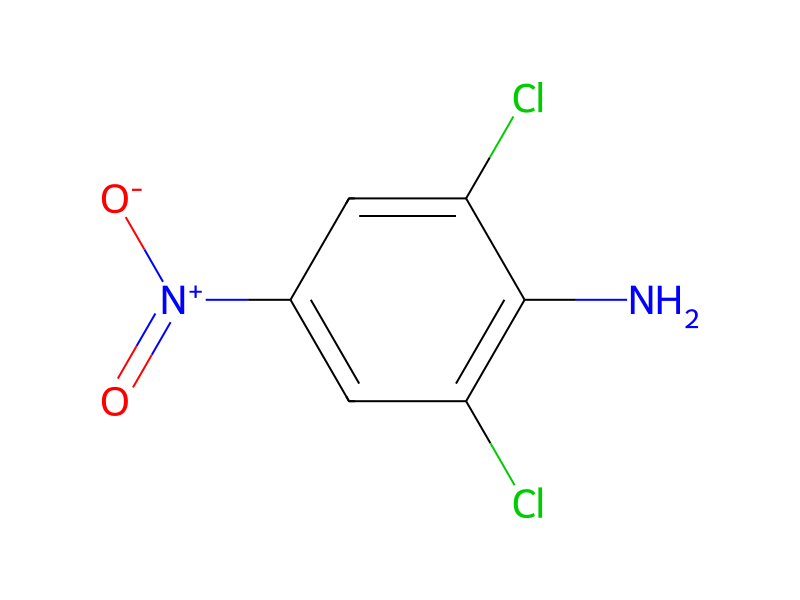

Product 1

Reagents, catalysts & solvents 1

Procedure
207 parts of 2,6-dichloro-4-nitro-aniline are introduced into 500 parts of isopropanol, and 780 parts of 65 percent strength by weight nitric acid are then added to the mixture. A solution of 125 parts of NaNO2 in 175 parts of water is run in at 50° C., as described in Example 1. The mixture is cooled, 400 parts of water are added and the product is filtered off. 172 parts (90% of theory) of 3,5-dichloro-nitro-benzene, of melting point 55°-57° C., are obtained.
Workup
- additionare then added to the mixture
- customis run in at 50° C.
- temperatureThe mixture is cooled
- filtrationthe product is filtered off
Sources & evidence
- ORD record
- ord-15e6aa4d348b49738d0af72b3ac1ea38
- Source dataset
- uspto-grants-1977_10
- Patent number
- US04053527
Reaction notes
Loading…