Trimethylsilylacetylene → 1-(5Methylpyridin-2-yl)-2-(2,3-difluoro-4-ethoxyphenyl) acetylene
Reaction equation

[CH3:1][C:2]1[CH:3]=[CH:4][C:5]([C:8]#[CH:9])=[N:6][CH:7]=1.CC1C=CC(Br)=NC=1.C[Si](C#C)(C)C.I[C:25]1[CH:30]=[CH:29][C:28]([O:31][CH2:32][CH3:33])=[C:27]([F:34])[C:26]=1[F:35]>[Pd].[Cu]I.C(N(CC)CC)C>[CH3:1][C:2]1[CH:3]=[CH:4][C:5]([C:8]#[C:9][C:25]2[CH:30]=[CH:29][C:28]([O:31][CH2:32][CH3:33])=[C:27]([F:34])[C:26]=2[F:35])=[N:6][CH:7]=1Participants
8
Reactant 4



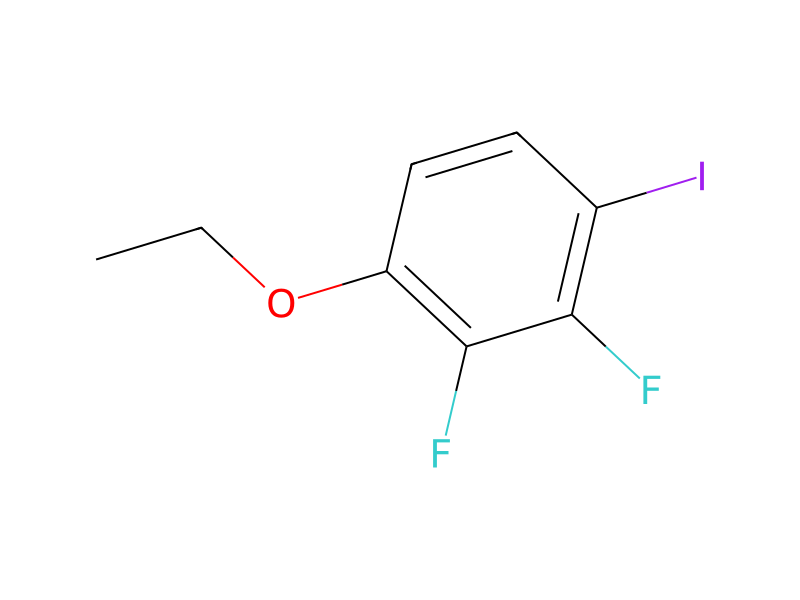
Product 1

Reagents, catalysts & solvents 3



Procedure
A mixture of 0.01 mol of 5-methylpyridin-2-yl-acetylene (which can be prepared from 5-methyl-2-bromopyridine by reaction with trimethylsilyl-acetylene and Pd catalyst and subsequent splitting off of the trimethylsilyl group), 0.01 mol of 4-iodo-2,3-difluorophenetole (for the preparation, see Example 9), 30 ml of triethylamine, 0.2 mmol of Pd catalyst and 0.1 mmol of CuI is stirred at room temperature for 24 hours. The reaction mixture is diluted with petroleum ether and filtered over silica gel. Evaporation and purification give 1-(5methylpyridin-2-yl)-2-(2,3-difluoro-4-ethoxyphenyl) acetylene.
Workup
- customfor the preparation
- filtrationfiltered over silica gel
- customEvaporation and purification
Sources & evidence
- ORD record
- ord-e5c2e1a1e50d4ddf8f8539b7d732b4a3
- Source dataset
- uspto-grants-1991_11
- Patent number
- US05068053
Reaction notes
Loading…