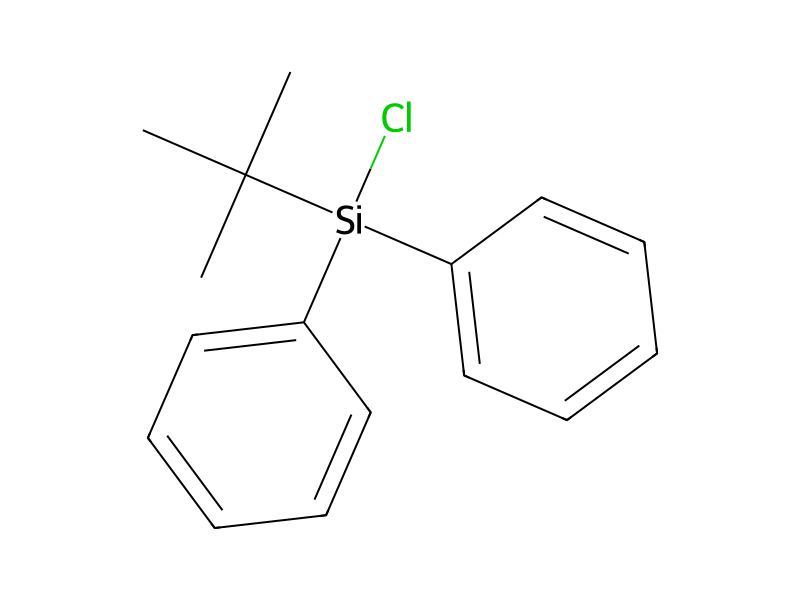
Dichlorodiphenylsilane → tert-Butyldiphenylchlorosilane
Reaction equation

[Mg].O1CCCC1.[C:7](Cl)([CH3:10])([CH3:9])[CH3:8].[C:12]1([Si:18]([C:21]2[CH:26]=[CH:25][CH:24]=[CH:23][CH:22]=2)(Cl)[Cl:19])[CH:17]=[CH:16][CH:15]=[CH:14][CH:13]=1>[Cu](C#N)C#N.CCCCCC>[C:7]([Si:18]([C:21]1[CH:22]=[CH:23][CH:24]=[CH:25][CH:26]=1)([C:12]1[CH:17]=[CH:16][CH:15]=[CH:14][CH:13]=1)[Cl:19])([CH3:10])([CH3:9])[CH3:8]Participants






Procedure
12.2 g (0.5 mol) magnesium was introduced into a 500 mL four-neck flask equipped with a reflux condenser, addition funnel, thermometer, and stirring rod. After drying under a nitrogen atmosphere, the tert-butyl Grignard reagent was prepared by the addition of 250 mL tetrahydrofuran and 46.3 g (0.5 mol) t-butyl chloride with stirring. To this was added 0.45 g (0.005 mol) copper cyanide at room temperature, and 126.6 g (0.5 mol) diphenyldichlorosilane was then dripped in while stirring. The system temperature rose to 50 degrees Centigrade. After heating and stirring under reflux for 5 hours, the addition of 100 mL hexane, filtration, distillation of the solvent, and continuing with distillation in vacuo gave 103 g (yield =75%) tert-butyldiphenylchlorosilane.
Workup
- customequipped with a reflux condenser, addition funnel
- customAfter drying under a nitrogen atmosphere
- stirringwith stirring
- stirringwhile stirring
- customrose to 50 degrees Centigrade
- temperatureAfter heating
- stirringstirring
- temperatureunder reflux for 5 hours
- distillationcontinuing with distillation in vacuo
Sources & evidence
- ORD record
- ord-0a02e30aa74d42df804b8dd8f5ab522b
- Source dataset
- uspto-grants-1991_11
- Patent number
- US05068386
Reaction notes
Loading…