Hydrochloric Acid → HCID 86750613, compound
Reaction equation

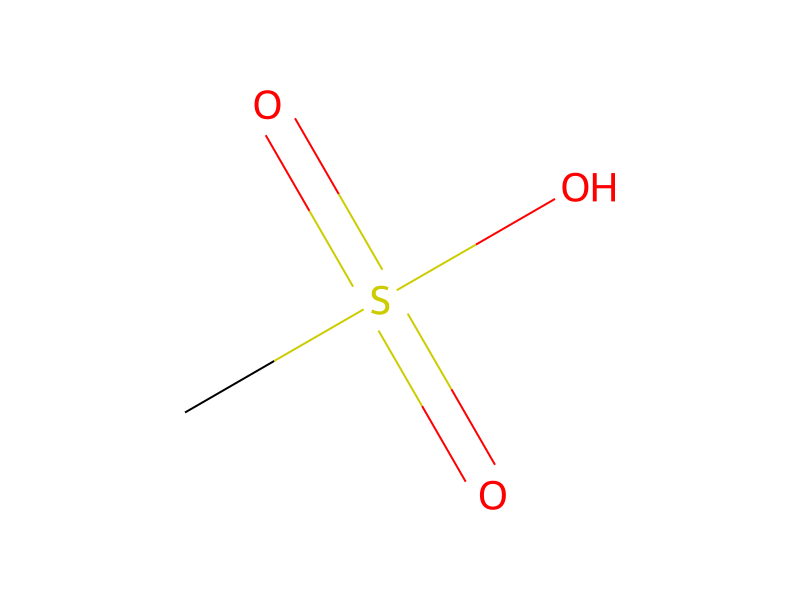
[CH3:1][S:2]([OH:5])(=[O:4])=[O:3].[Cl-].[Cl-].[Cl-].[Cl-].[Zr+4:10].Cl.N#N>C(Cl)(Cl)(Cl)Cl.O>[CH3:1][S:2]([O-:5])(=[O:4])=[O:3].[Zr+4:10].[CH3:1][S:2]([O-:5])(=[O:4])=[O:3].[CH3:1][S:2]([O-:5])(=[O:4])=[O:3].[CH3:1][S:2]([O-:5])(=[O:4])=[O:3]Participants






Procedure
A 1 liter, 3-necked round bottom flask which had been dried was equipped with a condenser, caustic trap, thermometer, and an addition funnel. Under a nitrogen atmosphere, the flask was charged with 250 ml of dry carbon tetrachloride (CCl4), stirring was initiated, and this was followed by 40.0 g (0.42 mole) of anhydrous methanesulfonic acid (MSA) and 4.0 g (0.023 mole) of MSA anhydride (added as a drying agent). Typically, the water content of the reaction solution was found by Karl Fischer analysis to be 16 ppm. Following a satisfactory analysis for water content (i.e., below 25 ppm), 23.3 g (0.1 mole) of zirconium tetrachloride was added dropwise to the solution over 1 hour during which time a white precipitate formed and gaseous HCl evolution was observed. The evolved HCl(g) was swept out of the reaction flask and through a caustic trap with a slow stream of nitrogen. A 50 ml portion of CCl4 was added to lower the viscosity of the mixture, and with N2 (g) flowing, the reaction was stirred for 16 hours at room temperature. Following this, the reaction mixture was heated to 40° C. until no more HCl evolution was observed (normally about three hours). The reaction was cooled to room temperature. The solid product, which precipitated from the reaction solution, was collected by vacuum filtration under nitrogen. The product was washed twice with dry CCl4. The product was split into two portions (portion one was approximately twice the size of portion two). The first portion was washed twice with ether and acetonitrile before removal of the volatiles in-vacuo. After obtaining a constant weight under vacuum, the first portion weighed 21.9 g, while the second portion weighed 11.1 g as is, for a total of 33.0 g, (70% yield). Both lots were analyzed.
Workup
- customA 1 liter, 3-necked round bottom flask which had been dried
- customwas equipped with a condenser, caustic trap
- additionUnder a nitrogen atmosphere, the flask was charged with 250 ml of dry carbon tetrachloride (CCl4)
- additionadded as a drying agent)
- additionwas added dropwise to the solution over 1 hour during which time a white precipitate
- customformed
- stirringthe reaction was stirred for 16 hours at room temperature
- customnormally about three hours
- customThe solid product, which precipitated from the reaction solution
- filtrationwas collected by vacuum filtration under nitrogen
- washThe product was washed twice with dry CCl4
- customThe product was split into two portions (portion one
- washThe first portion was washed twice with ether and acetonitrile before removal of the volatiles in-vacuo
- customAfter obtaining a constant weight under vacuum
Sources & evidence
- ORD record
- ord-d7f4c38cfda141b6b02bcb6b9267606f
- Source dataset
- uspto-grants-1997_03
- Patent number
- US05614650
Reaction notes
Loading…