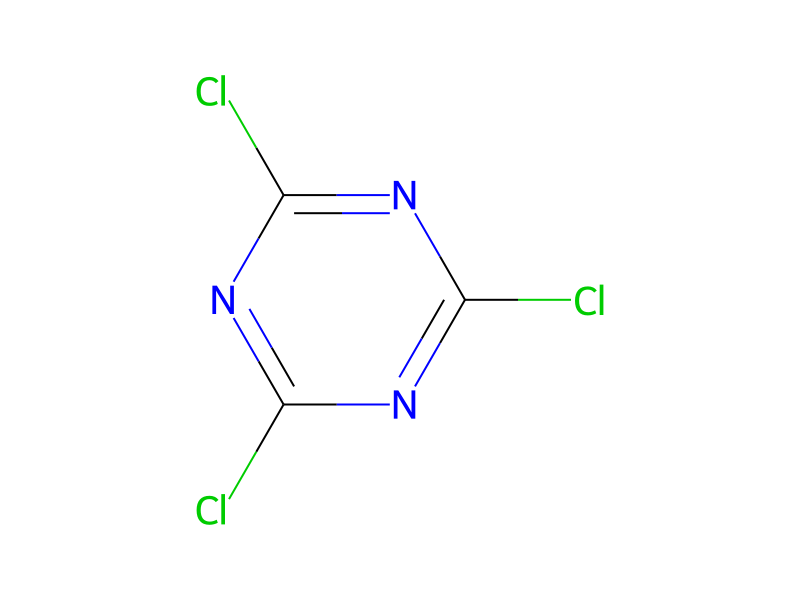
Cyanuric chloride → HCID 15616556, compound
Reaction equation

[N:1]1[C:8]([Cl:9])=[N:7][C:5](Cl)=[N:4][C:2]=1[Cl:3].C(N(C(C)C)CC)(C)C.[C:19]1([C@@H:25]([NH2:27])[CH3:26])[CH:24]=[CH:23][CH:22]=[CH:21][CH:20]=1>C1COCC1>[Cl:9][C:8]1[N:1]=[C:2]([Cl:3])[N:4]=[C:5]([NH:27][C@H:25]([C:19]2[CH:24]=[CH:23][CH:22]=[CH:21][CH:20]=2)[CH3:26])[N:7]=1Participants
Reactant 3


Product 1

Reagents, catalysts & solvents 1

Conditions
- Temperature
- 0 °C
Procedure
To a solution of cyanuric chloride (25.0 g, 0.135 mol), diisopropylethylamine (17.5 g, 0.135 mol) in THF (500 mL) at 0° C. was added dropwise a solution of (1S)-1-phenylethylamine (16.4 g, 0.135 mol) in THF (100 mL) while maintaining the reaction temperature at or near 0° C. The reaction mixture was allowed to warm to ambient temperature then was concentrated under reduced pressure. The residue was dissolved in EtOAc (500 mL) and extracted with 1 N HCl (250 mL), H2O (250 mL) and brine (250 mL). The organic layer was dried over sodium sulfate, filtered and concentrated under reduced pressure to afford the titled compound as a white solid (35 g, 96%) MP 146-147° 1H NMR (CDCl3) δ 7.39 (m, 5H), 6.40 (b d, 1H), 5.25 (m, 1H), 1.59 (d, 3H); MS (ESI+) (M+) 269.1 obs.
Workup
- temperatureto warm to ambient temperature
- concentrationthen was concentrated under reduced pressure
- dissolutionThe residue was dissolved in EtOAc (500 mL)
- extractionextracted with 1 N HCl (250 mL), H2O (250 mL) and brine (250 mL)
- dry with materialThe organic layer was dried over sodium sulfate
- filtrationfiltered
- concentrationconcentrated under reduced pressure
Sources & evidence
- ORD record
- ord-720c1211ed794bd9b9224943434c3181
- Source dataset
- uspto-grants-2003_10
- Patent number
- US06630469B2
Reaction notes
Loading…