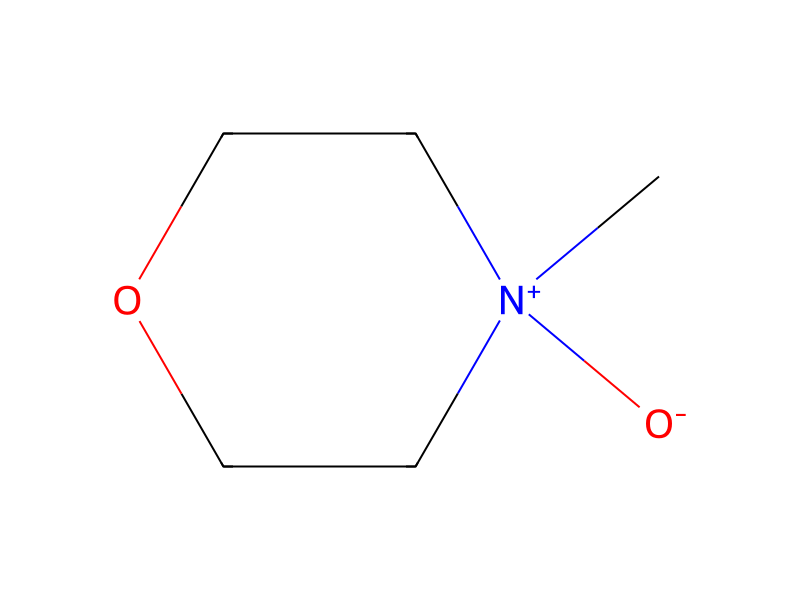
Methyl morpholine oxide → 2'-O-(2-Hydroxyethyl)-3',5'-bis(tert-butyldiphenylsilyl)guanosine
Reaction equation

[CH2:1]([O:4][C@@H:5]1[C@:9]([Si:11]([C:24]([CH3:27])([CH3:26])[CH3:25])([C:18]2[CH:23]=[CH:22][CH:21]=[CH:20][CH:19]=2)[C:12]2[CH:17]=[CH:16][CH:15]=[CH:14][CH:13]=2)([OH:10])[C@@H:8]([CH:28]([Si:30]([C:43]([CH3:46])([CH3:45])[CH3:44])([C:37]2[CH:42]=[CH:41][CH:40]=[CH:39][CH:38]=2)[C:31]2[CH:36]=[CH:35][CH:34]=[CH:33][CH:32]=2)[OH:29])[O:7][C@H:6]1[N:47]1[C:57]2[N:56]=[C:54]([NH2:55])[NH:53][C:51](=[O:52])[C:50]=2[N:49]=[CH:48]1)[CH:2]=C.C[N+]1([O-])CC[O:62]CC1.C([BH3-])#N.[Na+].C(=O)(O)[O-].[Na+]>C(Cl)Cl.[Os](=O)(=O)(=O)=O.CC(C)=O>[OH:62][CH2:2][CH2:1][O:4][C@@H:5]1[C@:9]([Si:11]([C:24]([CH3:27])([CH3:26])[CH3:25])([C:12]2[CH:17]=[CH:16][CH:15]=[CH:14][CH:13]=2)[C:18]2[CH:19]=[CH:20][CH:21]=[CH:22][CH:23]=2)([OH:10])[C@@H:8]([CH:28]([Si:30]([C:43]([CH3:46])([CH3:44])[CH3:45])([C:31]2[CH:36]=[CH:35][CH:34]=[CH:33][CH:32]=2)[C:37]2[CH:42]=[CH:41][CH:40]=[CH:39][CH:38]=2)[OH:29])[O:7][C@H:6]1[N:47]1[C:57]2[N:56]=[C:54]([NH2:55])[NH:53][C:51](=[O:52])[C:50]=2[N:49]=[CH:48]1Participants
Reactant 4



Product 1

Reagents, catalysts & solvents 3



Procedure
Compound 124 (9 g, 11.23 mmol) was dissolved in CH2Cl2 (80 mL). To the clear solution acetone (50 ML), 4-methyl morpholine-N-oxide (1.89 g, 16.17 mmol) was added. The reaction flask was protected from light. Thus 4% aqueous solution of osmium tetroxide was added and the reaction mixture was stirred at room temperature for 6 hr. Reaction volume was concentrated to half and ethyl acetate (50 mL) was added. It was then washed with water (30 mL) and brine (30 mL). Ethyl acetate layer was dried over anhydrous Na2SO4 and evaporated to dryness. Residue was then dissolved in CH2Cl2 and NaIO4 adsorbed on silica (21.17 g, 2 g/mmol) was added and stirred with the reaction mixture for 30 min. The reaction mixture was filtered and silica was washed thoroughly with CH2Cl2. Combined CH2Cl2 layer was evaporated to dryness. Residue was then dissolved in dissolved in 1M pyridinium-p-toluene sulfonate (PPTS) in dry MeOH (99.5 mL) under inert atmosphere. To the clear solution sodium cyanoborohydride (1.14 g, 18.2 mmol) was added and stirred at room temperature for 4 hr. 5% aqueous sodium bicarbonate (50 mL) was added to the reaction mixture slowly and extracted with ethyl acetate (2×50 mL). Ethyl acetate layer was dried over anhydrous Na2SO4 and evaporated to dryness. Residue placed on a flash column and eluted with 10% MeOH in CH2Cl2 to yield 125 (6.46 g, 72% yield). MS (Electrospray−) m/e 802 (M−H⊕)
Workup
- customReaction volume
- concentrationwas concentrated to half and ethyl acetate (50 mL)
- additionwas added
- washIt was then washed with water (30 mL) and brine (30 mL)
- dry with materialEthyl acetate layer was dried over anhydrous Na2SO4
- customevaporated to dryness
- dissolutionResidue was then dissolved in CH2Cl2
- additionwas added
- stirringstirred with the reaction mixture for 30 min
- filtrationThe reaction mixture was filtered
- washsilica was washed thoroughly with CH2Cl2
- customCombined CH2Cl2 layer was evaporated to dryness
- dissolutionResidue was then dissolved
- dissolutionin dissolved in 1M pyridinium-p-toluene sulfonate (PPTS) in dry MeOH (99.5 mL) under inert atmosphere
- stirringstirred at room temperature for 4 hr
- extractionextracted with ethyl acetate (2×50 mL)
- dry with materialEthyl acetate layer was dried over anhydrous Na2SO4
- customevaporated to dryness
- washeluted with 10% MeOH in CH2Cl2
Sources & evidence
- ORD record
- ord-139a9fb177f54f34bbdd3dd7f513e4e9
- Source dataset
- uspto-grants-2003_10
- Patent number
- US06639062B2
Reaction notes
Loading…