Hydrochloric Acid → 2-Methoxy-6-propylnaphthalene
Reaction equation

Br[C:2]1[CH:11]=[CH:10][C:9]2[C:4](=[CH:5][CH:6]=[C:7]([O:12][CH3:13])[CH:8]=2)[CH:3]=1.[CH2:14](Br)[CH2:15][CH3:16].[Mg].Cl>O1CCCC1.C1C=CC(P(C2C=CC=CC=2)CCP(C2C=CC=CC=2)C2C=CC=CC=2)=CC=1.Cl[Ni]Cl.O>[CH3:13][O:12][C:7]1[CH:6]=[CH:5][C:4]2[C:9](=[CH:10][CH:11]=[C:2]([CH2:14][CH2:15][CH3:16])[CH:3]=2)[CH:8]=1Participants
Reactant 4



Product 1

Reagents, catalysts & solvents 3



Procedure
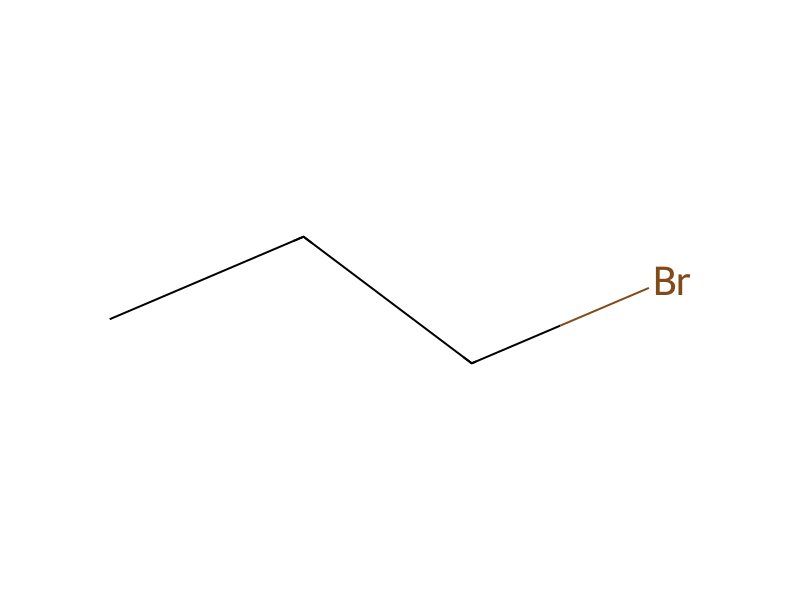
To a solution of 200 g of 2-bromo-6-methoxynaphthalene and 2.5 g of dichloro[1,2-bis(diphenylphosphino)ethane]nickel (II) in 200 ml of tetrahydrofuran (THF) was added dropwise a Grignard reagent prepared from 125 g of propyl bromide and 27 g of magnesium under nitrogen atomsphere. The reaction mixture was further stirred for 1 hour, and then poured into water. To the reaction mixture was then added diluted hydrochloric acid. The resulting organic phase was then separated. The resulting aqueous phase was extracted with toluene. The organic phase and the material thus extracted were together washed sequentially with water, saturated aqueous solution of sodium bicarbonate, water and saturated brine, and then dehydrated and dried over anhydrous sodium sulfate. The solvent was then distilled off to obtain 172 g of 2-methoxy-6-propylnaphthalene.
Workup
- customThe resulting organic phase was then separated
- extractionThe resulting aqueous phase was extracted with toluene
- extractionThe organic phase and the material thus extracted
- washwere together washed sequentially with water, saturated aqueous solution of sodium bicarbonate, water and saturated brine
- dry with materialdried over anhydrous sodium sulfate
- distillationThe solvent was then distilled off
Sources & evidence
- ORD record
- ord-98420df65afb4476ac6d8818898a423d
- Source dataset
- uspto-grants-2002_10
- Patent number
- US06468607B1
Reaction notes
Loading…