Tetrahydrofuran → Butyl ether
Reaction equation

[CH:1]1([CH2:4]Cl)[CH2:3][CH2:2]1.[Mg].[O:7]1[CH2:11][CH2:10][CH2:9][CH2:8]1>C(OCC)C>[CH2:2]([O:7][CH2:8][CH2:9][CH2:10][CH3:11])[CH2:3][CH2:1][CH3:4]Participants
Reactant 3

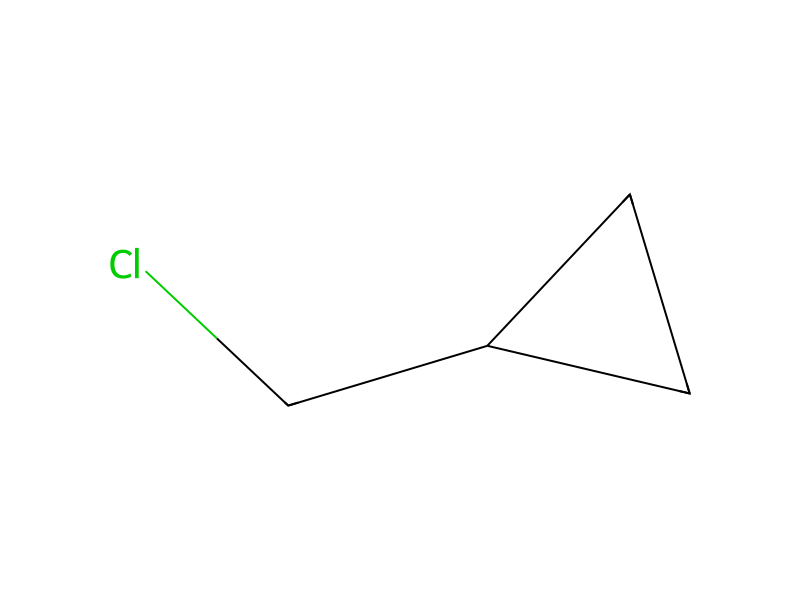

Product 1

Reagents, catalysts & solvents 1

Procedure
In another method, the organosilicon compound catalyst system component (C) is obtained by the reaction of a monocycloalkyltrialkoxysilane (i.e., mono(cyclopropyl)methyl-, mono(cyclobutyl)methyl-, mono(cyclopentyl)methyl-, mono(cyclohexyl)methyl-, mono(cycloheptyl)methyl-trialkoxysilane) with a (cycloalkyl)methyl Grignard reagent. For example, (cyclopropyl)chloromethane is first reacted with magnesium in the presence of a solvent, e.g., an ether such as tetrahydrofuran, diethyl ether, or di-n-butyl ether, to yield a (cyclopropyl)methyl Grignard reagent ((cyclopropyl)methyl magnesium chloride). This reaction may be carried out at a temperature from about room temperature to about 60° C. The (cyclopropyl)methyl Grignard reagent is then reacted with (cyclopropyl)methyl trimethoxysilane to obtain bis{(cyclopropyl)methyl}dimethoxysilane; this reaction may be conducted in the presence of an ether such as tetrahydrofuran, diethyl ether, or di-n-butyl ether, or in the presence of an aliphatic hydrocarbon solvent such as hexane or heptane or an aromatic hydrocarbon solvent such as toluene, benzene, or xylene. This reaction may be carried out at a temperature from about 50° C. to about 200° C., preferably at a temperature from about 100° C. to about 200° C. or at a temperature from about 100° C. to about 200° C. under boiling or refluxing of the solvent.
Sources & evidence
- ORD record
- ord-3b6c40aa28a049499c6406c6c55227d9
- Source dataset
- uspto-grants-2002_10
- Patent number
- US06469112B2
Reaction notes
Loading…