
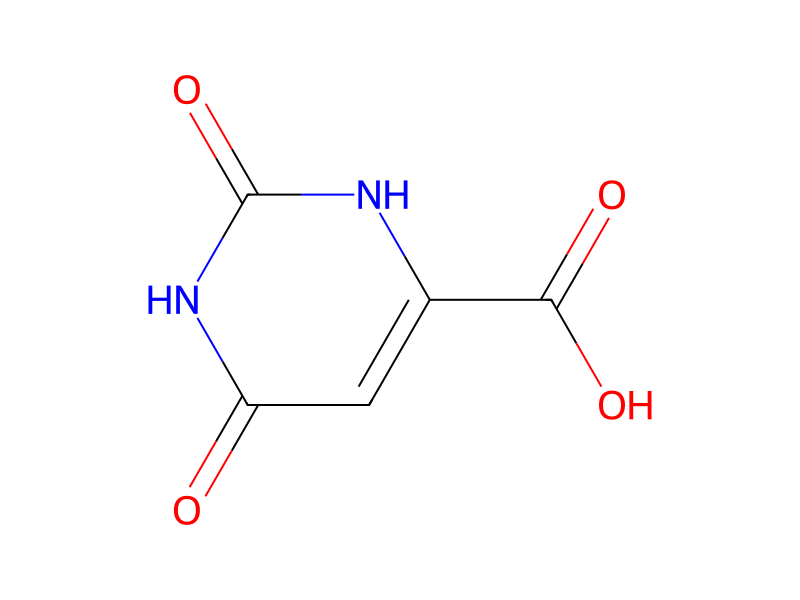
Grundinformationen
- Standard-SMILES
O=C(O)c1cc(=O)[nH]c(=O)[nH]1- InChIKey
PXQPEWDEAKTCGB-UHFFFAOYSA-N- Summenformel
- C5H4N2O4
- Durchschnittliche Molmasse
- 156,1 g/mol
- Monoisotopische Masse
- 156,01710661
Namen und Bezeichner
- Bevorzugter Name
- Orotic Acid
- IUPAC
- 2,4-dioxo-1H-pyrimidine-6-carboxylic acid
- Lokaler Name
- Orotsure
- Englischer Name
- Orotic acid
- Summenformel
- C5H4N2O4
- Molmasse
- 156.1
Namen und Synonyme
Orotic acid65-86-16-CarboxyuracilOropurOrodinOrotylVitamin B13OrotoninWhey factorOrotonsanAnimal galactose factorUracil-6-carboxylic acid
Weitere Namen anzeigen
orotic acid anhydrous2,6-DIOXO-1,2,3,6-TETRAHYDROPYRIMIDINE-4-CARBOXYLIC ACID2,6-DIHYDROXYPYRIMIDINE-4-CARBOXYLIC ACIDoroticOROTIC ACID FREE ACID ANHYDROUS
6-Uracilcarboxylic acidMolkensaeureOrotsaeureAcido oroticoUracil-6-carbosaeureAcide orotique2,6-Dihydroxy-4-pyrimidinecarboxylic acid4-Pyrimidinecarboxylic acid, 1,2,3,6-tetrahydro-2,6-dioxo-
Datenbank-Bezeichner
- CAS
65-86-1- PubChem CID
- 967
- DTXSID
DTXSID0025814- ChEMBL
CHEMBL1235017- ChEBI
CHEBI:16742- UNII
- 61H4T033E5
- EC Number
- 200-619-8
- Nikkaji
- J2.359K
Eigenschaften
Berechnete Struktureigenschaften
- XLogP
- -1,4
- Polarare Oberfläche (TPSA)
- 95,5 Ų
- H-Brücken-Donoren
- 3
- H-Brücken-Akzeptoren
- 4
- Frei drehbare Bindungen
- 1
- Schwere Atome
- 11
- Formalladung
- 0
- Komplexität
- 268
Experimentelle und physikochemische Eigenschaften
LogP
-0.83
log Kow = -0.83
-0.83
LogS-1.93
Color/FormCrystals
Solubility
less than 1 mg/mL at 68 °F (NTP, 1992)
1820
In water, 1,820 mg/L at 25 °C
1.82 mg/mL at 18 °C
DecompositionWhen heated to decomposition it emits toxic fumes of /nitrogen oxides/.
Melting Point
653 to 655 °F (NTP, 1992)
345.5
345-346 °C
345.5 °C
Physical Description
Orotic acid appears as white crystals or crystalline powder. (NTP, 1992)
Solid
Dissociation ConstantspKa1 = 2.07; pKa2 = 9.45
Collision Cross Section
181.87 Ų [M+Na]+ [CCS Type: DT; Method: stepped-field];125.2 Ų [M-H]- [CCS Type: DT; Method: stepped-field];138.85 Ų [M+H]+ [CCS Type: DT; Method: stepped-field]
138 Ų [M+H]+;121.7 Ų [M-H]-;180.7 Ų [M+Na]+
Physikochemische Eigenschaften
- Schmelzpunkt
- 300 °C · ≥300 °C
- Siedepunkt
- 280.29 °C · 280.29°C (rough estimate)
- Dichte
- 1.6814 · 1.6814 (rough estimate)
- Brechungsindex
- 1.48 · 1.4800 (estimate)
- storage temp.
- Sealed in dry,Room Temperature
- Löslichkeit
- 32 mg/mL · DMSO : 32 mg/mL (205.00 mM; Need ultrasonic and warming)
- Aggregatzustand
- Crystalline Powder
- pka
- 1 · pK1:1.8(+1);pK2:9.55(0) (25°C)
- Farbe
- White
- Wasserlöslichkeit
- Slightly soluble
- Merck
- 13 · 13,6942
- BRN
- 383901 · 383901
- Stabilität
- Stable. Incompatible with strong oxidizing agents.
- Kosmetik-Inhaltsstoffe Funktionen
- SKIN CONDITIONING
- InChI
- 1S/C5H4N2O4/c8-3-1-2(4(9)10)6-5(11)7-3/h1H,(H,9,10)(H2,6,7,8,11)
- InChIKey
- PXQPEWDEAKTCGB-UHFFFAOYSA-N
- SMILES
- OC(=O)C1=CC(=O)NC(=O)N1
- LogP
- -0.83 · -0.830
- CAS Datenbank
- 65 · 65-86-1(CAS DataBase Reference)
- NIST chemische Informationen
- Orotic acid(65-86-1)
- EPA chemische Informationen
- Orotic acid (65-86-1)
Sicherheit und Regulatorisches
GHS-Klassifizierung
GHS Classification
This chemical does not meet GHS hazard criteria for 6.7% (4 of 60) of reports.
Warning
H302 (93.3%): Harmful if swallowed [Warning Acute toxicity, oral];H315 (88.3%): Causes skin irritation [Warning Skin corrosion/irritation];H319 (88.3%): Causes serious eye irritation [Warning Serious eye damage/eye irritation];H335 (81.7%): May cause respiratory irritation [Warning Specific target organ toxicity, single exposure; Respiratory tract irritation]
P261, P264, P264+P265, P270, P271, P280, P301+P317, P302+P352, P304+P340, P305+P351+P338, P319, P321, P330, P332+P317, P337+P317, P362+P364, P403+P233, P405, and P501 (click each P-code to see the statement)
Aggregated GHS information provided per 60 reports by companies from 14 notifications to the ECHA C&L Inventory. Each notification may be associated with multiple companies.;Reported as not meeting GHS hazard criteria per 4 of 60 reports by companies.;There are 13 notifications provided by 56 of 60 reports by companies with hazard statement code(s).;Information may vary between notifications depending on impurities, additives, and other factors. The percentage value in parenthesis indicates the notified classification ratio from companies that provide hazard codes. Only hazard codes with percentage values above 10% are shown. For more detailed information, please visit ECHA C&L website.
Gefahrenhinweise
Regulatory Information
Chemical: 4-Pyrimidinecarboxylic acid, 1,2,3,6-tetrahydro-2,6-dioxo-
Directive (EC) No 46/2002
Status: Active Update: 05-11-2018 https://echa.europa.eu/registration-dossier/-/registered-dossier/27509
Other Safety InformationEvaluation - Chemicals that are unlikely to require further regulation to manage risks to environment
Fire HazardsFlash point data for this chemical are not available; however, it is probably combustible. (NTP, 1992)
Health HazardsSYMPTOMS: This compound may cause irritation.;ACUTE/CHRONIC HAZARDS: This compound may cause irritation. When heated to decomposition it may emit toxic fumes of carbon monoxide, carbon dioxide and NOx. (NTP, 1992)
Reactive GroupAcids, Carboxylic;Amides and Imides;Hydrocarbons, Aliphatic Unsaturated
Reactivity Profile
Carboxylic acids, such as OROTIC ACID, donate hydrogen ions if a base is present to accept them. They react in this way with all bases, both organic (for example, the amines) and inorganic. Their reactions with bases, called "neutralizations", are accompanied by the evolution of substantial amounts of heat. Neutralization between an acid and a base produces water plus a salt. Carboxylic acids with six or fewer carbon atoms are freely or moderately soluble in water; those with more than six carbons are slightly soluble in water. Soluble carboxylic acid dissociate to an extent in water to yield hydrogen ions. The pH of solutions of carboxylic acids is therefore less than 7.0. Many insoluble carboxylic acids react rapidly with aqueous solutions containing a chemical base and dissolve as the neutralization generates a soluble salt. Carboxylic acids in aqueous solution and liquid or molten carboxylic acids can react with active metals to form gaseous hydrogen and a metal salt. Such reactions occur in principle for solid carboxylic acids as well, but are slow if the solid acid remains dry. Even "insoluble" carboxylic acids may absorb enough water from the air and dissolve sufficiently in it to corrode or dissolve iron, steel, and aluminum parts and containers. Carboxylic acids, like other acids, react with cyanide salts to generate gaseous hydrogen cyanide. The reaction is slower for dry, solid carboxylic acids. Insoluble carboxylic acids react with solutions of cyanides to cause the release of gaseous hydrogen cyanide. Flammable and/or toxic gases and heat are generated by the reaction of carboxylic acids with diazo compounds, dithiocarbamates, isocyanates, mercaptans, nitrides, and sulfides. Carboxylic acids, especially in aqueous solution, also react with sulfites, nitrites, thiosulfates (to give H2S and SO3), dithionites (SO2), to generate flammable and/or toxic gases and heat. Their reaction with carbonates and bicarbonates generates a harmless gas (carbon dioxide) b
Air and Water ReactionsSlightly soluble in water.
Hazard Classes and Categories
Acute Tox. 4 (93.3%);Skin Irrit. 2 (88.3%);Eye Irrit. 2A (88.3%);STOT SE 3 (81.7%)
Acute toxicity (Oral) - Category 4
Sicherheit und Schutzausrüstung
Fire FightingFires involving this material can be controlled with a dry chemical, carbon dioxide or Halon extinguisher. (NTP, 1992)
First Aid
EYES: First check the victim for contact lenses and remove if present. Flush victim's eyes with water or normal saline solution for 20 to 30 minutes while simultaneously calling a hospital or poison control center. Do not put any ointments, oils, or medication in the victim's eyes without specific instructions from a physician. IMMEDIATELY transport the victim after flushing eyes to a hospital even if no symptoms (such as redness or irritation) develop.;SKIN: IMMEDIATELY flood affected skin with water while removing and isolating all contaminated clothing. Gently wash all affected skin areas thoroughly with soap and water. If symptoms such as redness or irritation develop, IMMEDIATELY call a physician and be prepared to transport the victim to a hospital for treatment.;INHALATION: IMMEDIATELY leave the contaminated area; take deep breaths of fresh air. If symptoms (such as wheezing, coughing, shortness of breath, or burning in the mouth, throat, or chest) develop, call a physician and be prepared to transport the victim to a hospital. Provide proper respiratory protection to rescuers entering an unknown atmosphere. Whenever possible, Self-Contained Breathing Apparatus (SCBA) should be used; if not available, use a level of protection greater than or equal to that advised under Protective Clothing.;INGESTION: DO NOT INDUCE VOMITING. If the victim is conscious and not convulsing, give 1 or 2 glasses of water to dilute the chemical and IMMEDIATELY call a hospital or poison control center. Be prepared to transport the victim to a hospital if advised by a physician. If the victim is convulsing or unconscious, do not give anything by mouth, ensure that the victim's airway is open and lay the victim on his/her side with the head lower than the body. DO NOT INDUCE VOMITING. IMMEDIATELY transport the victim to a hospital. (NTP, 1992)
Nonfire Spill Response
SMALL SPILLS AND LEAKAGE: If you spill this chemical, you should dampen the solid spill material with water, then transfer the dampened material to a suitable container. Use absorbent paper dampened with water to pick up any remaining material. Seal your contaminated clothing and the absorbent paper in a vapor-tight plastic bag for eventual disposal. Wash all contaminated surfaces with a soap and water solution. Do not reenter the contaminated area until the Safety Officer (or other responsible person) has verified that the area has been properly cleaned.;STORAGE PRECAUTIONS: You should store this chemical at ambient temperatures, and keep it away from oxidizing materials. (NTP, 1992)
Disposal Methods
SRP: The most favorable course of action is to use an alternative chemical product with less inherent propensity for occupational exposure or environmental contamination. Recycle any unused portion of the material for its approved use or return it to the manufacturer or supplier. Ultimate disposal of the chemical must consider: the material's impact on air quality; potential migration in soil or water; effects on animal, aquatic, and plant life; and conformance with environmental and public health regulations.
Personal Protective Equipment (PPE)
RECOMMENDED RESPIRATOR: Where the neat test chemical is weighed and diluted, wear a NIOSH-approved half face respirator equipped with an organic vapor/acid gas cartridge (specific for organic vapors, HCl, acid gas and SO2) with a dust/mist filter. (NTP, 1992)
Toxikologische Informationen
Interactions
In rats treated with phenobarbital for 3 days and simultaneously fed a semisynthetic diet containing 1.0% orotic acid, the extent of the increases in liver microsomal phosphatidylcholine, phosphatidylethanolamine, total RNA, total protein, and cytochrome P-450 were significantly greater than they were in rats treated identically with phenobarbital but without dietary orotic acid. This is attributed primarily to the stimulation of hepatic phosphatidylcholine synthesis by dietary orotic acid. In the absence of phenobarbital, orotic acid was shown to cause some increase in liver smooth endoplasmic reticulum components, but not cytochrome P-450. Orotic acid also decreased the activity of microsomal phosphatidylethanolamine N-methyltransferase, which may have contributed to the increase in the microsomal content of phosphatidylethanolamine. The hypothesis is advanced that phospholipid availability is a limiting factor in the hepatic response to phenobarbital. When more phospholipid is available to provide the structural framework for biogenesis of endoplasmic reticulum, all of the hepatic actions of phenobarbital, including induction of cytochrome P-450, are amplified.
Health EffectsChronically high levels of orotic acid are associated with at least 4 inborn errors of metabolism including: Argininemia, Citrullinemia Type I, Purine nucleoside phosphorylase deficiency and Orotic Aciduria.
Environmental Fate
TERRESTRIAL FATE: Based on a classification scheme(1), an estimated Koc value of 10(SRC), determined from a log Kow of -0.83(2) and a regression-derived equation(3), indicates that orotic acid is expected to have very high mobility in soil(SRC). Volatilization from moist soil surfaces is not an important environmental fate process because orotic acid will exist in ionized form, based on pKa values of 2.07 and 9.45(4), and ionized species do not volatilize(SRC). Volatilization from dry soil surfaces is not expected to occur based on an estimated vapor pressure of 1X10⁻⁸ mm Hg determined from a fragment constant method(5). Biodegradation data were not available(SRC, 2005).
AQUATIC FATE: Based on a classification scheme(1), an estimated Koc value of 10(SRC), determined from a log Kow of -0.83(2) and a regression derived equation(3), indicates that orotic acid is not expected to adsorb to suspended solids and sediment(SRC). Volatilization from water surfaces is not an important environmental fate process because orotic acid will exist in ionized form based on pKa values of 2.07 and 9.45(4), and ionized species do not volatilize(SRC). According to a classification scheme(5), an estimated BCF of 3(SRC), from its log Kow(2) and a regression-derived equation(6), suggests the potential for bioconcentration in aquatic organisms is low(SRC). Orotic acid may undergo direct photolysis in sunlit surface waters since it absorbs light greater than 290 nm(7), but the rate of this reaction is not known(SRC). Biodegradation data were not available(SRC, 2005).
ATMOSPHERIC FATE: According to a model of gas/particle partitioning of semivolatile organic compounds in the atmosphere(1), orotic acid, which has an estimated vapor pressure of 1X10⁻⁸ mm Hg at 25 °C(2), is expected to exist in the particulate phase in the ambient atmosphere. Particulate-phase orotic acid may be removed from the air by wet and dry deposition(SRC). Orotic acid may undergo direct photolysis in the environment since it absorbs light greater than 290 nm(3); however, the rate of this reaction is unknown(SRC).
Soil Adsorption/Mobility
The Koc of orotic acid is estimated as 10(SRC), using a log Kow of -0.83(1) and a regression-derived equation(2). According to a classification scheme(2), this estimated Koc value suggests that orotic acid is expected to have high mobility in soil(SRC).
Natural Pollution SourcesOrotic acid occurs in cow's milk and has also been isolated from certain strains of molds (Neurospora).
Artificial Pollution Sources
Orotic acid's production and use in biochemical research, particularly in the synthesis of nucleic acids(1) and its proposed use as a feed supplement for calves(2), may result in its release to the environment through various waste streams(SRC).
Carcinogen ClassificationNo indication of carcinogenicity to humans (not listed by IARC).
Environmental Bioconcentration
An estimated BCF of 3 was calculated for orotic acid(SRC), using a log Kow of -0.83(1) and a regression-derived equation(2). According to a classification scheme(3), this BCF suggests the potential for bioconcentration in aquatic organisms is low(SRC).
Volatilization from Water/Soil
pKa values of 2.07 and 9.45(1), indicate that orotic acid will exist in various ionized forms at pH range 5-9 in water and moist soil surfaces. Volatilization from water and moist soil surfaces will not be an important environmental fate process since ionized species do not volatilize(SRC). Volatilization from dry soil surfaces is not expected to occur based on an estimated vapor pressure of 1X10⁻⁸ mm Hg determined from a fragment constant method(2).
Non-Human Toxicity Excerpts
/LABORATORY ANIMALS: Chronic Exposure or Carcinogenicity/ Male Fischer 344 rats initiated with 1,2-dimethylhydrazine 2HCl (100 mg/kg) given 18 hr after partial hepatectomy and exposed to a diet containing 1% orotic acid for 13 months developed a 100% incidence of hepatocellular carcinoma. The creation of nucleotide pool imbalances by dietary orotic acid, for e.g., an increase in uridine nucleotides and a decrease in adenine nucleotides, was considered as a possible mechanism for the promotional effect of orotic acid on liver carcinogenesis. The significance of this hypothesis is that altered nucleotide pools affect both genomic as well as membrane organization. Consistent with this hypothesis is our finding that feeding rats with a diet containing 1% orotic acid for 10 weeks resulted in a liver DNA damage as monitored by its slower sedimentation in alkaline sucrose gradients compared to the corresponding controls. To assess the general applicability of this hypothesis, nucleotide pool imbalances were created by using methods other than feeding orotic acid and their effect on the incidence of gamma-glutamyltransferase positive foci in carcinogen initiated rats was determined. The results obtained indicated that rats initiated with 1,2-dimethylhydrazine.2HCl (100 mg/kg) given 18 hr after partial hepatectomy and exposed to diet deficient in arginine, a regimen that causes an increased synthesis and excretion of orotic acid, or were fed diets containing 1% thymidine or 1% thymine developed greater number of gamma-glutamyltransferase positive foci compared to the corresponding controls fed the basal diets.
/LABORATORY ANIMALS: Subchronic or Prechronic Exposure/ ... The present study was undertaken to evaluate hepatic cytochrome P-450 (CYP) function in a rat model of microvesicular steatosis produced by the intake of diets containing 1% orotic acid (OA) that were administered for 5, 10, or 21 days. Hepatic triglyceride levels were increased to 3-fold of control after 5 days and were elevated further at 10 and 21 days. Cholesterol and phospholipid contents were increased after 10 and 21 days but not by 5 days of feeding. Microsomal androst-4-ene-3,17-dione hydroxylation activities mediated by CYP2C11 (16alpha-hydroxylation) and CYP3A2 (6beta-hydroxylation) were decreased in liver from OA-fed rats for only 5 days, whereas CYP2A1/2-mediated steroid 7alpha-hydroxylation was decreased after 10 days; these observations were complemented by immunoblot analysis that demonstrated the impaired expression of the corresponding CYP proteins. CYP2C11 mRNA, the major CYP in male rat liver, was down-regulated in steatotic liver to 52 +/- 4% of control. Thus, microvesicular steatosis induced by short-term intake of OA-containing diets is histologically similar to that produced by hepatotoxic drugs and produces the rapid down-regulation of constitutive CYPs in rat liver.
/LABORATORY ANIMALS: Subchronic or Prechronic Exposure/ To evaluate orotic acid (OA) as a possible etiologic factor in cats with idiopathic hepatic lipidosis (HL). 20 clinically normal adult female cats. Cats were fed a control diet or a diet containing less protein. On day 1 of the control period, blood, urine, and liver biopsy specimens were obtained. Each cat was given an oral dose of water daily. On days 8, 15, and 22, blood and urine specimens were collected as on day 1. On day 29, liver, blood, and urine samples were obtained as on day 1. After a resting period of 30 to 60 days, cats were treated with orotic acid. Serum biochemical analyses, urinary OA-to-creatinine ratios, and liver biopsy specimens were evaluated. Cats were given OA orally (suspension or capsules) for 29 days. Sample collection and data obtained were identical to those described for the control period. Urinary OA-to-creatinine ratios were significantly higher in all treated cats, but ratios were significantly higher in those receiving OA in capsules than in those receiving OA in suspension. Diet or treatment did not alter hepatic biochemical or histologic variables significantly. However, 7 cats given the highest dose of OA in capsules developed azotemia, urolithiasis, and renal changes. Most concentrations of OA used in this study did not induce HL in cats during a 29-day period, but the highest dosage used did result in renal disease.
/LABORATORY ANIMALS: Chronic Exposure or Carcinogenicity/ The effect of dietary orotic acid (OA) in liver-pancreas carcinogenesis induced in female Syrian hamsters by N-Nitroso(2-hydroxypropyl) (2-oxopropyl)amine (HPOP) was evaluated. All animals infused with the carcinogen received the same doses. Results of the control group which received no OA or carcinogen were compared with the results of: (a) hamsters treated with HPOP and fed a regular 20% protein synthetic diet (group 1); (b) hamsters fed the OA diet for a brief time period during initiation with the carcinogen (group 2); and (c) hamsters in which OA was administered after carcinogen infusion for life (group 3). All animals of the control group were normal at autopsy, while those in group 1 (HPOP alone) revealed the spectrum of lesions accepted as classical in the multistep hyperplasia-dysplasia-carcinoma in situ (CIS) sequence of carcinogenesis. Results of group 2, in light of group 1, revealed an increased incidence of the following lesions in the common pancreatic duct: dilatation, 2.5 times; flat and papillary hyperplasia, 2 times; and dysplasia (atypical hyperplasia), 12 times. No significant increase of CIS and invasive cancer in the body and tail of the pancreas was observed; in addition, the incidence, nature, and location of pancreatic adenocarcinomas were not affected. Yet, the effect of OA administered after carcinogen infusion (group 3) when compared to group 1 seemed to enhance a further increase in the incidence of practically all lesions throughout the pancreas. An obvious overall step-up incidence along the multistep hyperplasia-dysplasia-CIS-invasive cancer process in the pancreas was observed. The increase in incidence of flat, papillary, and atypia of the epithelium of the common pancreatic duct in group 3 was mild compared to that found in the same duct of group 2, but the increase in incidence of these same three lesions when found in the main ducts was marked: flat hyperplasia, 3-fold;
For more Non-Human Toxicity Excerpts (Complete) data for OROTIC ACID (15 total), please visit the HSDB record page.
Environmental Abiotic Degradation
Orotic acid may undergo direct photolysis in the environment since it absorbs light greater than 290 nm(1); however, the rate of photolysis is unknown(SRC). pKa values of 2.07 and 9.45(2), indicate that orotic acid will exist in ionized form in water(SRC).
Probable Routes of Human ExposureOccupational exposure to orotic acid may occur through inhalation and dermal contact with this compound at workplaces where orotic acid is produced or used. (SRC)
Regulatorische Informationen
Regulatory Information
Chemical: 4-Pyrimidinecarboxylic acid, 1,2,3,6-tetrahydro-2,6-dioxo-
Directive (EC) No 46/2002
Status: Active Update: 05-11-2018 https://echa.europa.eu/registration-dossier/-/registered-dossier/27509
Sicherheitsdaten
- F
- 10-21
- wgk
- 3
- tsca
- TSCA listed
- hs_code
- 29335990
- RTECS-Nr.
- RM3180000
- risk_code
- 22-36/37/38
- Toxizität
- pic-esc 1 g/L ZAPOAK12,583,72
- hazard_code
- Xn,Xi
- hazard_note
- Harmful
- safety_code
- 26-36/37/39-22-37/39
- Speicherklasse
- 11 - Combustible Solids
- Giftige Stoffe Daten
- 65-86-1(Hazardous Substances Data)
- Hazard Classifications
- Acute Tox. 4 OralEye Irrit. 2Skin Irrit. 2STOT SE 3
Chemie und Industrie
Pharmakologische Informationen
Metabolism/Metabolites
... The aim of this work was to investigate whether orotate is differently metabolized in gut and in liver thus explaining the lack of effect on the intestinal lipoproteins secretion. Multienzyme complex (complex U) was found in appreciable amounts in rat, mouse and rabbit livers; the intestinal mucosa of the two last species contains a much lower level of multienzyme complex whereas in rat intestine its activity cannot be detected. Indeed, radioactive aspartate and orotate were not incorporated into intestinal cells RNA. The absence of orotate metabolisation by lack of orotate phosphoribosyltransferase and orotidine 5'-phosphate decarboxylase activity in rat intestine would explain why this organ, in contrast to the liver, is protected against disturbances of nucleotide metabolism and lipoproteins secretion induced by orotic-acid-supplemented diets.
Absorption, Distribution and Excretion
[14C]Orotic acid was rapidly distributed in blood after both i.p. and s.c. injection but was not completely absorbed from the peritoneal cavity until 20 min after injection. S.c. injection should be an acceptable alternative to i.p. injection although the incorporation into the liver acid soluble- and RNA-fractions was somewhat delayed after the s.c. injection.
Tissue LocationsLiver;Pancreas;Placenta
Cellular LocationsCytoplasm
Metabolite PathwaysBeta Ureidopropionase Deficiency;Dihydropyrimidinase Deficiency;MNGIE (Mitochondrial Neurogastrointestinal Encephalopathy);Pyrimidine metabolism;UMP Synthase Deficiency (Orotic Aciduria)
Verwendung und Herstellung
Uses
Biochemical research, especially the biosynthesis of nucleic acids.
Has been proposed as feed supplement in combination with methionine to aid growth of calves.
This is an endogenously produced metabolite found in the human body. It is used in metabolic reactions, catabolic reactions or waste generation.
Methods of Manufacturing
Preparation by condensation of urea with monoethyl ester of oxalacetic acid in methanol: US Patent 2937175 (1963 to Kyowa)
Synthesized from aspartic acid.
Prepn by condensation of urea with monoethyl ester of oxalacetic acid in methanol: Scriabine, US 2937175
The oldest known method for synthesizing orotic acid is the condensation of urea with diethyl oxalacetate and subsequent alkaline hydrolysis of the reaction product. Free orotic acid is obtained from the alkali salt by treatment with mineral acid. A newer synthesis starts by condensing chloroacetoacetyl chlorine, obtained from diketene and chlorine, with urea to give 6-chloromethyluracil. Oxidation of the latter with hydrogen peroxide in an alkaline medium yields orotic acid. In another method, hydantoin or hydantonitrile is treated with glycolic acid in an alkaline medium to give carboxymethylene hydantoin, which rearranges to form orotic acid. Orotic acid is also produced in fermentation by using microorganisms such as Corynebacterium, Brevibacterium.
General Manufacturing Information
4-Pyrimidinecarboxylic acid, 1,2,3,6-tetrahydro-2,6-dioxo-: ACTIVE
Classified as a vitamin (vitamin B13)
Anwendungen
VerwendenOrotic acid is an intermediate in de novo pyrimidine biosynthesis that may be used to study the specificity and kinetics of orotate phosphoribosyltransferase (OPRT) which catalyzes the reversible phosphoribosyl transfer from 5-phospho-α-d-ribose 1-diphosphate (PRPP) to orotic acid (OA), forming pyrophosphate and orotidine 5-monophosphate (OMP). It is used as a starting material for the potential commercial bioproduction of uridine 5-monophosphate (UMP) by microbes such as Corynebacterium ammoniagenes (ATCC 6872) or Saccharomyces cerevisiae. It may be used to study the AMPK/SREBP-1 dependent cell signaling pathway and transcription regulation mechanisms that induce hepatic lipogenesis.
Vor- und nachgelagerte Produkte
Vorgelagerte Rohstoffe
Nachgelagerte Produkte
Anbieter50 Anbieter
国药集团化学试剂有限公司86-21-63210123 · [email protected]
上海阿拉丁生化科技股份有限公司400-6206333 13167063860 · [email protected]
甘肃省百事兴药业有限公司15008395229 15008395229 · [email protected]
T&W GROUP021-61551611 13296011611 · [email protected]
上海如吉生物科技发展有限公司+86-21-65211385-8001 36031160 · [email protected]
韶远科技(上海)有限公司021-50795510 4000665055 · [email protected]
科瑞迪化学400-821-5857 021-64326257 · [email protected]
上海将来实业股份有限公司400-0066400 13621662912 · [email protected]
Syntechem Co.,Ltd[email protected]
大连美仑生物技术有限公司0411-62910999 13889544652 · [email protected]
阿法埃莎(中国)化学有限公司400-6106006 · [email protected]
安耐吉化学&3A(安徽泽升科技股份有限公司)400-0056266 · [email protected]
重庆张邦医药科技有限责任公司028-84252981 18583719936 · [email protected]
上海瀚鸿科技股份有限公司021-54306202 13764082696 · [email protected]
MedChemexpress LLC021-58955995 · [email protected]
合肥天健化工有限公司551-65418679 15856988503;15837135945 · [email protected]
杭州东帆化学有限公司86-0571-85151182
孝感深远化工有限公司15527621225; 15527621225 · [email protected]
山东西亚化学有限公司13355009207 13355009207 · [email protected]
玛雅试剂+86 (573) 82222445 (0)18006601000 452520369 · [email protected]
四川库利南科技有限公司400-1166-196 18981987031 · [email protected]
天津希恩思生化科技有限公司400 638 7771 · [email protected]
湖南汇百侍生物科技有限公司0731-85526065 13308475853 · [email protected]
斯百全化学(上海)有限公司021-021-021-67601398-809-809-809 15221380277 · [email protected]
上海源叶生物科技有限公司13636370518 · [email protected]
艾科试剂4008-755-333 18080918076 · [email protected]
上海思域化工科技有限公司86-21-34053660 · [email protected]
赛默飞世尔科技(中国)有限公司800-810-5118 · [email protected]
AdooQ BioScience, LLC+1 (866) 930-6790 · [email protected]
上海遐瑞医药科技有限公司+86 21 61551611
卡迪亚医药科技有限公司0371-86615086 18203638366 0371-86159066 13526786601
烟台傲嘉生物技术有限公司+86 13853510897 · [email protected]
潍坊沃腾进出口有限公司0536-2456718
越林试剂021-62960152 · [email protected]
无锡中坤生化科技有限公司+86 0510-85629785
湖北省圣宝莱生物科技有限公司027-59105235 13007105135 · [email protected]
上海将来实业股份有限公司400-0066400 13621662912 · [email protected]
上海将来实业股份有限公司021-61552785 · [email protected]
HBCChem, Inc.+1-510-219-6317 · [email protected]
上海笛柏生物科技有限公司400-008-9730,021-54359730 400-008-9730 · [email protected]
成都零六生物科技有限公司400-1166-196 13458535857 · [email protected]
雷丁试剂0510-85629785 18013409632 · [email protected]
郑州萃智医药科技有限公司19943855286 · [email protected]
上海嵩爰化工科技有限公司010-1234567 18521000990 · [email protected]
上海有朋化工有限公司021-69005955 13701776567 · [email protected]
北京海力扬化学科技有限公司13718199399 · [email protected]
北京欣赛维化学科技有限公司010-56218822 13717722232 · [email protected]
四川海诺威科技有限公司13708085536 13708085536 · [email protected]
南京百鑫德诺生物科技有限公司025-58849295 · [email protected]
上海凯赛化工有限公司021-33516722 13701817765 · [email protected]
Ergänzende Hinweise
DefinitionChEBI: A pyrimidinemonocarboxylic acid that is uracil bearing a carboxy substituent at position C-6.
Zugehörige Reaktionen
25


Verknüpfte Notizen
Wird geladen…