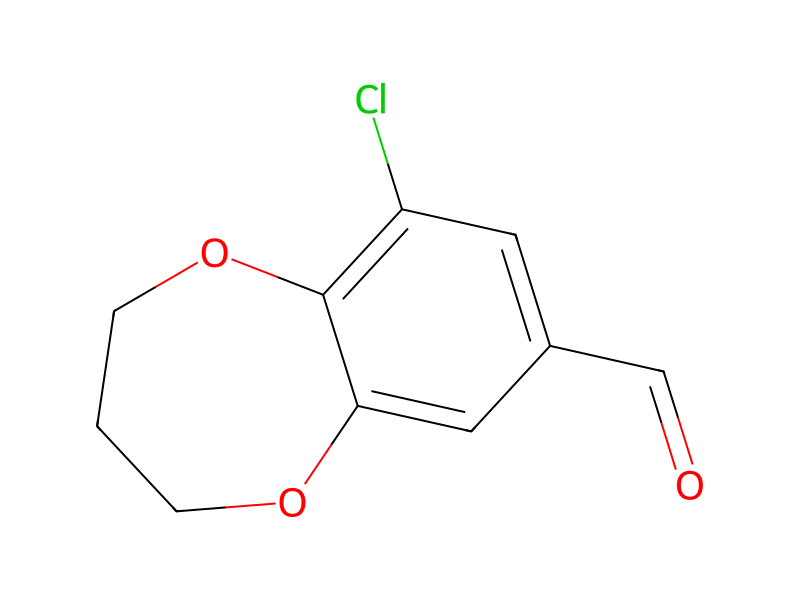
[Cl:1][C:2]1[C:7]2[O:8][CH2:9][CH2:10][CH2:11][O:12][C:6]=2[CH:5]=[C:4]([CH:13]=O)[CH:3]=1.[CH2:15]([NH2:19])[CH:16]([CH3:18])[CH3:17].C(O)(=O)C.C(O[BH-](OC(=O)C)OC(=O)C)(=O)C.[Na+]>ClCCCl>[Cl:1][C:2]1[C:7]2[O:8][CH2:9][CH2:10][CH2:11][O:12][C:6]=2[CH:5]=[C:4]([CH2:13][NH:19][CH2:15][CH:16]([CH3:18])[CH3:17])[CH:3]=1To an ice cold mixture of 9-chloro-3,4-dihydro-2H-1,5-benzodioxepine-7-carbaldehyde (2.07 g) and of isobutylamine (7.5 ml 8 eq.) were combined in 1,2-dichloroethane (75 ml) and cooled in ice water bath. Acetic acid (5.68 ml) was then added and followed by sodium triacetoxyborohydride (2.75 g, 1.4 eq.). The mixture was allowed to stir at room temperature overnight. It was partitioned with aqueous K2CO3 (75 mL, 1.5M). The aqueous layer was extracted with of dichloromethane (75 ml×2). The organic layers were combined, washed with brine, dried over sodium sulfate, and concentrated. The residue was purified by flash column chromatography (10-100% ethyl acetate in hexanes) gave the desired amine as a light yellow oil: MS (m+1)=270.2.