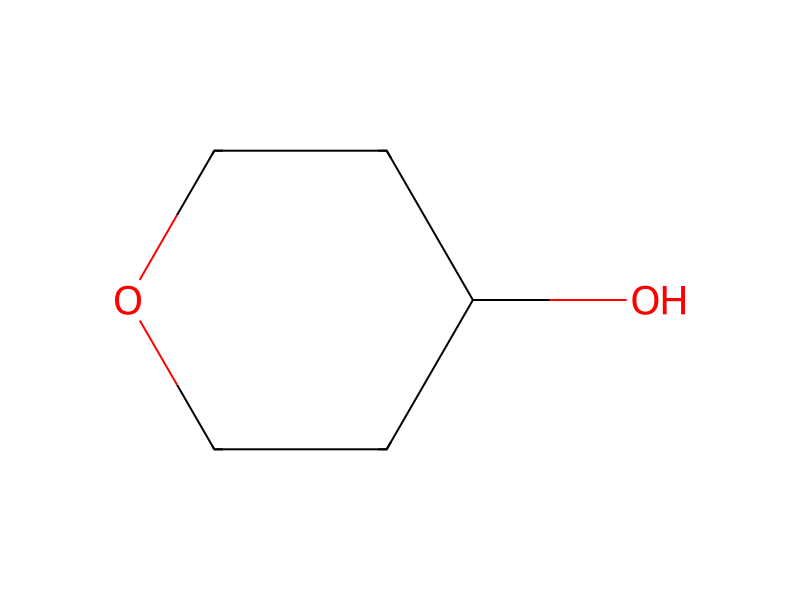
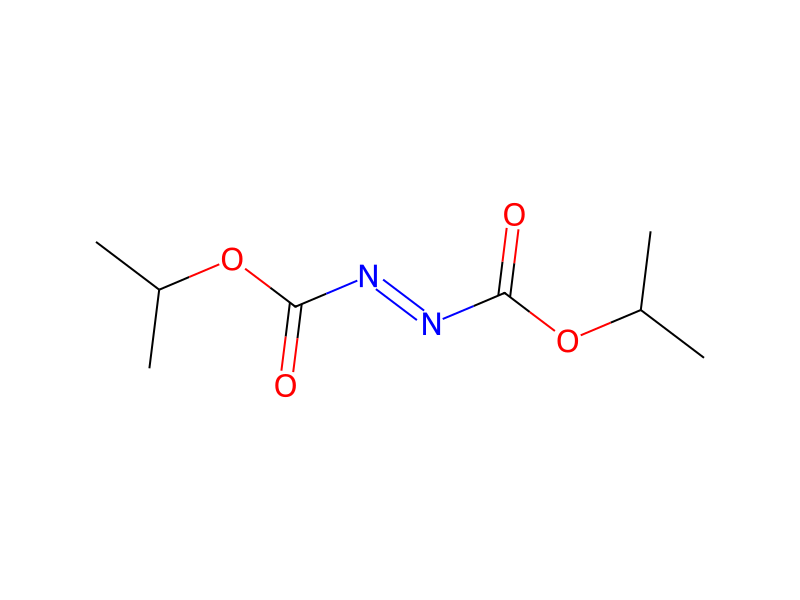
[Cl:1][C:2]1[CH:3]=[C:4]([OH:13])[C:5]([CH3:12])=[C:6]([CH:11]=1)[C:7]([O:9][CH3:10])=[O:8].[O:14]1[CH2:19][CH2:18][CH:17](O)[CH2:16][CH2:15]1.C1(P(C2C=CC=CC=2)C2C=CC=CC=2)C=CC=CC=1.CC(OC(/N=N/C(OC(C)C)=O)=O)C>O1CCCC1>[Cl:1][C:2]1[CH:3]=[C:4]([O:13][CH:17]2[CH2:18][CH2:19][O:14][CH2:15][CH2:16]2)[C:5]([CH3:12])=[C:6]([CH:11]=1)[C:7]([O:9][CH3:10])=[O:8]A 100 mL round bottom flask was charged with methyl 5-chloro-3-hydroxy-2-methylbenzoate (500 mg, 2.492 mmol), tetrahydro-2H-pyran-4-ol (318 mg, 3.12 mmol), triphenylphosphine (1307 mg, 4.98 mmol) and tetrahydrofuran (20 mL). The reaction was maintained for 15 min, at which time DIAD (1.454 mL, 7.48 mmol) was added in one portion. The resulting solution was heated at 55° C. for 24 h and then concentrated in vacuo. Purification of the residue by column chromatography (10-50% EtOAc/hexanes) gave methyl 5-chloro-2-methyl-3-((tetrahydro-2H-pyran-4-yl)oxy)benzoate as an orange-oil, which was used directly in the next step. 1H NMR (400 MHz, CHLOROFORM-d) δ 7.42 (d, J=2.02 Hz, 1H), 6.98 (d, J=2.02 Hz, 1H), 4.51 (tt, J=3.73, 7.39 Hz, 1H), 3.99 (ddd, J=3.66, 7.01, 11.31Hz, 2H), 3.91 (s, 3H), 3.64 (ddd, J=3.28, 7.77, 11.43 Hz, 2H), 2.38-2.45 (m, 3H), 1.99-2.10 (m, 2H), 1.74-1.92 (m, 2H). MS(ES) [M+H]+ 285.0
Loading…