HomeMCPWorkbenchSkills
HomeWorkbenchNotificationsMe
llms.txt · MCP GuidePrivacy Policy · Terms of Service · Supportv1.8.3
  1. Home
  2. /Reaction

Hydrogen Peroxide → 5,5-Dioxo-2-(3-methyl-3-pyridin-4-ylpropionamido)dibenzothiophene

HRID 1064006
Print

Reaction equation

HRID 1064006 reaction equation
CCN=C=NCCCN(C)C.[NH2:12][C:13]1[CH:25]=[CH:24][C:16]2S[C:18]3[CH:23]=[CH:22][CH:21]=[CH:20][C:19]=3[C:15]=2[CH:14]=1.ON1C2C=CC=CC=2N=N1.[CH3:36][CH:37]([C:42]1[CH:47]=[CH:46][N:45]=[CH:44][CH:43]=1)[CH2:38][C:39]([OH:41])=O.OO.C(=O)([O-])[O-].[K+].[K+].[S:56](=[O:60])(=O)(O)[OH:57]>CN(C=O)C.C(O)(=O)C.O>[O:57]=[S:56]1(=[O:60])[C:20]2[CH:21]=[CH:22][CH:23]=[CH:18][C:19]=2[C:15]2[CH:14]=[C:13]([NH:12][C:39](=[O:41])[CH2:38][CH:37]([CH3:36])[C:42]3[CH:47]=[CH:46][N:45]=[CH:44][CH:43]=3)[CH:25]=[CH:24][C:16]1=2
ParticipantsProcedureWorkupSources & evidenceReaction notes

Participants

11

Reactant 7

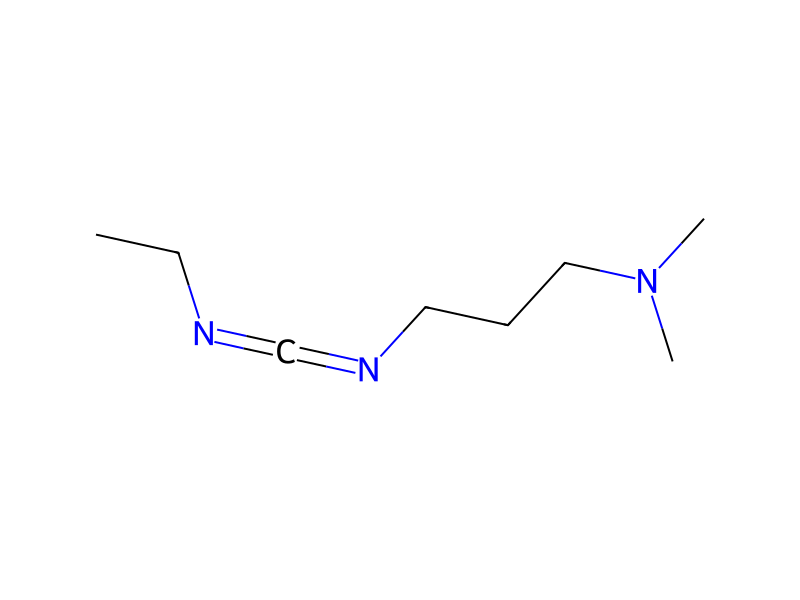
HCID 784Hydrogen PeroxideHCID 1118Sulfuric AcidHCID 11430Potassium CarbonateHCID 159081-Ethyl-3-(3'-dimethylaminopropyl)carbodiimideHCID 757711-HydroxybenzotriazoleHCID 2984422-DibenzothiophenamineHCID 5185904
3-(Pyridin-4-yl)butanoic acid

Product 1

HCID 222778265,5-Dioxo-2-(3-methyl-3-pyridin-4-ylpropionamido)dibenzothiophene

Reagents, catalysts & solvents 3

HCID 176Acetic AcidSolventHCID 962WaterSolventHCID 6228DimethylformamideSolvent

Procedure

EDAC (0.500 g, 2.6 mmol) was added to a solution of 2-aminodibenzothiophene (0.470 g, 2.4 mmol), 1-hydroxybenzotriazole (0.351 g, 2.6 mmol) and 3-methyl-3-pyridin-4-ylpropanoic acid (Method 7; 0.429 g, 2.6 mmol) in DMF (10 ml). The solution was then stirred at room temperature overnight. The solvent was removed in vacuo and the residue was then shaken in water (50 ml) and DCM (50 ml). The organic layer was separated, washed with brine (50 ml), dried and then evaporated in vacuo to leave a light brown solid. The crude amide was dissolved in a mixture of glacial acetic acid (15 ml) and concentrated sulphuric acid (0.5 ml) at 60° C. and hydrogen peroxide (30 wt. % solution in water, 3 ml) was added. The mixture was stirred at 60° C. for 2 hours and left to cool to room temperature overnight. The mixture was poured into water (50 ml) and made basic by the addition of potassium carbonate. The mixture was extracted into DCM (50 ml), the organic layer was separated and washed with brine (50 ml), dried and evaporated in vacuo to leave a light brown solid. The crude product was triturated with methanol (10 ml) to leave a pale yellow solid (0.496 g). NMR: 10.47 (s, 1H), 8.3 (d, 1H), 7.9 (m, 3H), 7.75 (t, 1H), 7.65 (m, 2H), 3.3 (m, 1H), 2.7 (m, 2H), 1.3 (d, 3H); m/z 379.

Workup

  1. customThe solvent was removed in vacuo
  2. stirringthe residue was then shaken in water (50 ml)
  3. customThe organic layer was separated
  4. washwashed with brine (50 ml)
  5. customdried
  6. customevaporated in vacuo
  7. customto leave a light brown solid
  8. stirringThe mixture was stirred at 60° C. for 2 hours
  9. waitleft
  10. temperatureto cool to room temperature overnight
  11. extractionThe mixture was extracted into DCM (50 ml)
  12. customthe organic layer was separated
  13. washwashed with brine (50 ml)
  14. customdried
  15. customevaporated in vacuo
  16. customto leave a light brown solid
  17. customThe crude product was triturated with methanol (10 ml)

Sources & evidence

ORD record
ord-879f10f9c9954f99bafae45139cb48fa
Source dataset
uspto-grants-2005_11
DOI
10.6084/m9.figshare.5104873.v1
Patent number
US06967216B2

Reaction notes

On this pageParticipantsProcedureWorkupSources & evidenceReaction notes