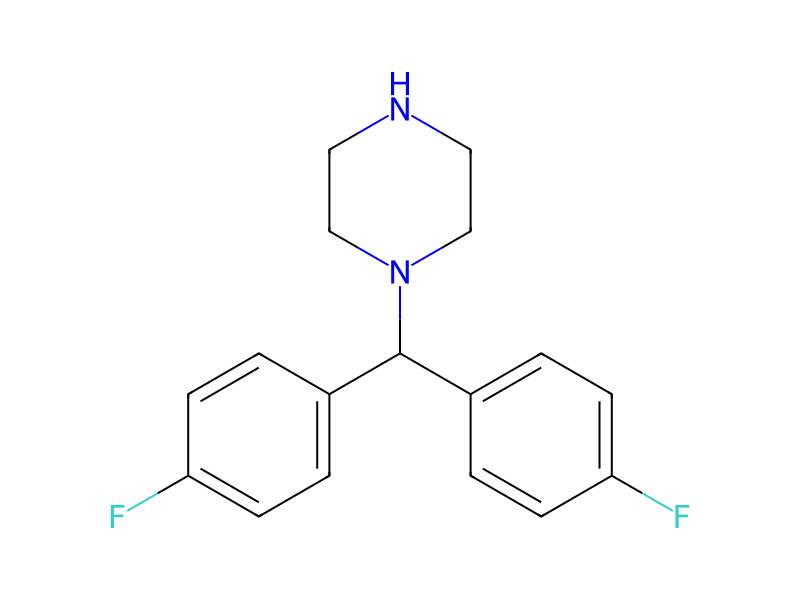
[F:1][C:2]1[CH:7]=[CH:6][C:5]([CH:8]([C:15]2[CH:20]=[CH:19][C:18]([F:21])=[CH:17][CH:16]=2)[N:9]2[CH2:14][CH2:13][NH:12][CH2:11][CH2:10]2)=[CH:4][CH:3]=1.[F:22][C:23]1[CH:24]=[C:25]([NH:29][C:30](=[O:33])[CH2:31]Cl)[CH:26]=[CH:27][CH:28]=1.C(=O)([O-])[O-].[K+].[K+].C(OCC)(=O)C>O1CCCC1.CN(C)C=O>[F:21][C:18]1[CH:19]=[CH:20][C:15]([CH:8]([C:5]2[CH:4]=[CH:3][C:2]([F:1])=[CH:7][CH:6]=2)[N:9]2[CH2:10][CH2:11][N:12]([CH2:31][C:30](=[O:33])[NH:29][C:25]3[CH:26]=[CH:27][CH:28]=[C:23]([F:22])[CH:24]=3)[CH2:13][CH2:14]2)=[CH:16][CH:17]=1A mixture of 300 mg of 1-[bis(4-fluorophenyl)methyl]piperazine and 234 mg of N-(3-fluorophenyl)chloroacetamide was dissolved in 20 ml of a 1:1 by volume mixture of tetrahydrofuran and N,N-dimethylformamide, and 400 mg of anhydrous potassium carbonate were added to the solution. The reaction mixture was then stirred at 70° C. for 2 hours, after which ethyl acetate was added to it and the organic layer was separated. The organic layer was washed three times with water, and then dried over anhydrous magnesium sulfate. The solvent was removed by evaporation under reduced pressure. The residue was subjected to silica gel thin layer chromatography using a 2:1 by volume mixture of cyclohexane and ethyl acetate as the developing solvent, to give a purified 1-[bis(4-fluorophenyl)methyl]-4-(3-fluorophenylcarbamoylmethyl)piperazine.
Loading…