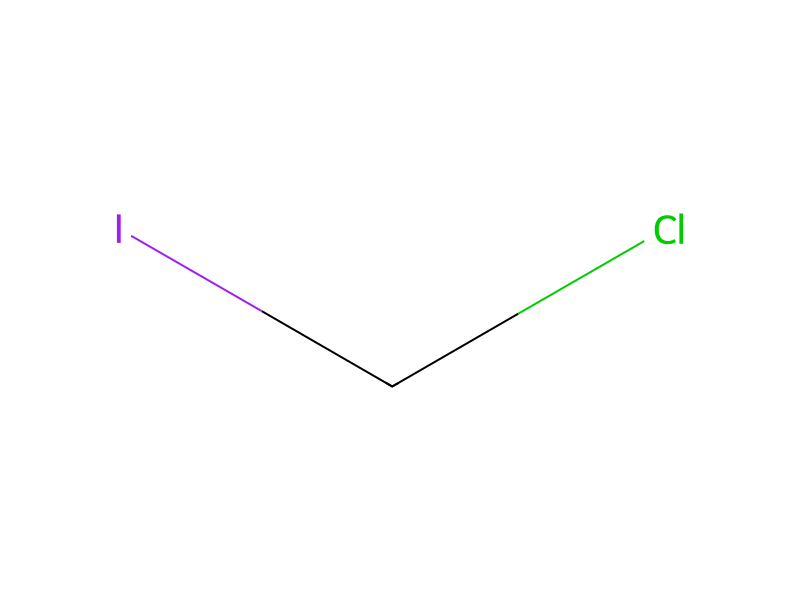
Chloroiodomethane → (S)-2-chloro-1-(2,2-dimethyl-1,3-dioxolane-4-yl)ethanone
Reaction equation

[CH3:1][C:2]1([CH3:11])[O:6][C@H:5]([C:7]([O:9]C)=O)[CH2:4][O:3]1.[Cl:12][CH2:13]I.[Li+].CC([N-]C(C)C)C.[OH-].[Na+]>C1COCC1.CCOC(C)=O.C(O)(=O)C>[Cl:12][CH2:13][C:7]([C@@H:5]1[CH2:4][O:3][C:2]([CH3:1])([CH3:11])[O:6]1)=[O:9]Participants
Reactant 4



Product 1

Reagents, catalysts & solvents 3



Conditions
- Temperature
- -78 °C
Procedure
To a solution of (S)-methyl 2,2-dimethyl-1,3-dioxolane-4-carboxylate (1.3 g, 8.1 mmol) and chloroiodomethane (4.3 g, 24 mmol) in THF (50 mL) at −78° C. was added a solution of LDA (16.2 mL, 24 mmol) in portions over 10 minutes. The reaction was stirred at −78° C. for 10 minutes. To this mixture was added a 10% solution of acetic acid (50 mL) in THF at −78° C. After addition, the slurry was warmed to ambient temperature. The reaction was poured into EtOAc (200 mL) and the aqueous layer basified using 1N NaOH. The organics were separated and washed with brine, dried over MgSO4 and concentrated in vacuo. The material was purified by chromatography using DCM as eluent to give (S)-2-chloro-1-(2,2-dimethyl-1,3-dioxolane-4-yl)ethanone (0.60 g, 3.4 mmol, 42% yield) as an oil.
Workup
- additionAfter addition
- temperaturethe slurry was warmed to ambient temperature
- customThe organics were separated
- washwashed with brine
- dry with materialdried over MgSO4
- concentrationconcentrated in vacuo
- customThe material was purified by chromatography
Sources & evidence
- ORD record
- ord-31947033ea6a43b1869f04a67173fcd1
- Source dataset
- uspto-grants-2015_07
- Patent number
- US09079890B2
Reaction notes
Loading…