Isopropanol → 4-Bromo-2-fluoro-1-isopropoxybenzene
Reaction equation

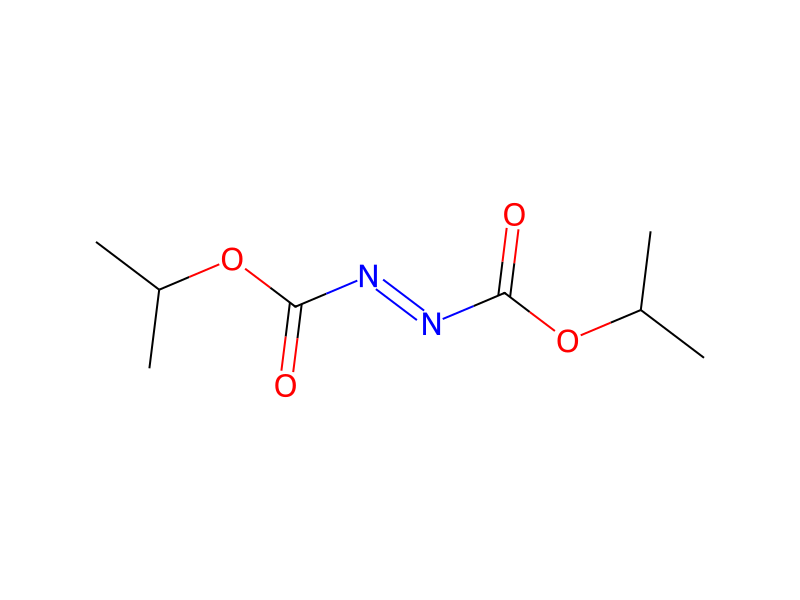
[Br:1][C:2]1[CH:7]=[CH:6][C:5]([OH:8])=[C:4]([F:9])[CH:3]=1.[CH:10](O)([CH3:12])[CH3:11].C1(P(C2C=CC=CC=2)C2C=CC=CC=2)C=CC=CC=1.CC(OC(/N=N/C(OC(C)C)=O)=O)C>C1COCC1>[Br:1][C:2]1[CH:7]=[CH:6][C:5]([O:8][CH:10]([CH3:12])[CH3:11])=[C:4]([F:9])[CH:3]=1Participants
6





Conditions
- Temperature
- 45 °C
Procedure
To a solution of 4-bromo-2-fluorophenol (10 g, 52.35 mmol) in THF (100 ml), isopropyl alcohol (4.8 ml, 62.62 mmol) and triphenylphosphine (20.6 g, 78.52 mmol) were added and heated to 45° C. followed by diisopropylazodicarboxylate (15.4 ml, 78.52 mmol). The mixture was refluxed for 1 h, concentrated and the residue was purified by column chromatography with ethyl acetate: petroleum ether to afford the title compound as a colourless liquid (13.1 g, 99%) which was used without purification in the next step.
Workup
- temperatureThe mixture was refluxed for 1 h
- concentrationconcentrated
- customthe residue was purified by column chromatography with ethyl acetate
Sources & evidence
- ORD record
- ord-8de0e36054f94005b8009b2fdd8cb849
- Source dataset
- uspto-grants-2015_10
- Patent number
- US09150579B2
Reaction notes
Loading…