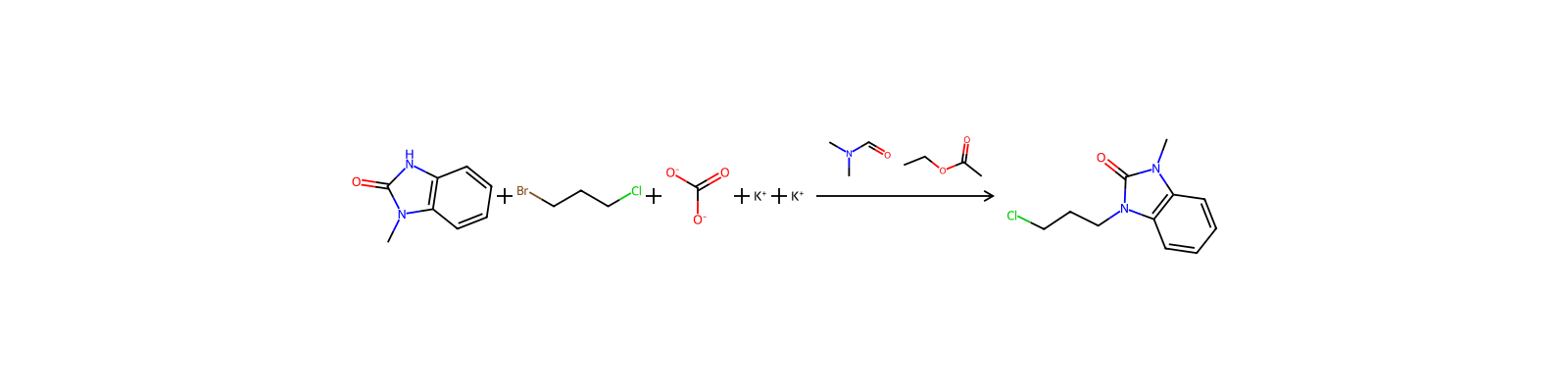
A mixture of 1-methyl-1H-benzo[d]imidazol-2(3H)-one (2 g, 13.5 mmol, 1 equiv), 1-bromo-3-chloropropane (3.98 ml, 40.5 mmol, 3 equiv), and potassium carbonate (2.79 g, 20.25 mmol, 1.5 equiv) in N,N-dimethylformamide was heated at 65° C. for 16 h. The reaction was cooled to ambient temperature and diluted with ethyl acetate. After being washed with water and brine, the organic layer was dried over MgSO4, filtered, and concentrated in vacuo. The resulting residue was purified using the Biotage chromatography system (SNAP 100 g cartridge, Rf=0.6, gradient—10%-50% ethyl acetate/hexanes) to afford 1-(3-chloropropyl)-3-methyl-1H-benzo[d]imidazol-2(3H)-one as a clear oil (2.57 g, 85%); 1H NMR (400 MHz, DMSO-d6): δ 2.05-2.12 (m, 1H); 2.14-2.21 (m, 1H); 3.32 (s, 3H); 3.53 (t, 1H, J=6.8 and 6.4 Hz); 3.66 (t, 1H, J=6.4 Hz); 3.92-3.97 (m, 2H); 7.05-7.09 (m, 2H); 7.12-7.16 (m, 1H); 7.17-7.21 (m, 1H); MS for C11H13ClN2O m/z 226.07 (M+H)+.