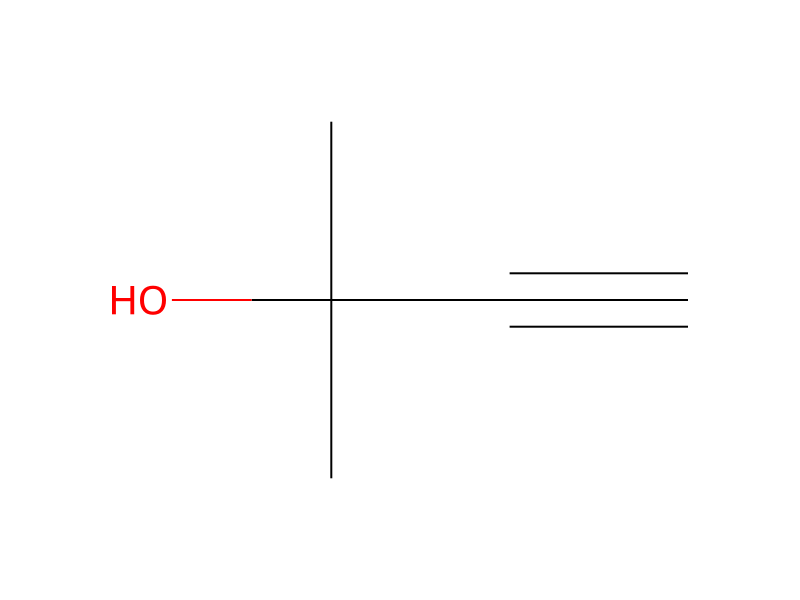
Br[C:2]1[CH:7]=[CH:6][C:5]([CH2:8][CH2:9][CH3:10])=[CH:4][CH:3]=1.[CH3:11][C:12]([OH:16])([CH3:15])[C:13]#[CH:14]>C(N(CC)CC)C.[Pd](Cl)Cl.C1(P(C2C=CC=CC=2)C2C=CC=CC=2)C=CC=CC=1.C1(P(C2C=CC=CC=2)C2C=CC=CC=2)C=CC=CC=1.[Cu]I.C1(P(C2C=CC=CC=2)C2C=CC=CC=2)C=CC=CC=1>[CH3:11][C:12]([OH:16])([CH3:15])[C:13]#[C:14][C:2]1[CH:7]=[CH:6][C:5]([CH2:8][CH2:9][CH3:10])=[CH:4][CH:3]=160 g of 1-bromo-4-propylbenzene, 38 g of 3-methyl-1-butyn-3-ol, 1.3 g of triphenylphosphine and 0.7 g of bis(triphenylphosphine) palladium(II) chloride were dissolved in 260 ml of triethylamine in nitrogen atmosphere, and 0.2 g of copper(I) iodide was added thereto. This was stirred for one hour at room temperature and for 5 hours at 90° C. The crystals as precipitated were filtered out and, after triethylamine was removed by distillation, extracted with chloroform. These were washed two times with 10% hydrochloric acid and two times with water, and chloroform was removed by distillation. The residue was purified by silicagel-chloroform column chromatography to obtain 37 g of 3-methyl-1-(4'-propylphenyl)-1-butyn-3-ol.