HomeMCPWorkbenchSkills
HomeWorkbenchNotificationsMe
llms.txt · MCP GuidePrivacy Policy · Terms of Service · Supportv1.8.0
  1. Home
  2. /Reaction

4-Hydroxybiphenyl → 4-(Biphenyl-4-yloxymethyl)-5-methyl-furan-2-carbonitrile

HRID 1786620
Notes
Print preview

Reaction equation

HRID 1786620 reaction equation
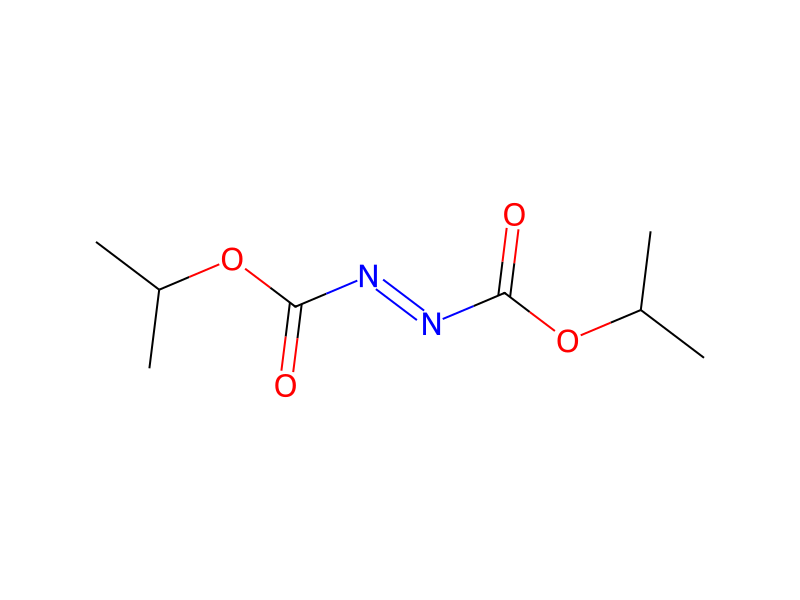
CC(OC(/N=N/C(OC(C)C)=O)=O)C.[OH:15][CH2:16][C:17]1[CH:18]=[C:19]([C:23]#[N:24])[O:20][C:21]=1[CH3:22].[C:25]1([C:32]2[CH:37]=[CH:36][CH:35]=[CH:34][CH:33]=2)[CH:30]=[CH:29][C:28](O)=[CH:27][CH:26]=1.C1(P(C2C=CC=CC=2)C2C=CC=CC=2)C=CC=CC=1>O1CCCC1>[C:25]1([C:32]2[CH:33]=[CH:34][CH:35]=[CH:36][CH:37]=2)[CH:30]=[CH:29][C:28]([O:15][CH2:16][C:17]2[CH:18]=[C:19]([C:23]#[N:24])[O:20][C:21]=2[CH3:22])=[CH:27][CH:26]=1
ParticipantsConditionsProcedureWorkupSources & evidenceReaction notes

Participants

6

Reactant 4

HCID 71034-HydroxybiphenylHCID 11776TriphenylphosphineHCID 5363146Diisopropyl azodicarboxylateHCID 184446624-Hydroxymethyl-5-methyl-furan-2-carbonitrile

Product 1

HCID 184446574-(Biphenyl-4-yloxymethyl)-5-methyl-furan-2-carbonitrileYield 79.2%

Reagents, catalysts & solvents 1

HCID 8028
Tetrahydrofuran
Solvent

Conditions

Temperature
0 °C

Procedure

Diisopropylazodicarboxylate (1.84 g, 10.6 mmoles) was added to a solution of 4-hydroxymethyl-5-methyl-furan-2-carbonitrile (147) (1.32 g, 9.6 mmoles), biphenyl-4-ol (1.63 g, 9.6 mmoles) and triphenylphosphine (4.3 g, 16.35 mmoles) in tetrahydrofuran (50 mL) with stirring and cooling to 0° C. under an argon atmosphere. After 5 minutes, the cooling was removed and the mixture stirred at room temperature for 16 h. The solvent was evaporated and the residue partitioned between ethyl acetate and water. The ethyl acetate phase was washed with brine and dried. After the solvent was evaporated, the residue was purified by flash chromatography (silica, gradient elution with 5% to 10% ethyl acetate in cyclohexane) to afford compound 148 as a white solid (2.2 g). IR (powder) CN st. 2225 cm−1.

Workup

  1. customthe cooling was removed
  2. stirringthe mixture stirred at room temperature for 16 h
  3. customThe solvent was evaporated
  4. customthe residue partitioned between ethyl acetate and water
  5. washThe ethyl acetate phase was washed with brine
  6. customdried
  7. customAfter the solvent was evaporated
  8. customthe residue was purified by flash chromatography (silica, gradient elution with 5% to 10% ethyl acetate in cyclohexane)

Sources & evidence

ORD record
ord-27f5cc3427694e1da2beab85727cff68
Source dataset
uspto-grants-2009_03
DOI
10.6084/m9.figshare.5104873.v1
Patent number
US07507754B2

Reaction notes

Loading…

On this pageParticipantsConditionsProcedureWorkupSources & evidenceReaction notes