HomeMCPWorkbenchSkills
HomeWorkbenchNotificationsMe
llms.txt · MCP GuidePrivacy Policy · Terms of Service · Supportv1.8.0
  1. Home
  2. /Reaction

Pyridine → 3-(2,4-Difluorophenyl)-4-(3-isopropyl-[1,2,4]triazolo[4,3-b]pyridazin-6-yl)-1,2,5-oxadiazole

HRID 1930049
Notes
Print preview

Reaction equation

HRID 1930049 reaction equation
[F:1][C:2]1[CH:7]=[C:6]([F:8])[CH:5]=[CH:4][C:3]=1[C:9](=O)[C:10]([C:12]1[CH:13]=[CH:14][C:15]2[N:16]([C:18]([CH:21]([CH3:23])[CH3:22])=[N:19][N:20]=2)[N:17]=1)=O.Cl.[NH2:26][OH:27].[N:28]1C=CC=CC=1.C1(P(C2C=CC=CC=2)C2C=CC=CC=2)C=CC=CC=1.CC(OC(/N=N/C(OC(C)C)=O)=O)C>CCOC(C)=O.C1(C)C=CC=CC=1.CCO>[F:1][C:2]1[CH:7]=[C:6]([F:8])[CH:5]=[CH:4][C:3]=1[C:9]1[C:10]([C:12]2[CH:13]=[CH:14][C:15]3[N:16]([C:18]([CH:21]([CH3:23])[CH3:22])=[N:19][N:20]=3)[N:17]=2)=[N:28][O:27][N:26]=1
ParticipantsConditionsProcedureWorkupSources & evidenceReaction notes

Participants

9

Reactant 5

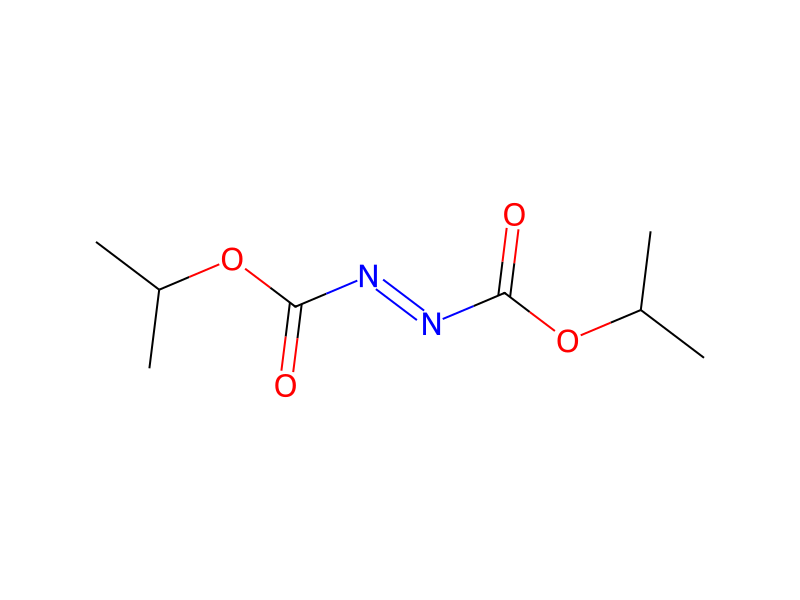
HCID 1049PyridineHCID 11776TriphenylphosphineHCID 443297Hydroxyamine hydrochlorideHCID 5363146Diisopropyl azodicarboxylateHCID 579298591-(2,4-Difluorophenyl)-2-(3-isopropyl-[1,2,4]triazolo[4,3-b]pyridazin-6-yl)ethane-1,2-dione

Product 1

HCID 57929982
3-(2,4-Difluorophenyl)-4-(3-isopropyl-[1,2,4]triazolo[4,3-b]pyridazin-6-yl)-1,2,5-oxadiazole
Yield 20%

Reagents, catalysts & solvents 3

HCID 702EthanolSolventHCID 1140TolueneSolventHCID 8857Ethyl AcetateSolvent2×

Conditions

Temperature
90 °C

Procedure

A 50 mL round bottomed flask was charged with 1-(2,4-difluorophenyl)-2-(3-isopropyl-[1,2,4]triazolo[4,3-b]pyridazin-6-yl)ethane-1,2-dione (0.300 g, 0.908 mmol, Preparation #M.1), hydroxylamine hydrochloride (0.631 g, 9.08 mmol) and EtOH (5 mL). The resulting mixture was treated with pyridine (3.67 mL, 45.4 mmol) and was then heated to about 90° C. for about 7 h. The mixture was cooled to ambient temperature, diluted with EtOAc (10 mL), washed with 1N HCl (10 mL) and water (10 mL). The organics were separated, dried over MgSO4, filtered and concentrated in vacuo to afford a yellow residue. To the residue was added triphenylphosphine (0.328 g, 1.25 mmol) and toluene (5 mL). The mixture was cooled to about 0° C. and DIAD (0.243 mL, 1.25 mmol) was added to give a solution which was heated to about reflux for about 1 h. The solution was cooled to ambient temperature, diluted with EtOAc (10 mL) and washed with saturated aqueous NaHCO3 (10 mL). The organics were separated, dried over MgSO4, filtered and concentrated to dryness. The residue was purified by flash chromatography on silica gel with MeOH/DCM (0-5% gradient) followed by RP-HPLC (Table 1, Method n) to afford the title compound (0.056 g, 20%) as a yellow solid. LC/MS (Table 1, Method g) Rt=2.83 min; MS m/z 343 (M+H)+.


Workup

  1. temperatureThe mixture was cooled to ambient temperature
  2. washwashed with 1N HCl (10 mL) and water (10 mL)
  3. customThe organics were separated
  4. dry with materialdried over MgSO4
  5. filtrationfiltered
  6. concentrationconcentrated in vacuo
  7. customto afford a yellow residue
  8. temperatureThe mixture was cooled to about 0° C.
  9. customto give a solution which
  10. temperaturewas heated
  11. temperatureto about reflux for about 1 h
  12. temperatureThe solution was cooled to ambient temperature
  13. washwashed with saturated aqueous NaHCO3 (10 mL)
  14. customThe organics were separated
  15. dry with materialdried over MgSO4
  16. filtrationfiltered
  17. concentrationconcentrated to dryness
  18. customThe residue was purified by flash chromatography on silica gel with MeOH/DCM (0-5% gradient)

Sources & evidence

ORD record
ord-f0afa3de80864215ab0b94242daf33ea
Source dataset
uspto-grants-2012_05
DOI
10.6084/m9.figshare.5104873.v1
Patent number
US08188083B2

Reaction notes

Loading…

On this pageParticipantsConditionsProcedureWorkupSources & evidenceReaction notes