HomeMCPWorkbenchSkills
HomeWorkbenchNotificationsMe
llms.txt · MCP GuidePrivacy Policy · Terms of Service · Supportv1.8.3
  1. Home
  2. /Reaction

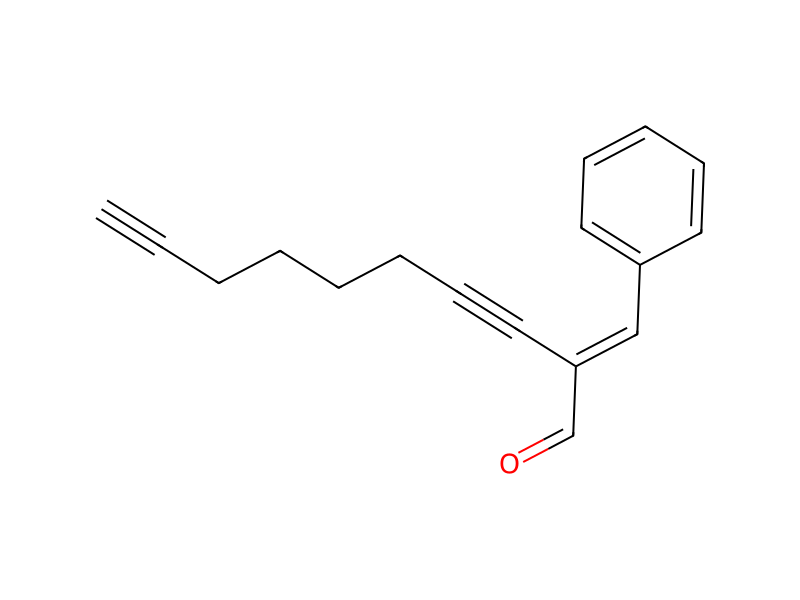
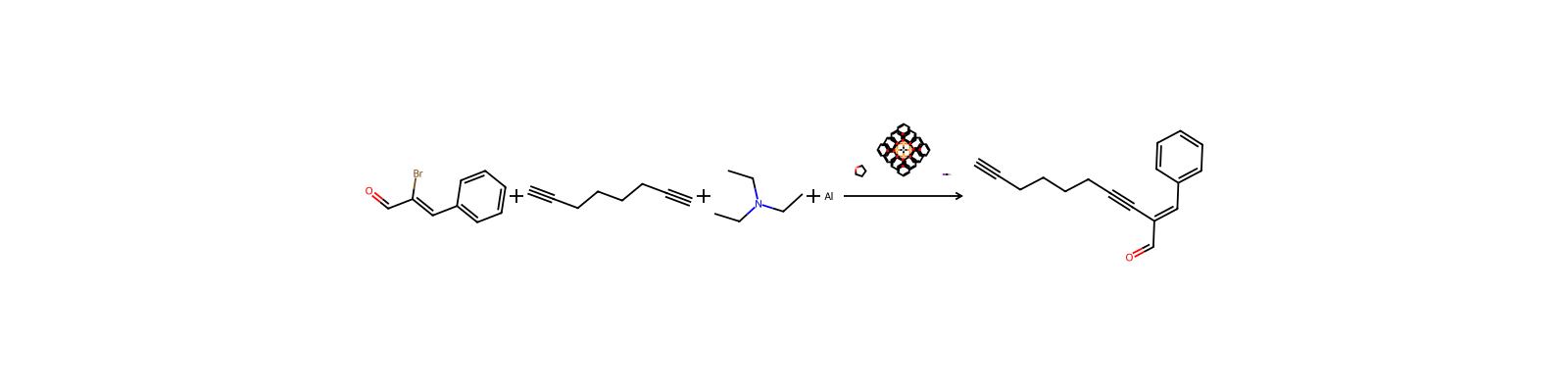
Triethylamine → (E)-2-(Phenylmethylidene)deca-3,9-diyn-1-al

HRID 1936912
Print

Reaction equation

HRID 1936912 reaction equation
Br[C:2](=[CH:5][C:6]1[CH:11]=[CH:10][CH:9]=[CH:8][CH:7]=1)[CH:3]=[O:4].[CH:12]#[C:13][CH2:14][CH2:15][CH2:16][CH2:17][C:18]#[CH:19].C(N(CC)CC)C.[Al]>C1COCC1.C1C=CC([P]([Pd]([P](C2C=CC=CC=2)(C2C=CC=CC=2)C2C=CC=CC=2)([P](C2C=CC=CC=2)(C2C=CC=CC=2)C2C=CC=CC=2)[P](C2C=CC=CC=2)(C2C=CC=CC=2)C2C=CC=CC=2)(C2C=CC=CC=2)C2C=CC=CC=2)=CC=1.[Cu]I>[C:6]1(/[CH:5]=[C:2](\[C:12]#[C:13][CH2:14][CH2:15][CH2:16][CH2:17][C:18]#[CH:19])/[CH:3]=[O:4])[CH:11]=[CH:10][CH:9]=[CH:8][CH:7]=1
ParticipantsProcedureWorkupSources & evidenceReaction notes

Participants

8

Reactant 4

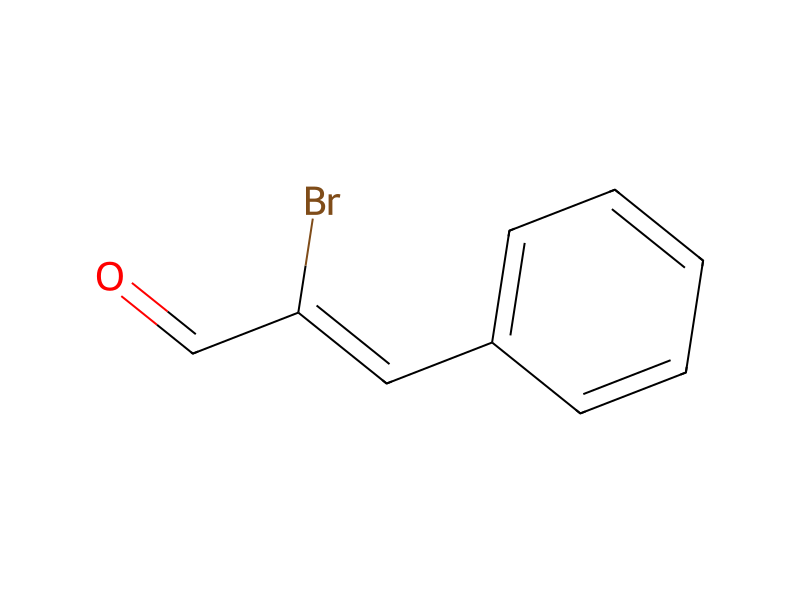
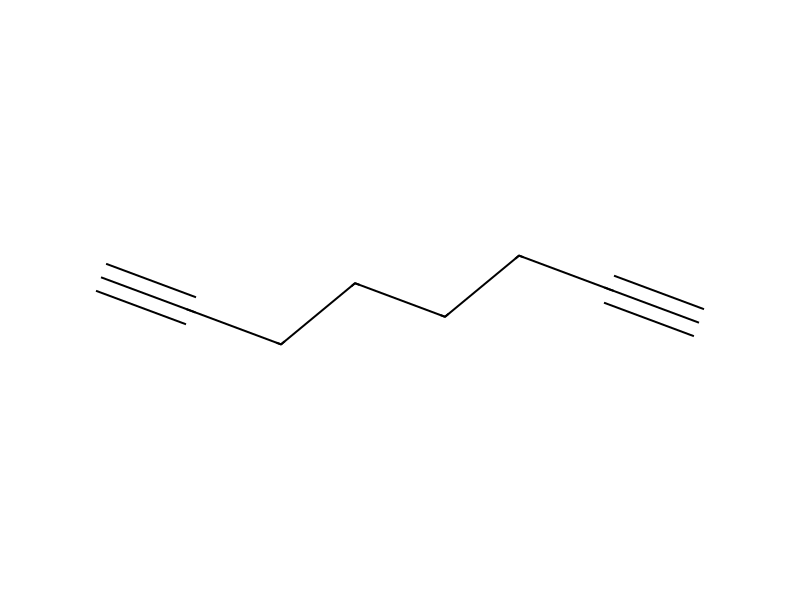
HCID 8471TriethylamineHCID 21585alpha-BromocinnamaldehydeHCID 700991,7-OctadiyneHCID 5359268Aluminum

Product 1

HCID 11817217(E)-2-(Phenylmethylidene)deca-3,9-diyn-1-alYield 91%

Reagents, catalysts & solvents 3

HCID 24350
Copper(1+) iodide; Copper(I) iodide; Cuprous iodide; Cuprous iodide (CuI)
Catalyst
HCID 178418397HCID 178418397, compoundCatalyst
HCID 8028TetrahydrofuranSolvent2×

Procedure

To a solution of Pd(PPh3)4 (0.55 g, 0.24 mmol) and α-bromocinnamaldehyde Compound 1 (2.08 g, 4.74 mmol) in degassed THF (170 mL) cooled in an ice-water bath was added a solution of 1,7-octadiyne (2.23 g, 9.48 mmol), triethylamine (15 mL), and CuI (0.36 g, 0.95 mmol) in degassed THF (30 mL) via a syringe under a nitrogen atmosphere. The reaction flask was then covered by a sheet of aluminum foil. After stirring at room temperature for 8 hours the reaction was quenched with saturated aqueous NH4Cl (50 mL) and diluted with EtOAc (100 mL). The organic layer was washed with brine, dried over anhydrous MgSO4, filtered, and concentrated in vacuo. The residue was purified by flash column chromatography (silica gel, 10 percent EtOAc in hexane) to give 2.13 g (91 percent) of Compound 2: yellow oil; Rf=0.50 (15 percent EtOAc in hexane); IR (neat) 3294, 2944, 2230, 2116, 1692, 1598, 1450, 1324, 1180 cm−1; 1H NMR (300 MHz, CDCl3) δ9.56 (s, 1H), 8.11-8.07 (m, 2H), 7.48-7.43 (m, 3H), 7.43 (s, 1H), 2.60 (t, J=6.65 Hz, 2H), 2.27 (td, J=6.78, 2.64 Hz, 2H), 1.97 (t, J=2.64 Hz, 1H), 1.86-1.69 (m, 4H); 13C NMR (75 MHz, CDCl3) δ192.4, 151.8, 134.9, 132.0, 131.1, 129.4, 124.1, 103.4, 84.6, 75.4, 69.4, 28.2, 28.0, 20.3, 18.7; MS (+FAB) m/z (relative intensity) 237 (M+H+, 100).

Workup

  1. customwas quenched with saturated aqueous NH4Cl (50 mL)
  2. additiondiluted with EtOAc (100 mL)
  3. washThe organic layer was washed with brine
  4. dry with materialdried over anhydrous MgSO4
  5. filtrationfiltered
  6. concentrationconcentrated in vacuo
  7. customThe residue was purified by flash column chromatography (silica gel, 10 percent EtOAc in hexane)

Sources & evidence

ORD record
ord-8fb6b7587d844f3dafa0ba2b8d918ef6
Source dataset
uspto-grants-2002_05
DOI
10.6084/m9.figshare.5104873.v1
Patent number
US06391916B1

Reaction notes

On this pageParticipantsProcedureWorkupSources & evidenceReaction notes