HomeMCPWorkbenchSkills
HomeWorkbenchNotificationsMe
llms.txt · MCP GuidePrivacy Policy · Terms of Service · Supportv1.8.3
  1. Home
  2. /Reaction

Diisopropylethylamine → (4-Cyclopropyl-3,4-dihydro-2H-quinoxalin-1-yl)-[4-(2,5-dichloro-phenoxy)-6-methyl-pyridin-3-yl]-methanone

HRID 1967040
Print

Reaction equation

HRID 1967040 reaction equation
[Cl:1][C:2]1[CH:18]=[CH:17][C:16]([Cl:19])=[CH:15][C:3]=1[O:4][C:5]1[C:10]([C:11]([O-:13])=O)=[CH:9][N:8]=[C:7]([CH3:14])[CH:6]=1.[Li+].C(N(C(C)C)C(C)C)C.CN(C(ON1N=NC2C=CC=NC1=2)=[N+](C)C)C.F[P-](F)(F)(F)(F)F.[CH:54]1([N:57]2[C:66]3[C:61](=[CH:62][CH:63]=[CH:64][CH:65]=3)[NH:60][CH2:59][CH2:58]2)[CH2:56][CH2:55]1.C(=O)(O)[O-].[Na+]>CN(C)C=O.C(OCC)(=O)C>[CH:54]1([N:57]2[C:66]3[C:61](=[CH:62][CH:63]=[CH:64][CH:65]=3)[N:60]([C:11]([C:10]3[CH:9]=[N:8][C:7]([CH3:14])=[CH:6][C:5]=3[O:4][C:3]3[CH:15]=[C:16]([Cl:19])[CH:17]=[CH:18][C:2]=3[Cl:1])=[O:13])[CH2:59][CH2:58]2)[CH2:56][CH2:55]1
ParticipantsProcedureWorkupSources & evidenceReaction notes

Participants

8

Reactant 5

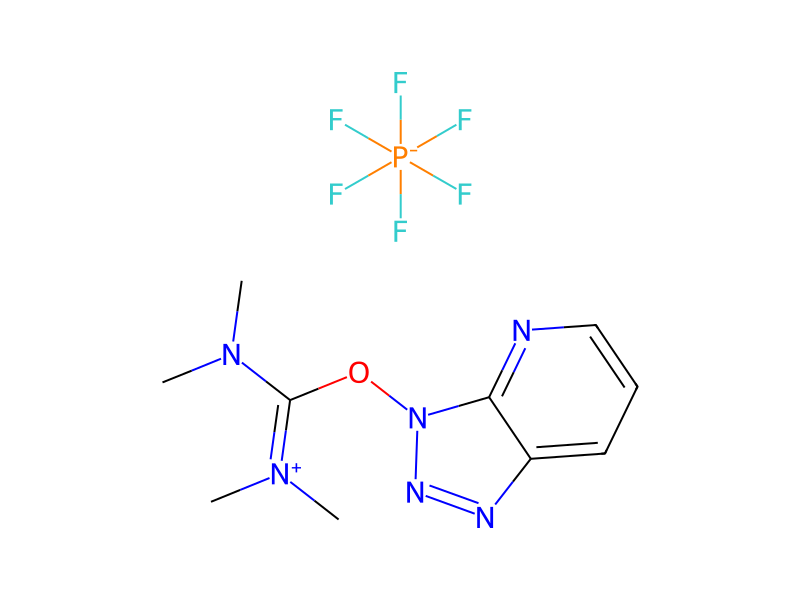
HCID 81531DiisopropylethylamineHCID 516892Sodium BicarbonateHCID 9886157Methanaminium, N-((dimethylamino)(3H-1,2,3-triazolo(4,5-b)pyridin-3-yloxy)methylene)-N-methyl-, hexafluorophosphate(1-) (1:1)2×HCID 67320585Lithium 4-(2,5-dichloro-phenoxy)-6-methyl-nicotinateHCID 673207551-Cyclopropyl-1,2,3,4-tetrahydroquinoxaline

Product 1

HCID 53259032(4-Cyclopropyl-3,4-dihydro-2H-quinoxalin-1-yl)-[4-(2,5-dichloro-phenoxy)-6-methyl-pyridin-3-yl]-methanoneYield 60%

Reagents, catalysts & solvents 2

HCID 6228DimethylformamideSolventHCID 8857Ethyl AcetateSolvent

Procedure

To a solution of 420 mg (1.381 mmol) lithium 4-(2,5-dichloro-phenoxy)-6-methyl-nicotinate in 6 mL dry N,N-dimethylformamide was added 1.17 mL (6.907 mmol) N-ethyldiisopropylamine and 635 mg (1.658 mmol) 0-(7-azabenzotriazol-1-yl)-N,N,N′,N′-tetramethyluronium hexafluorophosphate (HATU, commercially available, CAS RN 148893-10-1) and 289 mg (1.658 mmol) 1-cyclopropyl-1,2,3,4-tetrahydro-quinoxaline (Example 8, intermediate a). The reaction mixture was stirred for 18 hours at room temperature and then poured on 30 mL 10% aqueous sodium bicarbonate solution and 30 mL ethyl acetate. The layers were separated and the aqueous layer was extracted a second time with 30 mL ethyl acetate. The organic layers were washed with 30 mL brine, dried over magnesium sulfate, filtered and concentrated under vacuum. The residue was purified by silica gel chromatography using a MPLC system (20 g silica gel column, CombiFlash Companion, Isco Inc.) with gradient of n-heptane:ethyl acetate (100:0 to 0:100) to give 375 mg (60%) of the title compound as a light yellow solid. MS (ESI): m/z=454.108 [M+H]+.

Workup

  1. customThe layers were separated
  2. extractionthe aqueous layer was extracted a second time with 30 mL ethyl acetate
  3. washThe organic layers were washed with 30 mL brine
  4. dry with materialdried over magnesium sulfate
  5. filtrationfiltered
  6. concentrationconcentrated under vacuum
  7. customThe residue was purified by silica gel chromatography

Sources & evidence

ORD record
ord-abc3187e567443f0af80f313b99ccdb2
Source dataset
uspto-grants-2013_04
DOI
10.6084/m9.figshare.5104873.v1
Patent number
US08420647B2

Reaction notes

On this pageParticipantsProcedureWorkupSources & evidenceReaction notes