HomeMCPWorkbenchSkills
HomeWorkbenchNotificationsMe
llms.txt · MCP GuidePrivacy Policy · Terms of Service · Supportv1.8.3
  1. Home
  2. /Reaction

1,2-Dichloroethane → 4-(2-fluorophenyl)-7-(morpholine-4-carbonyl)-9H-pyrido[3,4-b]indole-1-carboxamide

HRID 2361246
Print

Reaction equation

HRID 2361246 reaction equation
[F:1][C:2]1[CH:7]=[CH:6][CH:5]=[CH:4][C:3]=1[C:8]1[C:20]2[C:19]3[C:14](=[CH:15][C:16]([C:21]([N:23]4[CH2:28][CH2:27][O:26][CH2:25][CH2:24]4)=[O:22])=[CH:17][CH:18]=3)[NH:13][C:12]=2[C:11]([C:29](O)=[O:30])=[N:10][CH:9]=1.[Cl-].[NH4+].C1C=[N:38]C2N(O)N=NC=2C=1.C(Cl)CCl.CCN(C(C)C)C(C)C>CN(C=O)C.CO.O.CCOC(C)=O>[F:1][C:2]1[CH:7]=[CH:6][CH:5]=[CH:4][C:3]=1[C:8]1[C:20]2[C:19]3[C:14](=[CH:15][C:16]([C:21]([N:23]4[CH2:24][CH2:25][O:26][CH2:27][CH2:28]4)=[O:22])=[CH:17][CH:18]=3)[NH:13][C:12]=2[C:11]([C:29]([NH2:38])=[O:30])=[N:10][CH:9]=1


ParticipantsProcedureWorkupSources & evidenceReaction notes

Participants

10

Reactant 5

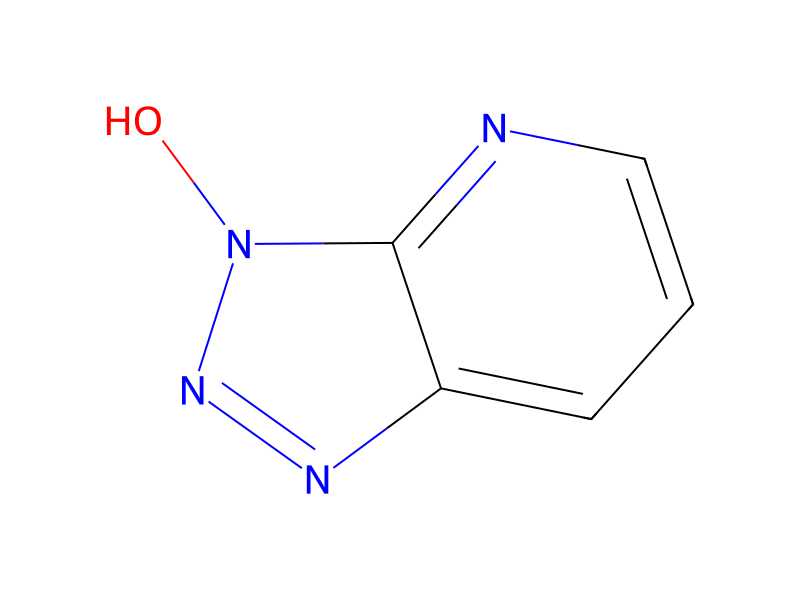
HCID 111,2-DichloroethaneHCID 25517Ammonium ChlorideHCID 81531DiisopropylethylamineHCID 181649HOAtHCID 679946974-(2-fluorophenyl)-7-(morpholine-4-carbonyl)-9H-pyrido[3,4-b]indole-1-carboxylic acid

Product 1

HCID 54766414
4-(2-fluorophenyl)-7-(morpholine-4-carbonyl)-9H-pyrido[3,4-b]indole-1-carboxamide
Yield 33%

Reagents, catalysts & solvents 4

HCID 887MethanolSolventHCID 962WaterSolventHCID 6228DimethylformamideSolventHCID 8857Ethyl AcetateSolvent

Procedure

To a yellow, heterogeneous solution of 4-(2-fluorophenyl)-7-(morpholine-4-carbonyl)-9H-pyrido[3,4-b]indole-1-carboxylic acid (0.0381 g, 0.091 mmol), ammonium chloride (9.72 mg, 0.182 mmol), HOAt (0.025 g, 0.182 mmol) and EDC (0.035 g, 0.182 mmol) in DMF (1.0 mL) was added DIPEA (0.063 mL, 0.364 mmol). The reaction was stirred overnight. EtOAc and water were added, and the layers were separated. The organic layer was washed with brine and 10% aq. LiCl successively, dried over Na2SO4, filtered and concentrated in vacuo to give a residue which was diluted with MeOH (1 mL) and subjected to autoprep reverse phase HPLC purification. The appropriate fractions were combined, basified with NaHCO3 (solid), and concentrated in vacuo. It was extracted with CH2Cl2 (3×). The organic layers were combined, dried over Na2SO4, and concentrated in vacuo to give the desired product (0.0124 g, 0.030 mmol, 32.6% yield) as a white solid. LC/MS (M+H)=419.08; 1H NMR (500 MHz, DMSO-d6) δ ppm 12.03 (s, 1H), 8.38 (br. S, 1H), 8.32 (s, 1H), 7.89 (s, 1H), 7.86 (br. S, 1H), 7.63-7.75 (m, 2H), 7.44-7.58 (m, 2H), 7.34 (d, J=8.2 Hz, 1H), 7.13 (d, J=8.2 Hz, 1H), 3.42-3.83 (m, 8H).

Workup

  1. customthe layers were separated
  2. washThe organic layer was washed with brine and 10% aq. LiCl successively
  3. dry with materialdried over Na2SO4
  4. filtrationfiltered
  5. concentrationconcentrated in vacuo
  6. customto give a residue which
  7. customsubjected to autoprep reverse phase HPLC purification
  8. concentrationconcentrated in vacuo
  9. extractionIt was extracted with CH2Cl2 (3×)
  10. dry with materialdried over Na2SO4
  11. concentrationconcentrated in vacuo

Sources & evidence

ORD record
ord-9837341c82b84656b80c7ed78fe4b192
Source dataset
uspto-grants-2014_04
DOI
10.6084/m9.figshare.5104873.v1
Patent number
US08685969B2

Reaction notes

On this pageParticipantsProcedureWorkupSources & evidenceReaction notes