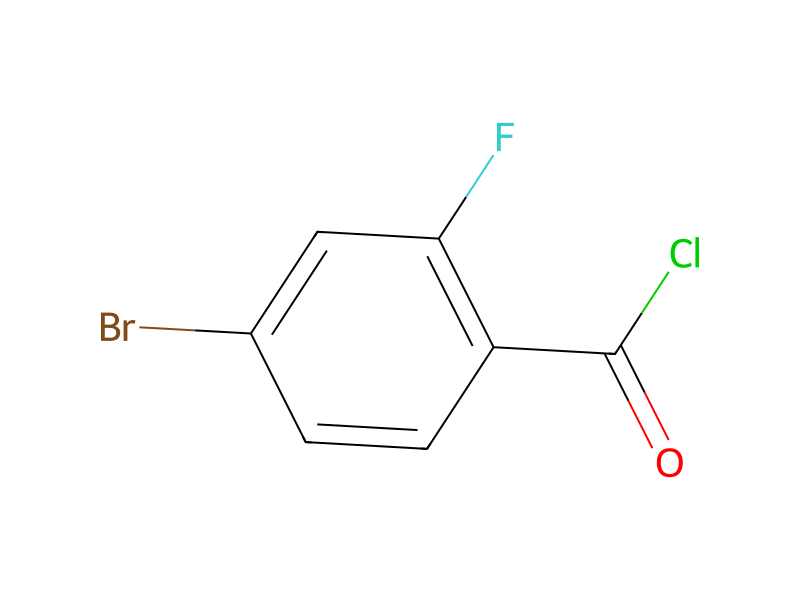
To a stirred solution of 4-bromo-2-fluorobenzoyl chloride (33 g, CAS 151982-51-3) in acetonitrile (150 ml) and THF (150 ml) at 0-5° C. was added dropwise (trimethylsilyl)diazomethane (83.4 ml, 2 M solution in hexane). The reaction mixture was stirred at room temperature for 30 min. TLC analysis showed the reaction was complete. 37% Hydrochloric acid (23.2 ml) was then added dropwise at 0-5° C. and the reaction mixture was stirred at room temperature for 1 hour. The reaction mixture was then poured into EtOAc and extracted sequentially with aq. Na2CO3 solution, water and saturated brine. The organic layer was then dried over Na2SO4 and concentrated in vacuo to afford a ca 1:1 mixture of 2-bromo-1-(4-bromo-3-fluoro-phenyl)-ethanone and 2-chloro-1-(4-bromo-3-fluoro-phenyl)-ethanone (34.4 g, 98%) as a yellow solid which was used in the next step without further purification. MS (EI): 203 ([{81Br}M-CH2Cl]+, 201 ([{79Br}M-CH2Cl]+).