HomeMCPWorkbenchSkills
HomeWorkbenchNotificationsMe
llms.txt · MCP GuidePrivacy Policy · Terms of Service · Supportv1.8.3
  1. Home
  2. /Reaction

Hydrochloric Acid → (4-{[2-(1H-Indol-3-yl)ethylamino]methyl}-1-phenylcyclohexyl)dimethylamine

HRID 346788
Print

Reaction equation

HRID 346788 reaction equation
[NH2:1][CH2:2][CH2:3][C:4]1[C:12]2[C:7](=[CH:8][CH:9]=[CH:10][CH:11]=2)[NH:6][CH:5]=1.[CH3:13][N:14]([CH3:29])[C:15]1([C:23]2[CH:28]=[CH:27][CH:26]=[CH:25][CH:24]=2)[CH2:20][CH2:19][CH:18]([CH:21]=O)[CH2:17][CH2:16]1.C(O[BH-](OC(=O)C)OC(=O)C)(=O)C.[Na+].Cl>O.ClCCCl>[NH:6]1[C:7]2[C:12](=[CH:11][CH:10]=[CH:9][CH:8]=2)[C:4]([CH2:3][CH2:2][NH:1][CH2:21][CH:18]2[CH2:17][CH2:16][C:15]([N:14]([CH3:13])[CH3:29])([C:23]3[CH:24]=[CH:25][CH:26]=[CH:27][CH:28]=3)[CH2:20][CH2:19]2)=[CH:5]1
ParticipantsProcedureWorkupSources & evidenceReaction notes

Participants

7

Reactant 4

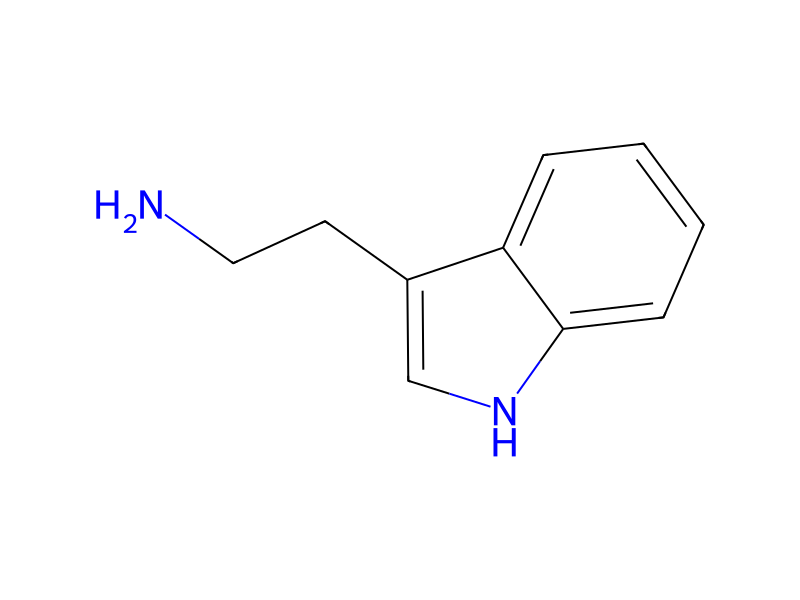
HCID 313Hydrochloric AcidHCID 1150TryptamineHCID 5049666Sodium triacetoxyborohydrideHCID 104439064-Dimethylamino-4-phenylcyclohexanecarbaldehyde

Product 1

HCID 10388959(4-{[2-(1H-Indol-3-yl)ethylamino]methyl}-1-phenylcyclohexyl)dimethylamine

Reagents, catalysts & solvents 2

HCID 11
1,2-Dichloroethane
Solvent
2×
HCID 962WaterSolvent

Procedure

Tryptamine (2-(1H-indol-3-yl)ethylamine, 321 mg, 2 mmol.) was dissolved in abs. 1,2-dichloroethane. After the addition of 4-dimethylamino-4-phenylcyclohexanecarbaldehyde (463 mg, 2 mmol.), the mixture was stirred for 1 h at RT. Sodium triacetoxyborohydride (660 mg, 3 mmol.) was then added, and stirring was carried out for 3 d at RT. For working up, 1,2-dichloroethane (10 ml), water (15 ml) and 2M HCl (3 ml) were added to the reaction mixture. After stirring vigorously for 15 min., the phases were separated and the aqueous phase (pH 3) was extracted again with 1,2-dichloroethane (10 ml). 5M NaOH was then added to the aqueous phase (pH 11), followed by extraction with EE (5×20 ml). The combined EE phases were dried, filtered and concentrated. The residue was the still impure diastereoisomeric mixture of the bases of the target product (690 mg, m.p. 56–64° C.), which was purified by flash chromatography on silica gel (70 g) and separated (eluant: 1200 ml of methanol/conc. ammonia solution 99.5:0.5). 220 mg (0.59 mmol.) of the non-polar diastereoisomer of (4-{[2-(1H-Indol-3-yl)ethylamino]methyl}-1-phenylcyclohexyl)dimethylamine (m.p. 78–83° C.) were obtained and were dissolved in 2-butanone; chlorotrimethylsilane (222 μl, 1.8 mmol.) was added at RT, and stirring was carried out for 2 h. The suspension was cooled for 1 h in an ice bath, and the solid was filtered off. The hygroscopic dihydrochloride was washed with cold ether and dried in vacuo. The dihydrochloride of the non-polar diastereoisomer of (4-{[2-(1H-Indol-3-yl)ethylamino]methyl}-1-phenylcyclohexyl)dimethylamine was thus obtained in a yield of 205 mg (white solid, m.p. 170–180° C. with decomposition, rearrangements at only 105° C.).


Workup

  1. stirringstirring
  2. waitwas carried out for 3 d at RT
  3. stirringAfter stirring vigorously for 15 min.
  4. customthe phases were separated
  5. extractionthe aqueous phase (pH 3) was extracted again with 1,2-dichloroethane (10 ml)
  6. addition5M NaOH was then added to the aqueous phase (pH 11)
  7. extractionfollowed by extraction with EE (5×20 ml)
  8. customThe combined EE phases were dried
  9. filtrationfiltered
  10. concentrationconcentrated
  11. additionthe still impure diastereoisomeric mixture of the bases of the target product (690 mg, m.p. 56–64° C.), which
  12. customwas purified by flash chromatography on silica gel (70 g)
  13. customseparated (eluant: 1200 ml of methanol/conc. ammonia solution 99.5:0.5)

Sources & evidence

ORD record
ord-72b5b0a156dd4ec0906453d9ca0e4ccd
Source dataset
uspto-grants-2007_02
DOI
10.6084/m9.figshare.5104873.v1
Patent number
US07173045B2

Reaction notes

On this pageParticipantsProcedureWorkupSources & evidenceReaction notes